# dermaht.com
> Generated by All in One SEO Pro v5.0.4, this is an llms-full.txt file, used by LLMs to index the site.
## Posts
### [DHT Blocker Therapy: What It Is, How It Works, and Who It Suits](https://dermaht.com/blogs/dht-blocker-therapy-what-it-is-how-it-works-and-who-it-suits/)
**Published:** October 22, 2026
**Author:** Dr. Nikitha Reddy
**Content:**
Ask ten people with thinning hair about DHT blocker therapy and you’ll get ten different answers. Some swear by it, others are scared off by what they’ve read online. Most have only half the picture.
Dr. Nikitha Reddy, MD Dermatologist and Hair Transplant Surgeon, explains how this treatment fits into the wider picture of hair loss care, from medication to [hair transplant in Hyderabad](https://dermaht.com/), and what’s worth weighing up before starting.
One thing to know upfront: these are prescription medicines, not supplements, and they work very differently from a serum or a procedure.
What Is DHT, and Why Does It Thin Hair?
DHT, short for dihydrotestosterone, is a hormone our body makes from testosterone with the help of an enzyme called 5-alpha reductase.
In people who are genetically prone to pattern hair loss, some follicles react strongly to it. Cycle after cycle, those follicles shrink. The hair that grows back is finer, shorter, and stays on the scalp for less time. Doctors call this miniaturisation, and it’s the core process behind androgenetic alopecia in men and women, even though the pattern looks different in each.
How Does DHT Blocker Therapy Work?
Most DHT blockers don’t “block” DHT at the scalp directly. They’re 5-alpha reductase inhibitors, which means they slow the enzyme that turns testosterone into DHT. Less DHT, less pressure on sensitive follicles.
Finasteride targets one form of the enzyme and is the medicine most commonly approved for male pattern hair loss. Dutasteride blocks two forms, so it lowers DHT further, and it’s used off-label for hair loss in many countries. A 24-week meta-analysis found dutasteride more effective than finasteride with similar side-effect rates, though that rests on only three trials, so it’s early days.
What they can’t do matters just as much. They don’t bring back follicles that are already gone. The goal is to slow further thinning and support the follicles still working.
“A DHT blocker isn’t a quick fix, and it isn’t for everyone. It acts on the cause behind pattern hair loss, but only in follicles that are still alive, which is why the diagnosis has to be confirmed first,” said Dr. Nikitha Reddy, MD Dermatologist.
Types of DHT Blocker Therapy
Minoxidil often gets mentioned alongside these, but it isn’t a DHT blocker. It works by a different route, and doctors sometimes combine the two.
Who May Benefit, and Who Should Be Careful
DHT blocker therapy tends to suit adults with confirmed pattern hair loss in the early to moderate stage, when follicles are thinning but not gone. It won’t help thinning that comes from other causes, like thyroid problems, low iron, crash diets, or stress-related shedding. Those need their own fix.
Some people need extra caution. Pregnant women, or women who may become pregnant, shouldn’t take these medicines or handle crushed or broken tablets, because they can affect a male foetus. People with liver problems should tell their doctor, and finasteride can lower PSA readings, which matters for anyone having prostate screening. In women, oral DHT blockers aren’t a standard first option; hormonal evaluation comes first.
Side Effects: What the Research Shows
### **Possible Sexual and Mood-Related Side Effects**
The main side effects reported with these drugs include:
- Reduced libido: A decrease in sexual desire.
- Erectile difficulty: Trouble achieving or maintaining an erection.
- Ejaculation changes: Changes in ejaculation.
- Risk of sexual dysfunction: A meta-analysis of 15 placebo-controlled trials involving 4,495 men found a 1.57-fold higher relative risk of sexual dysfunction overall. Most participants did not experience these problems, but the risk is not zero.
- Mood changes: Some men report low mood or anxiety. Regulators in several countries have required these risks to be mentioned on drug labels. Any mood changes should be discussed with the prescribing doctor early.
- Persistent symptoms: Rare reports describe symptoms continuing after stopping the medication, although research into this is ongoing.
> “Follow-up is a big part of the treatment. If a patient notices anything that bothers them, it’s better to adjust or stop early than to push through it quietly,” said Dr. Nikitha Reddy, MD Dermatologist.
What to Expect: A Realistic Timeline
Hair grows slowly, so this therapy does too. In the first few weeks, some people notice a bit of extra shedding. It usually settles. By three to six months, shedding often reduces. A fair judgement of results usually takes around twelve months, and responses vary from person to person.
Here’s the catch most people don’t expect: the benefit lasts only while treatment continues. Stop, and thinning generally picks up again over the following months.
DHT Blocker Therapy Alongside Other Hair Loss Treatments
Medication rarely works in isolation. Doctors often pair DHT blockers with topical minoxidil, and sometimes with in-clinic treatments.
Once follicles in an area are gone, medication can’t bring them back. That’s where [FUE Hair Transplant](https://dermaht.com/fue-hair-transplant-in-hyderabad/) enters the conversation, and even then, many doctors continue a DHT blocker afterwards to protect the native hair around the transplanted area.
What a Doctor Checks Before Starting DHT Blocker Therapy
**Who evaluates.** A registered dermatologist confirms the type of hair loss before any prescription is written. At DermaHT in Kokapet, this evaluation is done by Dr. Nikitha Reddy, usually with a scalp examination and, where needed, dermoscopy to look at follicle size and density.
**What gets reviewed.** Family history, pattern and stage of thinning, medical history (liver, prostate, mood), current medicines, and sometimes blood tests for thyroid, iron, or vitamin D, since those can mimic or add to pattern hair loss.
**How the plan is decided.** Medicine alone, a combination, or a procedure depends on what the evaluation shows. Follow-up reviews are usually set at three to six months to check response and side effects.
A Few Things Worth Remembering
DHT blocker therapy is a medical decision, not a hair-care habit. It’s slow, it needs ongoing use, and it works best when the diagnosis is right in the first place.
**Before picking a treatment, it helps to know what’s actually behind the thinning. A scalp check usually answers that.**
Frequently Asked Questions What is DHT blocker therapy? It’s a prescription treatment that lowers DHT levels by slowing the enzyme that produces it, aiming to slow further thinning in pattern hair loss. How long does DHT blocker therapy take to work? Usually months, not weeks. Many doctors judge response at around six to twelve months, and results vary between people. Can women use DHT blockers? Oral DHT blockers aren’t a standard first option for women and are unsafe in pregnancy. A doctor looks at hormones and the cause of thinning first. Do I need to take it forever? The benefit generally lasts only while treatment continues. Whether and when to stop is a decision for you and your doctor. Do natural DHT blockers work? Evidence for ingredients like saw palmetto is limited, and effects appear modest. They aren’t a replacement for medical evaluation.
## **References**
1. Efficacy and safety of dutasteride compared with finasteride in treating men with androgenetic alopecia: a systematic review and meta-analysis. Clin Interv Aging. 2019;14:399-406. <https://pubmed.ncbi.nlm.nih.gov/30863034/>
2. Arif T, Dorjay K, Adil M, Sami M. Dutasteride in Androgenetic Alopecia: An Update. Curr Clin Pharmacol. 2017. <https://pubmed.ncbi.nlm.nih.gov/28294070/>
3. Adverse Sexual Effects of Treatment with Finasteride or Dutasteride for Male Androgenetic Alopecia: A Systematic Review and Meta-analysis. Acta Derm Venereol. 2019;99(1):12-17. <https://pubmed.ncbi.nlm.nih.gov/30206635/>
4. Comparison between dutasteride and finasteride in hair regrowth and reversal of miniaturization in male and female androgenetic alopecia: a systematic review. <https://pmc.ncbi.nlm.nih.gov/articles/PMC11694415/>
**Disclaimer:** The information shared in this content is for educational purposes only and not for promotional use.
1.
**Categories:** Uncategorized
---
### [Androgenetic Hair Loss in Women: Causes, Early Signs, and What Actually Helps](https://dermaht.com/blogs/androgenetic-hair-loss-in-women-causes-early-signs-and-what-actually-helps/)
**Published:** October 1, 2026
**Author:** Dr. Nikitha Reddy
**Content:**
Hair thinning in women doesn’t usually announce itself the way it does in men. No receding hairline to point at, a wider part and a thinner ponytail than you remember. By the time most women bring it up to a doctor, they’ve usually spent months blaming stress, the weather, or “one of those phases.”
Dr. Nikitha Reddy, MD, Dermatologist and Hair Transplant Surgeon known for [hair transplant in Hyderabad](https://dermaht.com/), explains what’s actually happening on the scalp, why it looks different in women than in men, and what treatment realistically looks like.
It’s called androgenetic hair loss, and it’s a lot more common than most women realise. People don’t talk about it with the same directness as male pattern baldness, which is part of why so many women end up managing it quietly, on their own, for far longer than they need to.
What Is Androgenetic Hair Loss in Women?
Androgenetic hair loss in women, also called female pattern hair loss, happens when genetically sensitive hair follicles gradually shrink in response to androgens, mainly a byproduct of testosterone called DHT. It’s the same underlying hormone pathway involved in male pattern baldness, but it manifests differently on a woman’s scalp.
.
Instead of a receding hairline, women usually see diffuse thinning across the top and crown, with the front hairline staying mostly intact. The part line widens first. Hair might still be there, technically, finer, shorter, and a lot less dense than before.
Genetics play the biggest role here. If your mother or grandmother dealt with thinning hair, there’s a reasonable chance the same pattern shows up in you, though it doesn’t always follow a clean family line the way it tends to in men.
What Causes It?
A few things tend to feed into androgenetic hair loss in women, and it’s rarely one cause working alone:
- **Hormonal shifts.**
- **PCOS and other hormonal conditions.**
> “Women often assume hormonal hair loss is temporary and will fix itself once things settle down. Sometimes that’s true, especially after childbirth. But when there’s a genetic component involved, it usually needs an actual treatment plan, not just patience,” said [Dr. Nikitha Reddy](https://dermaht.com/about-us/), MD, Dermatologist, Derma HT, Hyderabad
Early Signs Worth Paying Attention To
Female pattern hair loss tends to progress slowly, which is exactly why it’s easy to miss early on. A few things worth noticing:
- The part looking wider than it used to, especially in photos taken from above
- A ponytail that feels noticeably thinner in your hand
- More visible scalp under bright light
- Increased shedding that doesn’t settle after a few weeks
None of these confirm androgenetic hair loss on their own. Thyroid issues, iron deficiency, and telogen effluvium (a stress-related shedding pattern) can look similar in the early stages, which is why a proper diagnosis matters more than guessing from symptoms alone.
Androgenetic Hair Loss vs Other Types of Female Hair Loss — Quick Comparison
| **Type** | **Pattern** | **Onset** | **Reversible?** |
|---|---|---|---|
| Androgenetic Hair Loss | Diffuse thinning, widened part, crown-focused | Gradual, often around menopause | Manageable, not fully reversible |
| Telogen Effluvium | Sudden, all-over shedding | 2-3 months after a trigger (illness, stress, childbirth) | Usually reversible |
| Iron/Thyroid-Related | Diffuse thinning, brittle hair | Variable | Reversible once corrected |
| Traction Alopecia | Localised, near hairline/temples | Gradual, tied to hairstyling habits | Reversible if caught early |
What Are the Treatment Options?
There’s no single fix, and anyone promising one probably isn’t being upfront with you. Treatment for androgenetic hair loss in women usually depends on its stage and underlying causes:
- **Topical minoxidil** — often the first line of treatment; helps slow shedding and support existing follicles
- [**PRP therapy**](https://dermaht.com/prp-treatment-in-hyderabad/) — uses growth factors from your own blood to support follicle health
- [**GFC treatment**](https://dermaht.com/gfc-treatment-in-hyderabad/) — a more concentrated version of the same growth factor approach
- **Addressing underlying hormonal issues** — relevant when PCOS or another condition is contributing
- [**Hair transplant**](https://dermaht.com/fue-hair-transplant-in-hyderabad/) — considered in more advanced cases where thinning has progressed significantly and other options haven’t provided enough density back
Which of these actually makes sense depends on the stage and cause, and that’s not something to self-diagnose from a blog, however detailed it is.
> “The biggest difference between a good outcome and a frustrating one usually comes down to timing. Women who come in early, when thinning is still mild, have a lot more options on the table than someone who has waited years hoping it resolves on its own,” said Dr. Nikitha, whose work at DermaHT has earned the clinic recognition on leading doctor discovery platforms, including ClinicSpots and Practo.
Can Hair Transplant Work for Women?
Yes, though it’s not the starting point for most cases. Hair transplant surgery for women works differently than it does for men, mainly because the donor area (usually the back of the scalp) isn’t always as clearly defined in diffuse female thinning. A dermatologist needs to confirm there’s a stable, healthy donor zone before the transplant even becomes a realistic conversation.
For women dealing with more advanced thinning, or those who’ve already tried non-surgical options without enough improvement, it can be a genuinely good long-term solution. It’s not something to jump to as a first step without ruling out hormonal or nutritional causes first.
A Note on Living With It
Hair loss in women feels different from what it does for men. It’s important to recognize this difference instead of ignoring it. It’s tied up with a lot more than appearance for most people. That’s part of why an actual diagnosis matters, not just for treatment planning, but for peace of mind. Understanding what’s happening and why can make it easier to cope, even before treatment starts working.
If you’re noticing a widening part or thinner ponytail and wondering whether it’s “just stress,” it might be worth getting it checked rather than sitting with the uncertainty for another few months.
Book an Appointment Wondering if your part line is trying to tell you something? A ten-minute scalp check usually has the answer. Frequently Asked Questions 1. What is the main cause of androgenetic hair loss in women? It’s mainly genetic sensitivity to DHT, a byproduct of testosterone. Hormonal shifts like menopause, pregnancy, or PCOS can trigger or speed it up, but the underlying sensitivity is usually inherited. 2. At what age does female pattern hair loss usually start? It varies quite a bit. Some women notice it in their late 20s or 30s, but onset is more common around or after menopause. Family history tends to influence how early it shows up. 3. Can androgenetic hair loss in women be reversed? Not fully, but it can be managed and slowed significantly with the right treatment, especially if caught early. Existing follicles can often be supported even if fully reversing the process isn’t realistic. 4. Is hair transplant a good option for women with thinning hair? It can be, but only after a dermatologist confirms there’s a stable donor area to work with. It’s usually considered after non-surgical options, not instead of them, unless thinning is already advanced. 5. How is androgenetic hair loss different from stress-related hair loss? Androgenetic hair loss is gradual and pattern-based, mainly affecting the crown and part line. Stress-related shedding (telogen effluvium) tends to be sudden, all-over, and usually resolves within a few months once the trigger passes.
## **References**
1. PubMed — Androgenetic Alopecia in Women (J Investig Dermatol Symp Proc) — <https://pubmed.ncbi.nlm.nih.gov/12894991/>
2. NCBI — Female Pattern Hair Loss: Review — <https://www.ncbi.nlm.nih.gov/pmc/articles/PMC3968982/>
3. International Journal of Trichology — Female Androgenetic Alopecia Study — <https://pubmed.ncbi.nlm.nih.gov/27625557/>
## **Disclaimer:**
This blog is for educational purposes only and is not a substitute for professional medical advice.
Please consult a qualified doctor for guidance specific to your case.
**Categories:** Uncategorized
---
### [Hair Loss After Weight Loss Surgery: What Helps?](https://dermaht.com/blogs/hair-loss-after-weight-loss-surgery-what-helps/)
**Published:** September 11, 2026
**Author:** Dr. Nikitha Reddy
**Content:**
Hair loss after weight loss surgery is common and usually temporary. The combination of surgical stress, rapid weight loss, and lower nutrient intake pushes a large share of hairs into a resting phase, so shedding tends to start around three to four months later. In most people the hair grows back once protein and nutrient levels stabilize. The fix is rarely a hair treatment, it’s getting nutrition back on track.
> According to Dr. Nikitha Reddy, an MD Dermatologist offering [Hair Transplant in Hyderabad](https://dermaht.com/), “This kind of shedding looks alarming because it’s diffuse, all over rather than in a pattern. But it’s usually the body reacting to stress and low nutrients, not balding. Feed the body properly and the hair almost always comes back.”
Book an Appointment
Shedding months after weight loss surgery?
Why does hair fall after weight loss surgery?
The shedding has a clear cause, and knowing it is reassuring, because it points to something fixable rather than permanent.
**The stress of surgery.** Any major operation can tip hairs into their resting phase, leading to a wave of shedding a few months later, a pattern known as telogen effluvium.
**Rapid weight loss.** Losing weight fast is itself a physical stress on the body, which adds to the shedding signal on top of the surgery.
**Low protein and nutrients.** Eating much less, plus reduced absorption, can leave protein, iron, zinc, and B12 short, and hair is one of the first things the body deprioritises.
**It’s usually temporary.** This shedding tends to peak and then settle, with regrowth following once nutrition steadies, typically within six to twelve months.
Because the stress can also unmask genetic thinning underneath, it’s worth confirming whether the shedding is temporary or early pattern loss, since only the latter is what a treatment like [PRP](https://dermaht.com/prp-treatment-in-hyderabad/) is meant for.
What helps hair grow back?
Most of what helps is nutritional, because that’s where the cause usually sits. The hair follows once the body has what it needs.
**Hit your protein targets.** Protein is the single most important factor, so meeting the intake your bariatric team sets gives the follicles the building blocks to recover.
**Correct the deficiencies.** Iron, zinc, B12, and vitamin D are checked and topped up where low, since fixing a real shortage is what actually restarts growth.
**Stick to your supplements.** Following the vitamin and mineral plan from your surgical team, often long-term, prevents the deficiencies that drive the shedding.
**Give it time.** Once nutrition is steady, regrowth is gradual, and most people see it return over the following months without any special hair treatment.
If shedding lingers or you want to support regrowth actively, our overview of [non-surgical](https://dermaht.com/blogs/non-surgical-hair-loss-options-for-women/) hair loss options covers what’s worth considering beyond nutrition.
Why Choose Dr. Nikitha Reddy?
[Dr. Nikitha Reddy](https://dermaht.com/about-us/) is an MD Dermatologist registered with the Telangana State Medical Council (TSMC/FMR/04492), with 6+ years in hair restoration. The job at DermaHT here is to confirm the shedding is temporary effluvium and not something that needs treating, then check for the deficiencies behind it. Most of these patients need reassurance and the right bloodwork far more than they need a procedure.
📞 Call Now: +91 90639 77407
Frequently Asked Questions
**Is hair loss after weight loss surgery permanent?
No. It’s usually temporary and grows back as nutrition stabilizes.
**When does hair loss start after bariatric surgery?
Usually around three to four months after the operation.
**What helps regrowth after weight loss surgery?
Enough protein, correcting deficiencies, and following your supplement plan.
**Should I take biotin for it?
Only if you’re deficient. Protein and overall nutrition matter more.
## **Disclaimer:**
This blog is for educational purposes only and is not a substitute for professional medical advice.
Please consult a qualified doctor for guidance specific to your case.
**Categories:** Blog
---
### [FUE Graft Survival Rate: What Affects It?](https://dermaht.com/blogs/fue-graft-survival-rate-what-affects-it/)
**Published:** September 7, 2026
**Author:** Dr. Nikitha Reddy
**Content:**
In skilled hands, FUE graft survival usually sits around 90 to 95 percent, meaning most transplanted follicles take and grow. The number isn’t fixed, though, and it rises or falls with how the grafts are handled, how long they spend outside the body, and how well the recipient area supplies them with blood. Patient factors and aftercare matter too. Survival is less about luck and more about control at every step.
> According to Dr. Nikitha Reddy, an MD Dermatologist offering [Hair Transplant in Hyderabad](https://dermaht.com/), “A graft is a living thing for the few hours it’s out of the body, and most survival is won or lost in those hours. Keep it hydrated, handle it gently, and place it quickly. The rest is the patient looking after it afterward.”
Book an Appointment
Want to know what a realistic survival rate looks like?
What affects FUE graft survival?
Most of what decides survival happens during the procedure, in details the patient never sees.
**Time out of the body.** Grafts are most fragile once extracted, and the longer they wait before placement, the lower the survival, which is why pace and team coordination matter.
**Hydration and handling.** Drying out is one of the biggest graft killers, so they’re kept in a chilled holding solution and handled gently, never crushed or squeezed.
**Skill at extraction and placement.** Cutting follicles during extraction or making poorly angled recipient sites damages grafts before they ever take, which is where surgeon experience shows.
**Recipient blood supply.** Grafts live on the blood supply they reconnect to, so packing them too densely or placing them in poorly vascular tissue lowers how many survive.
This is why survival tracks so closely with how carefully the [FUE](https://dermaht.com/fue-hair-transplant-in-hyderabad/) itself is carried out, rather than the method’s name on a brochure.
What can you do to protect graft survival?
The clinic controls most of it, but the weeks after surgery are where the patient’s part decides the rest.
**Protect the grafts early.** Avoiding knocks, friction, and pressure in the first days stops new grafts being dislodged before they anchor.
**Don’t smoke.** Smoking narrows blood vessels and starves the grafts of the supply they need, which can pull survival down noticeably.
**Keep conditions controlled.** Managing things like blood sugar and following medication advice helps the scalp heal and feed the grafts properly.
**Follow the aftercare plan.** Gentle washing, no scratching, and sticking to instructions protect the result through the fragile early window.
How well you handle that early window shapes the final count, and the day-by-day markers in our [FUE recovery](https://dermaht.com/blogs/fue-recovery-day-1-to-month-12/) guide show exactly when the grafts are most at risk.
Why Choose Dr. Nikitha Reddy?
[Dr. Nikitha Reddy](https://dermaht.com/about-us/) is an MD Dermatologist registered with the Telangana State Medical Council (TSMC/FMR/04492), with 6+ years in hair restoration. Graft survival at DermaHT is protected through short out-of-body times, careful handling, and recipient sites planned around blood supply, not just coverage. Patients are also walked through the aftercare that keeps survival high once they leave the chair.
📞 Call Now: +91 90639 77407
Frequently Asked Questions
**What is a good FUE graft survival rate?
Around 90 to 95 percent in experienced hands.
**What lowers graft survival the most?
Drying out, long time out of the body, and rough handling.
**Does smoking affect graft survival?
Yes. It narrows blood vessels and starves the grafts.
**Can aftercare improve graft survival?
Yes. Protecting grafts in the early days makes a real difference.
## **Disclaimer:**
This blog is for educational purposes only and is not a substitute for professional medical advice.
Please consult a qualified doctor for guidance specific to your case.
**Categories:** Blog
---
### [Copper Peptide for Hair Growth: What It Is and How It Actually Works](https://dermaht.com/blogs/copper-peptide-for-hair-growth/)
**Published:** August 21, 2026
**Author:** Dr. Nikitha Reddy
**Content:**
Not everyone with thinning hair needs to jump straight to surgery. That’s usually the last thing people realise, and only after months of trying random products that never really did much. Copper peptide for hair growth keeps showing up in serums, in scalp treatments, in clinic consultations, but nobody really stops to explain what it does or who it’s actually for.
Dr. Nikitha Reddy, MD Dermatologist and Hair Transplant Surgeon at DermaHT Hair Transplant Clinic, Kokapet, Hyderabad, one of the established names for [hair transplant in Hyderabad](https://dermaht.com/), shares how copper peptides work on the scalp, who tends to benefit, and where they fit next to other options. Nothing exaggerated here. Just the science, the way she’d explain it to a patient sitting across from her.
What Is a Copper Peptide, Exactly?
A copper peptide, usually referred to in research as GHK-Cu, is a small peptide bound to a copper ion, and it occurs naturally in the human body. It wasn’t invented for a serum bottle. GHK-Cu was first identified in human plasma decades ago, and interestingly, its levels tend to drop with age, around the same stretch of life when a lot of people first notice their hair thinning out.
That drop is part of why dermatology took an interest in it, not just for skin, but for scalp health too. On the scalp, copper peptides are studied mainly for how they support the tissue around a hair follicle. Not as something that forces new growth overnight, more like something that keeps the surrounding environment healthier.
Dr. Nikitha Reddy puts it plainly in consultations: copper peptides don’t create follicles that aren’t there. What they can do is support the ones still alive but struggling. Which is really why the stage of your hair loss matters so much before deciding if this route makes sense for you.
How Does Copper Peptide Support Hair Growth?
There are a few ways copper peptides are believed to work on the scalp, and they’re all connected:
- **Blood vessel formation.** Better micro-circulation around the follicle means more oxygen and nutrients get to the root.
- **Follicle support.** Follicles shrink in early pattern hair loss. Copper peptides are studied for helping with that.
- **Lower oxidative stress.** GHK-Cu has antioxidant properties, which may help a scalp that’s inflamed or under stress.
- **Working with the skin’s own repair process**, since the compound is already something the body recognises.
> Dr. Nikitha Reddy says: “Copper peptides are one of the better-studied ingredients in this space, but let’s be clear, they’re not a switch you flip. They work quietly, by improving the environment the follicle is trying to survive in. That’s why they usually work best as part of a plan, not something used on its own.”
It’s also why copper peptide for hair growth often comes up alongside [PRP](https://dermaht.com/prp-treatment-in-hyderabad/) and [GFC](https://dermaht.com/gfc-treatment-in-hyderabad/). All three lean on the scalp’s own biology instead of surgically moving hair around.
Copper Peptides vs Other Scalp Treatments — A Quick Comparison
Results build gradually with most of these, and honestly, starting early tends to matter more than which one you pick.
Who Is a Good Candidate for Copper Peptide Treatment?
Hair fall isn’t one thing, so it makes sense that one treatment won’t suit everyone. Copper peptides tend to work better for:
- People still in the early or moderate stage of thinning, with follicles that are still active
- Anyone noticing more shedding than usual, or hair that feels weaker and breaks easily
- Patients who’d rather try a non-surgical route before even thinking about a transplant
- People who’ve already had a [FUE Hair Transplant](https://dermaht.com/fue-hair-transplant-in-hyderabad/) and want to support the results
It’s usually not where you’d start with advanced baldness, where there aren’t really active follicles left to work with. At that point, surgery tends to give a more realistic outcome, and that’s not something to guess at from a product label.
Dr. Nikitha Reddy says: “The mistake I see most is someone using a copper peptide serum on a patch with no active follicles left. It’s not that the ingredient failed, it just was never going to work there. A proper scalp check tells you what you’re actually dealing with.”
Is Copper Peptide Treatment Backed by Research?
GHK-Cu has a fairly long research history in dermatology, mostly around skin repair and wound healing, and there’s growing interest in what it can do for hair. A few published studies point toward its role in tissue regeneration and reducing oxidative damage, and that’s really the basis for using it in hair care.
But let’s be honest about where things stand. Research specifically on copper peptides for hair growth is still developing, and results vary a fair bit from person to person, depending on the stage and cause of the hair loss. That’s true of most regenerative scalp treatments, not just this one.
At DermaHT Hair Transplant Clinic, Dr. Nikitha Reddy looks at each patient’s scalp before suggesting copper peptide therapy or anything else. It isn’t handed out as a default.
Can You Use Copper Peptides at Home?
You’ll find copper peptides in plenty of over-the-counter serums, which is probably where most people first hear the term. Used topically, they can support general scalp health as part of a routine.
But topical use and an in-clinic session aren’t quite the same thing. In a clinic, the compound can be delivered more precisely, closer to where the follicles actually sit, instead of relying on it soaking through the skin. Whether a serum is enough for you, or whether something more targeted makes sense, really comes down to how advanced your thinning is.
That’s really where a proper scalp check counts for more than whatever’s on the shelf.
What Dr. Nikitha Reddy Recommends
At DermaHT, no two patients get the same plan by default. Every scalp is looked at individually before copper peptide therapy, or anything else, comes up.
What she typically checks:
- The stage and pattern of the thinning
- Whether follicles in that area are still active
- What’s actually causing the hair fall
- Whether copper peptides alone will do it, or whether pairing them with PRP or GFC makes more sense
Dr. Nikitha Reddy says: “I’d rather take fifteen extra minutes examining someone’s scalp than watch them spend months on something that was never right for their kind of hair loss. That’s really how we work here.”
Wondering if copper peptide therapy is right for your scalp, or if something else would do more? A proper evaluation is the only real way to know, and that’s a conversation worth having with a dermatologist, not a search bar.
A Few Honest Takeaways
Copper peptide for hair growth isn’t a miracle ingredient, but it’s not a gimmick either. It sits somewhere in between, a reasonably well-researched compound that supports the scalp’s own biology, and it tends to work best for people who catch their thinning early and want a non-surgical way to deal with it.
If you’ve been searching for answers and mostly finding serum comparisons, maybe the better next step is an actual scalp evaluation. If you’re around Hyderabad, it might be worth stopping by DermaHT Hair Transplant Clinic in Kokapet, where Dr. Nikitha Reddy can take a proper look and tell you honestly what will help and what won’t.
Talk to Dr. Nikitha Reddy →
**Your scalp’s already telling a story. A quick evaluation just helps you read it right.**
Frequently Asked Questions (FAQs) 1. What does copper peptide do for hair growth?
Copper peptides, mainly GHK-Cu, support blood vessel formation around the follicle, help with miniaturised follicles, and reduce oxidative stress on the scalp. Together, that creates a healthier environment for the follicles you already have.
2. Is copper peptide better than PRP for hair loss?
Not really a fair comparison. PRP pulls growth factors from your own blood, copper peptides are a specific compound that supports follicle and tissue health. Sometimes they’re combined for a stronger effect, depending on the case.
3. Can copper peptide serums regrow hair on bald patches?
Not likely. Copper peptides support follicles that are still active. Where there’s nothing active left, topical or even in-clinic copper peptide treatment probably won’t do much, and surgery might be the more realistic option.
4. How long does it take to see results from copper peptide treatment?
Like most scalp treatments, it’s gradual, over months, not days, since it works with your hair’s natural growth cycle. A dermatologist can give you a realistic timeline based on your specific case.
5. Are copper peptides safe to use?
Generally, yes, especially when professionally formulated or delivered in-clinic. Still, it’s worth getting your scalp assessed by a qualified dermatologist before starting anything.
## **References**
1. National Center for Biotechnology Information (NCBI) — GHK-Cu, a Skin and Hair Care Ingredient: A Review — <https://www.ncbi.nlm.nih.gov/>
2. DermNet NZ — Peptides in Cosmetic Dermatology — <https://dermnetnz.org/>
3. International Society of Hair Restoration Surgery (ISHRS) — Non-Surgical Hair Restoration Options — <https://ishrs.org/patients/hair-restoration-options/>
**Disclaimer:** The information shared in this content is for educational purposes only and not for promotional use.
**Categories:** Uncategorized
---
### [Why Hair Transplants Fail: 6 Real Reasons](https://dermaht.com/blogs/why-hair-transplants-fail-6-real-reasons/)
**Published:** August 8, 2026
**Author:** Dr. Nikitha Reddy
**Content:**
Hair transplant failure is uncommon, but when it happens the cause is almost always identifiable. Most failures trace back to who was operated on, how the surgery was done, or how the grafts were cared for afterwards. The transplant itself rarely fails at random. Knowing the six real reasons makes nearly all of them avoidable.
> According to Dr. Nikitha Reddy, an MD Dermatologist offering [Hair Transplant in Hyderabad](https://dermaht.com/), “A transplant doesn’t usually fail on the table, it fails in the decisions around it. Wrong patient, wrong plan, or careless aftercare. Get those right and the grafts almost always grow.”
Book an Appointment
Worried a past transplant didn’t take?
What are the reasons tied to the patient and the plan?
Plenty of failures are decided before surgery even begins, in the assessment and the planning.
**The cause was never diagnosed.** Transplanting over an undiagnosed or active condition, like ongoing aggressive pattern loss or a scarring alopecia, means the new hair sits in failing ground and the result unravels.
**Not enough donor hair.** A thin or unstable donor area can’t supply what the bald zone needs, so coverage ends up sparse and the donor itself looks depleted.
**A plan that ignored the future.** Designing a low, dense hairline for a young patient still losing hair leaves an unnatural island as the surrounding hair keeps receding.
This is why a sound [FUE](https://dermaht.com/fue-hair-transplant-in-hyderabad/) begins with candidacy and a donor assessment, not with booking a surgery date.
What are the reasons tied to technique and aftercare?
The rest come down to execution, both in the chair and in the weeks that follow.
**Poor surgical technique.** Grafts placed at the wrong angle, cut during extraction, or packed too aggressively survive poorly and can look unnatural, which is where experience shows.
**Mishandled grafts.** Follicles left out of the body too long, allowed to dry, or handled roughly lose viability before they’re ever placed.
**Neglected aftercare.** Infection, knocking grafts loose in the first days, or smoking all starve or dislodge the new hair before it takes hold.
When a transplant does fail, the damage is often fixable, and our guide on whether you can get a[ second transplant](https://dermaht.com/blogs/can-you-get-a-second-hair-transplant-2/) covers what corrective work involves.
Why Choose Dr. Nikitha Reddy?
[Dr. Nikitha Reddy](https://dermaht.com/about-us/) is an MD Dermatologist registered with the Telangana State Medical Council (TSMC/FMR/04492), with 6+ years in hair restoration. Most of what makes a transplant fail is screened out before surgery at DermaHT, through diagnosis, donor assessment, and an honest talk about what the result can and can’t be. It’s also worth knowing that early shedding is normal, and what looks like failure at three months is often just the hair on its way back.
📞 Call Now: +91 90639 77407
Frequently Asked Questions
**How common is hair transplant failure?
Uncommon. Most failures trace to candidacy, technique, or aftercare.
**Can a failed hair transplant be fixed?
Often yes, with corrective surgery once the cause is understood.
**Does shedding after surgery mean it failed?
No. Early shedding is normal, and the hair usually regrows.
**How do I avoid a failed transplant?
Choose an experienced surgeon and follow aftercare closely.
**Disclaimer:** This blog is for educational purposes only and is not a substitute for professional medical advice. Please consult a qualified doctor for guidance specific to your case.
## **Disclaimer:**
This blog is for educational purposes only and is not a substitute for professional medical advice.
Please consult a qualified doctor for guidance specific to your case.
**Categories:** Blog
---
### [How Many PRP Sessions Do You Need?](https://dermaht.com/blogs/how-many-prp-sessions-do-you-need/)
**Published:** August 4, 2026
**Author:** Dr. Nikitha Reddy
**Content:**
Most people need three to four PRP sessions to start, spaced about a month apart, followed by maintenance every few months. PRP doesn’t stop the underlying cause of hair loss, so the early sessions build the result and the later ones hold it. The exact number depends on how advanced the thinning is and how well you respond. For most patients, the first visible change shows after the second or third session.
> According to Dr. Nikitha Reddy, an MD Dermatologist offering [Hair Transplant in Hyderabad](https://dermaht.com/), “People want a single number, but PRP is a course, not a one-off. The first few sessions do the heavy lifting, and then it’s about maintenance. Skip the upkeep and the gains slowly fade.”
Book an Appointment
Wondering how many sessions your hair would need?
How many PRP sessions are usually needed?
The typical plan splits into an initial course to build results, then spaced-out sessions to keep them.
**Three to four to start.** The standard opening course is three to four sessions, roughly a month apart, which gives the follicles repeated stimulation over the early months.
**Results around session three.** Most people notice reduced shedding first, then gradual thickening, with visible change usually appearing by the second or third session.
**Maintenance every few months.** After the initial course, a session every four to six months helps hold the result, since the underlying hair loss keeps progressing.
**Adjusted to your response.** If there’s little change after the first course, the plan is reviewed rather than simply repeated, because not every cause responds the same way.
The right schedule is set after assessing your scalp rather than pulled from a fixed template, which is how a [PRP](https://dermaht.com/prp-treatment-in-hyderabad/) course is planned around your stage of loss.
What changes the number of sessions?
Two people rarely need exactly the same plan, because a handful of factors shift the count up or down.
**Stage of hair loss.** Early thinning often responds within the standard course, while more advanced loss may need more sessions or a combined approach to show results.
**The underlying cause.** PRP works best on pattern hair loss and certain thinning types, and less predictably where the cause is scarring or fully dormant follicles.
**Combined treatments.** Pairing PRP with minoxidil or finasteride can mean steadier results and sometimes fewer top-up sessions over time.
**Your goal.** Actively rebuilding density needs more sessions up front, while simply maintaining existing hair needs fewer, spaced further apart.
Whether PRP is even the best route depends on your case, and our comparison with [GFC vs PRP](https://dermaht.com/blogs/prp-vs-gfc-which-is-better-for-hair-loss/) lays out how the two differ on results and session counts.
Why Choose Dr. Nikitha Reddy?
[Dr. Nikitha Reddy](https://dermaht.com/about-us/) is an MD Dermatologist registered with the Telangana State Medical Council (TSMC/FMR/04492), with 6+ years in hair restoration. PRP plans at DermaHT start with a proper diagnosis of why hair is thinning, so the number of sessions is matched to the cause rather than sold as a fixed package. Patients are told upfront when PRP is likely to help and when something else would serve them better.
📞 Call Now: +91 90639 77407
Frequently Asked Questions
**How many PRP sessions will I need?
Usually three to four to start, then maintenance every few months.
**How far apart are PRP sessions?
About four weeks apart during the initial course.
**When will I see PRP results?
Most people notice change by the second or third session.
**Do PRP results last without maintenance?
No. Results fade gradually without periodic top-up sessions.
## **Disclaimer:**
This blog is for educational purposes only and is not a substitute for professional medical advice.
Please consult a qualified doctor for guidance specific to your case.
**Categories:** Blog
---
### [Traction Alopecia: Can Hair Grow Back?](https://dermaht.com/blogs/traction-alopecia-can-hair-grow-back/)
**Published:** July 30, 2026
**Author:** Dr. Nikitha Reddy
**Content:**
Traction alopecia is hair loss caused by constant pulling on the roots, usually from tight hairstyles or headwear. Caught early, it’s reversible, and the hair grows back once the tension is removed. Left for years, the follicles scar over, and that loss becomes permanent. The deciding factor is how long the pulling has been going on before it’s addressed.
> According to Dr. Nikitha Reddy, an MD Dermatologist offering [Hair Transplant in Hyderabad](https://dermaht.com/), “Traction alopecia is one of the few types of hair loss you can often undo, but only while the follicle is still alive. The early signs, tiny bumps and broken hairs along the hairline, are the window. Once it scars, that window is closed.”
Book an Appointment
Seeing thinning along your hairline from tight styles?
Can traction alopecia hair grow back?
In its early stages, yes. The follicles are stressed, not destroyed, so removing the cause usually lets the hair return over a few months.
**Take off the tension.** The first and most important step is loosening or stopping the styles and headwear doing the pulling, since nothing regrows while the strain continues.
**Minoxidil to restart growth.** Topical minoxidil is often used to push stressed follicles back into active growth and speed up regrowth once the tension is gone.
**Calm the inflammation.** Where there’s redness or folliculitis, a doctor may add topical or injected steroids, and antibiotics if the follicles are infected.
**Give it months, not weeks.** Regrowth is gradual, and it can take several months of consistent change before density along the hairline visibly recovers.
Stubborn early cases sometimes need a nudge beyond minoxidil, which is where a regenerative option like [PRP](https://dermaht.com/prp-treatment-in-hyderabad/) can support the follicles still capable of bouncing back.
When does traction alopecia become permanent?
The reversible window doesn’t stay open forever. Past a certain point, the follicle is replaced by scar tissue and can’t regrow on its own.
**Years of constant pulling.** The longer the tension continues, the more follicles are lost for good, which is why chronic cases respond far less to treatment.
**A smooth, shiny scalp.** Once the affected area looks bare and shiny with no visible follicle openings, the follicles there have usually scarred over.
**No response to treatment.** When tension is removed and minoxidil is tried for months with no regrowth, the loss in that zone is likely permanent.
**Where surgery comes in.** Permanent traction loss along the hairline can be rebuilt with a transplant, provided the pulling has stopped and the area is stable.
Because traction tends to strike the front and temples, restoring it is really hairline work, and our guide on rebuilding a [receding hairline](https://dermaht.com/blogs/fue-for-receding-hairline-what-to-expect/) covers how that edge is designed.
Why Choose Dr. Nikitha Reddy?
[Dr. Nikitha Reddy](https://dermaht.com/about-us/) is an MD Dermatologist registered with the Telangana State Medical Council (TSMC/FMR/04492), with 6+ years in hair restoration. The first thing assessed at DermaHT is whether the follicles are still active or already scarred, because that single distinction decides whether you need treatment to regrow hair or surgery to replace it. Catching it early is always the simpler route.
📞 Call Now: +91 90639 77407
Frequently Asked Questions
**Is traction alopecia reversible?
Yes, if caught early and the pulling stops before scarring sets in.
**How long does traction alopecia take to regrow?
Usually several months of reduced tension and treatment.
**Can a hair transplant fix traction alopecia?
Yes, for permanent cases, once the area is stable and tension-free.
**What does early traction alopecia look like?
Thinning, broken hairs, and small bumps along the hairline.
## **Disclaimer:**
This blog is for educational purposes only and is not a substitute for professional medical advice.
Please consult a qualified doctor for guidance specific to your case.
**Categories:** Blog
---
### [Norwood Scale: Which Stage Needs a Transplant?](https://dermaht.com/blogs/norwood-scale-which-stage-needs-a-transplant/)
**Published:** July 24, 2026
**Author:** Dr. Nikitha Reddy
**Content:**
The Norwood scale grades male pattern baldness across seven stages, and not every stage calls for surgery. Stages 1 and 2 are usually managed with medication, while stage 3 is where a transplant first becomes a sensible option. Stages 4 and 5 are often strong surgical candidates, and stages 6 and 7 are treatable but limited by how much donor hair is left. The stage points you in a direction, but donor supply and stability decide the rest.
> According to Dr. Nikitha Reddy, an MD Dermatologist offering [Hair Transplant in Hyderabad](https://dermaht.com/), “Patients fixate on their Norwood number, but the scale only describes the pattern, not the supply. Two people at the same stage can have very different donor reserves. The number opens the conversation, it doesn’t settle it.”
Book an Appointment
Not sure which stage you’re at?
Which Norwood stages suit a hair transplant?
The right stage isn’t a single number, but the pattern does map onto rough guidance for when surgery starts to make sense.
**Stages 1 and 2.** Minimal recession or a maturing hairline. There’s little to transplant here, so medication and monitoring usually come first rather than surgery.
**Stage 3.** The first stage where a transplant is genuinely appropriate. The pattern is established, the recession is defined, and a natural hairline can be rebuilt with relatively modest grafts.
**Stages 4 and 5.** Strong candidates as a rule, with enough donor hair to cover well-defined frontal and crown loss, often planned in one larger session or two.
**Stages 6 and 7.** Treatable but constrained, since the bald area outpaces the donor supply, so the goal shifts to a natural frontal frame rather than full coverage.
Advanced stages that need the highest graft numbers in fewer sittings are often where a strip-based [FUT](https://dermaht.com/fut-hair-transplant-in-hyderabad/) earns its place, since it can yield more grafts per session than extraction alone.
What else decides if you need one?
Two people at the same stage can get very different advice, because the Norwood number is only part of the assessment.
**Donor supply.** The scale measures baldness, not the hair available to fix it, and thin or low-density donor areas limit what any stage can achieve.
**Age and progression.** Rapid loss in a young patient is a caution flag, since transplanting a low hairline while loss continues behind it can look stranded later.
**Medical stability first.** Minoxidil or finasteride often comes before or alongside surgery, to hold the native hair so the transplant isn’t chasing a moving target.
**Realistic expectations.** Surgery restores a frame and meaningful coverage, not the density of a teenager, and matching hopes to donor reality is part of the decision.
This is also where your stage turns into real numbers, and our guide on [graft count](https://dermaht.com/blogs/how-many-grafts-do-i-need-for-fue/) shows roughly how much each level of loss tends to need.
Why Choose Dr. Nikitha Reddy?
[Dr. Nikitha Reddy](https://dermaht.com/about-us/) is an MD Dermatologist registered with the Telangana State Medical Council (TSMC/FMR/04492), with 6+ years in hair restoration. Staging at DermaHT pairs the Norwood pattern with a proper donor assessment, because the number on its own has been shown to vary between examiners and says nothing about how much hair is available to work with. The plan follows the supply, not just the stage.
📞 Call Now: +91 90639 77407
Frequently Asked Questions
**At what Norwood stage should I get a transplant?
Usually stage 3 or above, once the pattern is stable.
**Can a stage 7 patient have a hair transplant?
Yes, but donor limits mean a hairline frame, not full coverage.
**Does a higher Norwood stage need more grafts?
Yes. Coverage needs rise sharply from stage 4 onward.
**Is the Norwood stage the only thing that matters?
No. Donor supply, age, and stability matter just as much.
## **Disclaimer:**
This blog is for educational purposes only and is not a substitute for professional medical advice.
Please consult a qualified doctor for guidance specific to your case.
**Categories:** Blog
---
### [Minoxidil After Hair Transplant: Do You Need It?](https://dermaht.com/blogs/minoxidil-after-hair-transplant-do-you-need-it/)
**Published:** July 21, 2026
**Author:** Dr. Nikitha Reddy
**Content:**
Minoxidil isn’t strictly required for transplanted hair to grow, since those grafts resist the hormone that drives balding. What it does is protect the native hair around them, which is still vulnerable and can keep thinning without it. Started at the right time, it also supports faster regrowth and reduces post-surgery shedding. For most patients that makes it worth using, though how much you need depends on how much native hair you still have.
> According to Dr. Nikitha Reddy, an MD Dermatologist offering [Hair Transplant in Hyderabad](https://dermaht.com/), “The grafts will grow either way, that part is settled. The real question is the hair you didn’t transplant, which is still on the same genetic clock it was before surgery. Minoxidil is mostly there to defend that hair, not the new grafts.”
Book an Appointment
Unsure whether minoxidil fits your case?
Why is minoxidil recommended after a transplant?
The benefit isn’t really about the grafts, which are built to last. It’s about everything around them and how quickly the result fills in.
**Protects native hair.** Transplanted follicles resist DHT, but the original hair beside them doesn’t, and minoxidil helps hold on to that surrounding hair as the years pass.
**Reduces shock loss.** Surgery can push nearby hairs into early shedding, and starting minoxidil at the right point softens that phase and helps the hair return sooner.
**Speeds up regrowth.** By extending the active growth phase and improving blood flow, minoxidil tends to bring transplanted hair through faster than waiting it out alone.
**Keeps density even.** Defending the native hair stops a gap opening up behind the transplant, which is what keeps the overall look balanced rather than patchy.
In short, minoxidil protects the result rather than creates it, which is why it sits alongside an [FUE](https://dermaht.com/fue-hair-transplant-in-hyderabad/) rather than replacing any part of it.
When should you start, and for how long?
Timing matters as much as the decision to use it. Too early can irritate fresh grafts, and stopping too soon undoes the point.
**Wait for the scalp to heal.** Most surgeons hold minoxidil until around two weeks after surgery, since applying it on fresh incisions can sting and risks disturbing new grafts.
**Start once cleared.** After the recipient area has settled, a 5% topical for men or a lower strength for women is the usual starting point, on your surgeon’s go-ahead.
**Give it real time.** Benefits build over months, not weeks, and using it for at least six months after surgery is what the evidence supports for density and growth.
**Keep going for the native hair.** Stop and your grafts stay, but the original hair can resume thinning, so long-term use is what protects that part of the result.
Where minoxidil fits depends on where you are in healing, and the stage-by-stage markers in our [FUE recovery](https://dermaht.com/blogs/fue-recovery-day-1-to-month-12/) guide show when the scalp is usually ready for it.
Why Choose Dr. Nikitha Reddy?
[Dr. Nikitha Reddy](https://dermaht.com/about-us/) is an MD Dermatologist registered with the Telangana State Medical Council (TSMC/FMR/04492), with 6+ years in hair restoration. Every transplant plan at DermaHT includes a medical maintenance plan, minoxidil or otherwise, matched to how much native hair a patient is protecting rather than handed out the same way to everyone. The surgery places the hair, and the right aftercare is what keeps it looking that way.
📞 Call Now: +91 90639 77407
Frequently Asked Questions
**Is minoxidil mandatory after a hair transplant?
No. Grafts grow without it, but it protects your native hair.
**When can I start minoxidil after surgery?
Usually around two weeks, once the scalp heals and your surgeon clears it.
**How long should I use minoxidil after a transplant?
At least six months, and long-term to keep protecting native hair.
**Will my transplant fall out if I stop minoxidil?
No. Transplanted hair stays, but surrounding native hair may keep thinning.
## **Disclaimer:**
This blog is for educational purposes only and is not a substitute for professional medical advice.
Please consult a qualified doctor for guidance specific to your case.
**Categories:** Blog
---
### [ Alopecia Causes in Females](https://dermaht.com/blogs/alopecia-causes-in-females/)
**Published:** July 21, 2026
**Author:** Dr. Nikitha Reddy
**Content:**
If you have noticed more hair on your pillow, in the shower drain, or on your hairbrush lately, you are not imagining things, and you are certainly not alone. Alopecia in females is far more common than most people realise, and the causes behind it are rarely just one thing.
At DermaHT, one of the trusted names for [hair transplant in Hyderabad](https://dermaht.com/), Dr Nikitha Reddy, MD Dermatologist, sees female patients every week who are confused about why their hair is thinning even though nothing in their routine has changed. This blog breaks down the actual causes of alopecia in females, in plain language, so you know what might be happening before you panic or reach for another product.
What is Alopecia? A Quick Explanation
Alopecia simply means hair loss. It is not one single condition. It is an umbrella term that covers several different patterns and reasons for hair thinning or shedding.
In females, alopecia typically shows up as:
- Overall thinning across the scalp, rather than a receding hairline
- Widening of the centre parting
- More visible scalp, especially at the crown
- Increased shedding during washing or combing
Understanding which pattern you are dealing with is the first step. Dr Nikitha Reddy usually starts every consultation with a scalp examination to identify the pattern before discussing causes.
Common Causes of Alopecia in Females
There is rarely a single cause. Most female patients have two or three overlapping factors contributing to their hair fall.
Hormonal Changes
Hormones play a bigger role in female hair loss than most people expect. Fluctuations during pregnancy, postpartum recovery, perimenopause, or thyroid imbalance can all disturb the hair growth cycle and push more follicles into a resting or shedding phase.
Genetics (Female Pattern Hair Loss)
Just like men, women can inherit a genetic tendency toward thinning hair. This is known as female pattern hair loss, and it usually shows up as gradual thinning at the crown and widening part line rather than a receding hairline.
Hormonal Changes
Hormones play a bigger role in female hair loss than most people expect. Fluctuations during pregnancy, postpartum recovery, perimenopause, or thyroid imbalance can all disturb the hair growth cycle and push more follicles into a resting or shedding phase.
Nutritional Deficiencies
Low iron, vitamin D, B12, or protein intake can weaken the hair growth cycle. Crash dieting or restrictive eating patterns are common triggers, especially in younger women.
Stress and Telogen Effluvium
A significant physical or emotional stressor, such as illness, surgery, childbirth, or a major life event, can trigger a condition called telogen effluvium. This causes noticeable diffuse shedding two to three months after the triggering event.
Hairstyling and Traction
Tight ponytails, buns, braids, and frequent chemical treatments can cause traction alopecia over time, particularly along the hairline and temples.
Doctor’s Quote
> “Female hair loss is almost never explained by just one factor. I have had patients blame their shampoo for months when the real cause was an undiagnosed thyroid issue. That is why a proper scalp and health assessment always comes before any treatment recommendation.” — Dr Nikitha Reddy, MD Dermatologist, DermaHT Hair Transplant Clinic, Kokapet, Hyderabad
When Should You See a Doctor for Female Hair Loss?
Some shedding is completely normal. On average, losing 50 to 100 strands a day is expected. You should consider a professional opinion if you notice:
- Sudden or excessive shedding that lasts more than a few weeks
- Visible thinning at the crown or widening parting
- Bald patches, especially round or coin shaped ones
- Hair loss accompanied by fatigue, weight changes, or irregular periods
[Dr Nikitha Reddy](https://dermaht.com/about-us/) recommends getting a proper scalp assessment rather than self-diagnosing through the internet, since the treatment approach depends entirely on the underlying cause.
How is Alopecia in Females Diagnosed?
At DermaHT Hair Transplant Clinic, diagnosis usually involves:
- A detailed history of diet, stress, hormonal changes, and hairstyling habits
- Trichoscopy to examine follicle density and scalp condition closely
- Blood tests for thyroid, iron, and vitamin levels where needed
This process helps identify whether the cause is temporary, like telogen effluvium, or more long term, like genetic thinning, so the right approach can be planned instead of a guessing game.
What Are the Treatment Options?
Depending on the cause, options may include correcting nutritional deficiencies, hormonal management, topical treatments, or non-surgical procedures such as [PRP](https://dermaht.com/prp-treatment-in-hyderabad/) or GFC to support existing follicles. In cases of long-standing pattern hair loss with no active regrowth response, a hair transplant in Hyderabad may also be discussed as a longer-term option, but only after the underlying cause has been addressed first.
Quick Reference: Alopecia Causes at a Glance
Non-surgical options like [GFC](https://dermaht.com/gfc-treatment-in-hyderabad/) are also commonly recommended alongside these causes once the diagnosis is confirmed.
| **Cause | **Typical Pattern | **Common Trigger |
|---|---|---|
| Hormonal changes | Diffuse thinning | Pregnancy, postpartum, perimenopause, thyroid |
| Genetics | Crown thinning, wide parting | Family history |
| Nutritional deficiency | Overall weak, thin hair | Low iron, B12, protein |
| Telogen effluvium | Sudden diffuse shedding | Stress, illness, surgery |
| Traction alopecia | Hairline and temple thinning | Tight hairstyles |
| Medical conditions | Varies (patchy or diffuse) | PCOS, thyroid, autoimmune |
Book an Appointment
Your Hair is Trying to Tell You Something. Let’s Actually Listen.
Conclusion
Alopecia in females is rarely about one bad habit or one wrong product. It is usually a combination of hormones, genetics, nutrition, and lifestyle working against your hair at the same time. Understanding the real cause is what makes any treatment plan actually work.
If your hair fall has been bothering you for a while, it may be worth getting your scalp properly assessed rather than trying another round of home remedies. You can visit DermaHT Hair Transplant Clinic in Kokapet, Hyderabad, for a proper scalp and hair loss evaluation with Dr Nikitha Reddy.
Book an Appointment
Skip the Guesswork. Get Your Scalp Read by Someone Who Knows Hair.
Frequently Asked Questions
**What is the most common cause of hair loss in women?**
Hormonal changes and genetic female pattern hair loss are among the most common causes, though nutritional deficiencies and stress-related shedding are also very frequent.
**Can alopecia in females be reversed?**
It depends on the cause. Temporary conditions like telogen effluvium and nutritional deficiencies often improve once corrected. Genetic pattern hair loss can be managed and slowed but usually needs ongoing treatment.
**Is female hair loss different from male hair loss?**
Yes. Women typically experience diffuse thinning across the scalp and a widening parting, while men more commonly see a receding hairline and crown balding.
**Does stress really cause hair loss in women?**
Yes. Significant physical or emotional stress can push hair follicles into a resting phase, leading to noticeable shedding a few months later. This is medically known as telogen effluvium.
**When should I worry about hair loss and see a dermatologist?**
If shedding continues beyond a few weeks, you notice visible thinning or bald patches, or hair loss comes with other symptoms like fatigue or irregular periods, it is best to get a professional scalp assessment rather than waiting it out.
### **References :**
1. American Academy of Dermatology Association —[www.aad.org](http://www.aad.org)
2. National Institutes of Health (NIH) —[ www.ncbi.nlm.nih.go](http://www.ncbi.nlm.nih.gov)
**Categories:** Blog
---
### [Does Wearing a Cap Cause Hair Loss?](https://dermaht.com/blogs/does-wearing-a-cap-cause-hair-loss/)
**Published:** July 8, 2026
**Author:** Dr. Nikitha Reddy
**Content:**
Wearing a cap does not cause baldness. Hair follicles draw their oxygen and nutrients from the blood supply beneath the scalp, not from the air, so a cap can’t starve or suffocate them. The only real risk comes from headwear worn very tightly over long periods, which can pull at the hairline and cause traction. In almost every other case, the true cause of hair loss lies elsewhere.
> According to Dr. Nikitha Reddy, an MD Dermatologist offering[ Hair Transplant in Hyderabad](https://dermaht.com/), “I hear the cap theory almost every week. Caps don’t reach the follicle, so they can’t switch on pattern baldness, which is driven by genetics and hormones. What a very tight cap can do, over years, is tug at the edges, and that’s a different and preventable problem.”
Book an Appointment
Noticing thinning the cap can’t explain?
Can a cap actually cause hair loss?
For the most part, no. A cap sits on top of the hair, nowhere near the machinery that controls balding. The few real risks are specific and avoidable.
**Follicles don’t suffocate.** Hair gets its oxygen and nutrients from blood underneath the scalp, not from the air, so covering your head doesn’t starve the roots.
**Pattern baldness is internal.** Male and female pattern hair loss is driven by genetics and hormones, a process a cap has no contact with and can’t trigger.
**Very tight wear is the exception.** Headwear that pulls hard on the same spot every day can cause traction at the hairline, the one situation where a cap genuinely contributes.
**Dirty caps irritate, not balding.** A sweaty, unwashed cap can flare up dandruff or scalp irritation, but that’s a hygiene issue, not a cause of permanent loss.
So if hair is thinning under a cap you wear normally, the cap is almost certainly innocent, and the genetic thinning underneath is the kind of early loss a treatment like[ PRP](https://dermaht.com/prp-treatment-in-hyderabad/) is designed to slow.
What really causes hair loss?
If the cap is off the hook, it’s worth knowing what actually drives hair loss, since the real causes respond to real treatment.
**Genetics and hormones.** The most common cause by far is androgenetic alopecia, where follicles shrink under the influence of DHT, following a predictable pattern over years.
**Tension over time.** Constant pulling from tight ponytails, buns, turbans, or very tight caps can cause traction alopecia, which is reversible early but can scar if ignored.
**Stress and illness.** A physical or emotional shock can push hair into shedding a few months later, a temporary effect known as telogen effluvium that usually recovers on its own.
**Nutrition and health.** Thyroid problems, iron deficiency, and crash dieting all show up in the hair, which is why a real diagnosis looks past the obvious suspects.
Catching the real cause early opens up options, and our explainer on[ GFC](https://dermaht.com/blogs/what-is-gfc-hair-treatment/) covers one non-surgical route for thickening hair before thinning advances.
Why Choose Dr. Nikitha Reddy?
[Dr. Nikitha Reddy](https://dermaht.com/about-us/) is an MD Dermatologist, with 6+ years in hair restoration. Patients who come in blaming a cap usually leave with an actual diagnosis, because pinning down whether loss is genetic, tension-related, or temporary changes what comes next. Treating the right cause beats treating the convenient one.
📞 Call Now: +91 90639 77407
Frequently Asked Questions
**Does wearing a hat every day cause baldness?**
No, normal hat wearing doesn’t trigger genetic or pattern hair loss.
Can a tight cap damage my hairline?**
Yes, if worn very tightly for long periods, it can cause traction.
Do caps make the scalp unable to breathe?**
No, follicles get oxygen from blood, not from the air.
Can washing my cap help my hair?**
A clean cap prevents scalp irritation, but won’t reverse real hair loss.
### **References :**
National Center for Biotechnology Information. Traction Alopecia.[ https://www.ncbi.nlm.nih.gov/books/NBK470434/](https://www.ncbi.nlm.nih.gov/books/NBK470434/)
National Center for Biotechnology Information. Androgenetic Alopecia.[ https://www.ncbi.nlm.nih.gov/books/NBK430924/](https://www.ncbi.nlm.nih.gov/books/NBK430924/)
**Categories:** Blog
---
### [Can Hair Transplant Look Unnatural?](https://dermaht.com/blogs/can-hair-transplant-look-unnatural/)
**Published:** July 4, 2026
**Author:** Dr. Nikitha Reddy
**Content:**
Yes, a hair transplant can look unnatural if performed by an inexperienced surgeon. Unnatural results often stem from bad planning, such as a straight or overly low hairline, the wrong planting angle,or using too many multi-hair grafts in the front .A hair transplant can look unnatural, but in modern practice that’s the exception, not the rule. The old “pluggy” look came from large grafts and badly drawn hairlines, both of which good technique has moved past. Done well, the result is hard to spot even up close.
> According to Dr. Nikitha Reddy, an MD Dermatologist offering[ Hair Transplant in Hyderabad](https://dermaht.com/), “A natural hairline isn’t a straight line, it’s slightly irregular, with single hairs leading the front. When a transplant looks fake, it’s usually because that randomness was ignored. Nature isn’t symmetrical, so the design shouldn’t be either.”
Book an Appointment
Wondering what a natural hairline would look like on you?
What makes a hair transplant look unnatural?
When a result looks off, it usually traces back to a handful of avoidable mistakes rather than the surgery itself.
**A harsh hairline.** Front hairlines that are too straight, too low, or too dense for the face read as artificial, since real hairlines are soft, irregular, and single-haired at the very edge.
**Wrong angle and direction.** Hair grows at a specific slant, and grafts placed against that natural flow stick up or splay out instead of lying the way the surrounding hair does.
**Pluggy density.** Old-style large grafts or clumped placement create visible tufts, the doll-hair look most people picture when they imagine a bad transplant.
**Ignoring future loss.** Planting a low, dense line in a young patient who keeps losing hair behind it can leave a floating island of hair that looks stranded years later.
Most of this comes down to placement rather than the method on paper, which is why the way single follicular units are angled and spaced during an[ FUE](https://dermaht.com/fue-hair-transplant-in-hyderabad/) session decides whether the result reads as natural.
How do surgeons keep results looking natural?
Natural results aren’t luck. They come from deliberate choices at every stage of the plan.
**Single hairs at the front.** The first row of the hairline uses one-hair grafts, building a soft transition that blends into bare skin instead of a hard wall of hair.
**Matching the natural angle.** Grafts are placed to follow the existing growth direction, so new hair lies flat and moves the same way the rest does.
**A density gradient.** Coverage is heavier behind the hairline and lighter at the edge, copying how real hair naturally thins toward the front.
**Planning for the years ahead.** A conservative hairline that still suits the face at fifty matters more than a low one that looks good only at twenty-five.
The hairline carries most of the naturalness, which is why it gets the most planning, and our guide on rebuilding a [receding hairline](https://dermaht.com/blogs/fue-for-receding-hairline-what-to-expect/) walks through how that front edge is designed.
Why Choose Dr. Nikitha Reddy?
[Dr. Nikitha Reddy](https://dermaht.com/about-us/) is an MD Dermatologist with 6+ years in hair restoration. Hairline design at DermaHT is mapped to each patient’s face and age before a single graft is placed, because a natural result is decided on paper long before it’s decided in the chair. The aim is hair no one can point to as transplanted
📞 Call Now: +91 90639 77407
Frequently Asked Questions
**Do hair transplants always look fake?**
No, Modern follicular unit work is usually undetectable when done well.
**What makes a transplant look unnatural?**
A harsh hairline, wrong angles, or clumped, overly dense placement.
**Can an unnatural transplant be fixed?**
Often yes, corrective work can soften hairlines and redistribute grafts.
**How long until the result looks natural?**
Most results settle and look natural by around twelve months.
### **References :**
National Center for Biotechnology Information. Hair Transplantation.[ https://www.ncbi.nlm.nih.gov/books/NBK547740/](https://www.ncbi.nlm.nih.gov/books/NBK547740/)
National Center for Biotechnology Information. Evaluation Indicators of Aesthetic Effects on Hair Transplantation.[ https://pmc.ncbi.nlm.nih.gov/articles/PMC4972479/](https://pmc.ncbi.nlm.nih.gov/articles/PMC4972479/)
**Categories:** Blog
---
### [Dermatologist vs Cosmetic Surgeon for Hair Transplant](https://dermaht.com/blogs/dermatologist-vs-cosmetic-surgeon-for-hair-transplant/)
**Published:** June 30, 2026
**Author:** Dr. Nikitha Reddy
**Content:**
Both dermatologists and cosmetic surgeons perform hair transplants, so the real question isn’t the job title on the door. It’s whether the doctor can first work out why your hair is falling, then carry out the surgery cleanly. A dermatologist’s edge is the diagnosis. A surgeon’s edge is operative experience, and the best results come from whoever brings both to your case.
> According to Dr. Nikitha Reddy, an MD Dermatologist offering[ Hair Transplant in Hyderabad](https://dermaht.com/), “A transplant is only as good as the diagnosis behind it. If you move hair without knowing what caused the loss, you can end up transplanting into a scalp that keeps shedding.”
Here is a quick breakdown of how the two specialties differ across key aspects of hair restoration.
| **Aspect** | **Dermatologist** | **Cosmetic Surgeon** |
|---|---|---|
| Core focus | Skin and hair | Aesthetic surgery |
| Diagnosing cause | Primary strength | Less emphasis |
| Medical therapy | Prescribes too | Surgery focused |
| Base training | Dermatology, trichology | Surgical specialty |
Book an Appointment
Want a proper diagnosis before any surgery talk?
What does a dermatologist bring to hair restoration?
A dermatologist’s training centers on skin, scalp, and hair, which shapes what happens before the transplant even starts.
**Diagnoses the cause.** Hair loss can come from genetics, thyroid issues, nutrition, or autoimmune conditions, and a dermatologist works out which one is driving yours before anyone plans grafts.
**Reads the scalp.** Scalp and skin health sit at the core of dermatology, so the ground your grafts go into gets assessed properly rather than assumed to be healthy.
**Manages medical therapy.** Options like minoxidil, finasteride, and PRP are prescribed and tracked by dermatologists, which often protects the native hair sitting around a transplant.
**Spots poor candidates.** Some hair loss won’t hold a transplant, and catching that early saves a patient from surgery that was always going to disappoint.
That assessment gives the surgery something solid to build on, since a clean [FUT](https://dermaht.com/fut-hair-transplant-in-hyderabad/) result leans as much on picking the right patient as on the technique.
So how do you actually choose?
The title alone won’t tell you who’s good. These are the things worth checking, whichever specialty the doctor trained in.
**Hair transplant volume.** How many hair transplants the doctor has personally done matters far more than the letters after their name.
**Real result photos.** Ask to see their own before-and-after cases, not stock images or borrowed examples.
**A diagnosis first.** A good doctor explains why your hair is thinning before talking about grafts, whatever their base specialty.
**Follow-up and aftercare.** Results take months to show, so ongoing review counts for more than a polished first consultation.
That same honest judgment shows up in smaller calls too, like whether someone is even at the[ right age](https://dermaht.com/blogs/hair-transplant-at-25-too-young/) for surgery yet, rather than booking every patient who asks.
Why Choose Dr. Nikitha Reddy?
[Dr. Nikitha Reddy](https://dermaht.com/about-us/) is an MD Dermatologist with 6+ years focused on hair restoration. Every consultation at DermaHT starts with finding out why your hair is thinning, the part a dermatology background is built for, before any talk of grafts or surgery dates. The diagnosis leads, because a transplant only works when it’s aimed at the right problem.
📞 Call Now: +91 90639 77407
Frequently Asked Questions
**Can a dermatologist perform a hair transplant?**
Yes, Dermatologists trained in hair restoration perform them regularly.
Is a cosmetic surgeon better for hair transplants?**
Not automatically, hair-specific experience matters more than base specialty.
Why diagnose hair loss before a transplant?**
A transplant fails if the real cause of shedding goes untreated.
What should I check before choosing?**
Their transplant volume, real result photos, and honest case selection.
### **References :**
National Center for Biotechnology Information. Alopecia.[ https://www.ncbi.nlm.nih.gov/books/NBK538178/](https://www.ncbi.nlm.nih.gov/books/NBK538178/)
National Center for Biotechnology Information. Androgenetic Alopecia.[ https://www.ncbi.nlm.nih.gov/books/NBK430924/](https://www.ncbi.nlm.nih.gov/books/NBK430924/)
**Categories:** Blog
---
### [How to Sleep After Hair Transplant?](https://dermaht.com/blogs/how-to-sleep-after-hair-transplant/)
**Published:** June 24, 2026
**Author:** Dr. Nikitha Reddy
**Content:**
How you sleep in the first week after a hair transplant has a real effect on how well the grafts settle. The safe setup is simple: sleep on your back with your head raised to about 30 to 45 degrees, and keep the transplanted area off the pillow. This protects the new grafts while they’re still fragile and lets swelling drain away from your face. After roughly ten days to two weeks, once the grafts are anchored, you can go back to your usual position.
> According to Dr. Nikitha Reddy, an MD Dermatologist offering[ Hair Transplant in Hyderabad](https://dermaht.com/), “The first few nights decide a lot. Grafts aren’t locked in yet, so one night face-down on the pillow can undo careful work. Back-sleeping with the head raised isn’t fussy advice, it’s graft protection.”
Book an Appointment
Heading into your recovery week and not sure how to set up?
What is the safest way to sleep after surgery?
The goal for the first week is steady, slightly raised, and zero pressure on the grafts. A few things make that easy to hold through the night.
**Sleep on your back.** Lying face-up keeps the recipient area off the pillow entirely, which is the single biggest thing protecting the grafts while they settle.
**Raise your head 30 to 45 degrees.** A wedge pillow, two or three firm pillows, or a recliner holds your head above heart level so fluid drains away from the forehead instead of pooling there overnight.
**Use a U-shaped travel pillow.** Cradling the neck stops your head from rolling sideways in your sleep, which is how most people accidentally end up pressing grafts into the pillow.
**Protect the bedding.** Grafts can ooze a little the first night or two, so an old pillowcase or a dark towel saves your sheets and saves you the worry.
The recipient area needs the most care here, since that’s where the new grafts sit, and protecting it through those first nights is what gives an[ FUE](https://dermaht.com/fue-hair-transplant-in-hyderabad/) result the best chance to settle.
How long do you have to sleep this way?
This routine isn’t forever. Each phase loosens up as the grafts get more secure.
**First 72 hours.** Grafts are at their most fragile. Strict back-sleeping and elevation matter most now, and this is also when facial swelling tends to build.
**Days 3 to 4.** Swelling usually peaks around now, which is when the raised head position earns its keep, letting gravity carry fluid down and away.
**Days 7 to 10.** The grafts start anchoring into the scalp. You can ease off a little, though most surgeons still want you off your side and stomach.
**Days 10 to 14.** Most patients return to their normal sleeping position once the grafts are secure, though your own surgeon’s timeline is the one to follow.
Sleep is one slice of the early healing window, and the day-by-day markers in our[ FUT recovery](https://dermaht.com/blogs/fut-recovery-suture-care-timeline/) guide show what else to expect alongside it.
Why Choose Dr. Nikitha Reddy?
[Dr. Nikitha Reddy](https://dermaht.com/about-us/) is an MD Dermatologist with 6+ years in hair restoration. Patients at DermaHT leave with clear written aftercare for the first two weeks, sleep setup included, because good surgery and good recovery go hand in hand.
📞 Call Now: +91 90639 77407
Frequently Asked Questions
**Can I sleep on my side after a hair transplant?**
Not for the first 7 to 10 days. Side sleeping can press grafts against the pillow.
How many pillows should I use after surgery?**
Two or three firm pillows, or a wedge, to hold a 30 to 45 degree angle.
When can I sleep normally again?**
Most patients return to their usual position after 10 to 14 days.
Does sleeping upright really reduce swelling?**
Yes, a raised head lets fluid drain away from the forehead and eyes overnight.
### **References :**
National Center for Biotechnology Information. Hair Transplantation: Preventing Post-operative Oedema.[ https://pmc.ncbi.nlm.nih.gov/articles/PMC2956963/](https://pmc.ncbi.nlm.nih.gov/articles/PMC2956963/)
National Center for Biotechnology Information. Complications in Hair Transplantation.[ https://pmc.ncbi.nlm.nih.gov/articles/PMC6371733/](https://pmc.ncbi.nlm.nih.gov/articles/PMC6371733/)
**Categories:** Blog
---
### [What Is Shock Loss After Hair Transplant?](https://dermaht.com/blogs/what-is-shock-loss-after-hair-transplant/)
**Published:** June 21, 2026
**Author:** Dr. Nikitha Reddy
**Content:**
Shock loss is the temporary shedding of the transplanted hair after a hair transplant, and it usually happens around two to four weeks after surgery. It’s a normal, expected part of the process: the grafted hair shafts fall out while the follicles stay alive under the skin, then push out new hair from around the third or fourth month. It can look alarming, but the shedding is a sign the follicles are resetting, not that the transplant has failed. Some of the surrounding native hair occasionally sheds too, and that grows back as well.
> According to Dr. Nikitha Reddy, an MD Dermatologist offering[ Hair Transplant in Hyderabad](https://dermaht.com/), “Almost every patient sees the transplanted hair fall out in the first few weeks, and almost every patient panics. What’s shedding is the hair shaft, not the graft. The follicle stays put and grows a new hair a few months later.”
Book an Appointment
Seeing your transplanted hair shed?
Why does shock loss happen after a transplant?
Shock loss isn’t a sign the transplant failed. It’s the grafted follicles reacting to surgery, and a few specific things set it off.
**Surgical trauma.** Extracting and re-implanting follicles is a shock to them, and that stress alone pushes the grafted hairs into an early resting phase where they let go of the shaft.
**Interrupted blood supply.** A newly placed graft is briefly cut off from its blood supply until it reconnects, and during that gap the hair shaft is shed while the follicle conserves itself.
**The resting-phase reset.** The grafts drop into telogen, the resting stage, and hairs in telogen release the strand they were holding, which is exactly what the early shedding is.
**Surrounding native hair.** Sometimes the trauma also tips nearby existing hairs into shedding, which recovers as well, though the transplanted hair is the main story here.
How gently the grafts are handled and placed affects how they settle through this phase, which is part of what careful[ FUE](https://dermaht.com/fue-hair-transplant-in-hyderabad/) work is built around.
When does the transplanted hair grow back?
The shedding phase follows a fairly set timeline, and knowing it ahead of time removes most of the worry.
**Weeks 2 to 4.** The transplanted hair starts to shed. This is the stage the clinic calls shock loss, and it’s an expected part of the process rather than a problem.
**Months 1 to 3.** The follicles rest quietly under the skin. The scalp can look flat and it may feel like nothing is happening, but the roots are simply preparing to grow.
**Month 3 to 4.** New growth begins. The rested follicles re-enter their growth phase and fine new hairs start pushing through.
**Month 6 to 12.** Density fills in. The regrown hair thickens and lengthens, with the final result usually settling by around a year.
This shedding sits inside the wider healing curve rather than apart from it, and the month-by-month markers in our[ FUE recovery](https://dermaht.com/blogs/fue-recovery-day-1-to-month-12/) guide show where it fits before regrowth takes over.
Why Choose Dr. Nikitha Reddy?
[Dr. Nikitha Reddy](https://dermaht.com/about-us/) is an MD Dermatologist with 6+ years in hair restoration. Every transplant plan at DermaHT includes a frank conversation about shock loss before surgery, not after the shedding has already started, because patients who know it’s coming handle those weeks far better than the ones caught off guard. Honest expectations do more for results than any reassurance offered too late.
📞 Call Now: +91 90639 77407
Frequently Asked Questions
**Is shock loss after a hair transplant permanent?
No. The shed hair regrows, usually from around month three or four.
**When does shock loss start after surgery?
Usually two to four weeks after the transplant.
**Does shock loss mean the transplant failed?
No. Shedding of the transplanted hair is a normal part of the process.
**Does shock loss affect existing hair too?
Sometimes, and that hair generally grows back as well.
### **References**
National Center for Biotechnology Information. Complications in Hair Transplantation.[ https://pmc.ncbi.nlm.nih.gov/articles/PMC6371733/](https://pmc.ncbi.nlm.nih.gov/articles/PMC6371733/)
National Center for Biotechnology Information. Complications of Hair Transplant Procedures: Causes and Management.[ https://pmc.ncbi.nlm.nih.gov/articles/PMC8719980/](https://pmc.ncbi.nlm.nih.gov/articles/PMC8719980/)
**Categories:** Blog
---
### [Biotin for Hair Loss: Does It Actually Work?](https://dermaht.com/blogs/biotin-for-hair-loss-does-it-actually-work/)
**Published:** August 30, 2026
**Author:** Dr. Nikitha Reddy
**Content:**
Biotin helps with hair loss only if you’re actually deficient in it, and true biotin deficiency is uncommon. For the typical case of genetic thinning, a biotin supplement does little, since the problem isn’t a missing vitamin. Anything your body doesn’t need is simply passed out in urine. Real hair loss usually calls for a proper diagnosis and evidence-based treatment rather than an over-the-counter pill.
> According to Dr. Nikitha Reddy, an MD Dermatologist offering [Hair Transplant in Hyderabad](https://dermaht.com/), “Biotin is the supplement people reach for first, but it only works if a deficiency is the cause, and that’s rare. For pattern hair loss, it does almost nothing. I’d rather find out why the hair is thinning than hand someone a vitamin and hope.”
Book an Appointment
Tried biotin with no change?
Does biotin actually work for hair loss?
It depends entirely on whether you’re deficient. For most people, the honest answer is that it does very little.
**Only useful in deficiency.** Biotin supports hair, skin, and nails, but supplementing helps only when there’s a genuine shortage, which most people on a normal diet don’t have.
**Deficiency is rare.** The body gets enough from everyday food and gut bacteria, so true deficiency usually shows up only with specific conditions, medications, or restrictive diets.
**No help for pattern loss.** Genetic hair loss is driven by hormones, not a vitamin gap, so biotin doesn’t slow or reverse it however much you take.
**A real testing catch.** High-dose biotin can skew blood test results, including thyroid and heart markers, so it’s worth pausing it before any lab work.
If thinning is genuinely underway, it usually needs something that acts on the follicle rather than a supplement, which is where an in-clinic option like [PRP](https://dermaht.com/prp-treatment-in-hyderabad/) does more than a pill can.
What works better than biotin?
The treatments with real evidence behind them target the cause of hair loss, not a vitamin level.
**Get a diagnosis first.** Knowing whether loss is genetic, hormonal, or from a deficiency decides everything, and skips the trial-and-error of random supplements.
**Minoxidil and finasteride.** These are the first-line, evidence-backed options for pattern hair loss, working on the follicle and the hormone driving the loss.
**In-clinic therapies.** Treatments like PRP and GFC stimulate the follicles directly and tend to outperform anything taken purely for its vitamin content.
**Fix a real deficiency.** If bloodwork does show a genuine shortage of biotin, iron, or vitamin D, correcting it can genuinely help, which is exactly why testing comes first.
Newer in-clinic options are worth understanding too, and our explainer on whether [exosome therapy](https://dermaht.com/blogs/does-exosome-therapy-work-for-hair-loss/) works lays out the evidence behind one of them.
Why Choose Dr. Nikitha Reddy?
[Dr. Nikitha Reddy](https://dermaht.com/about-us/) is an MD Dermatologist registered with the Telangana State Medical Council (TSMC/FMR/04492), with 6+ years in hair restoration. The first step at DermaHT is finding out why hair is thinning, because that decides whether a supplement, a medication, or an in-clinic treatment is the right answer. Patients are told honestly when something they’re already taking, like biotin, isn’t doing the job they think it is.
📞 Call Now: +91 90639 77407
Frequently Asked Questions
**Does biotin regrow hair?
Only if you’re biotin deficient, which is uncommon.
**Is biotin good for genetic hair loss?
No. Pattern hair loss is hormonal, not a vitamin shortage.
**Can biotin affect blood tests?
Yes. High doses can skew thyroid and heart test results.
**What works better than biotin for hair loss?
A proper diagnosis, then minoxidil, finasteride, or in-clinic treatment.
## **Disclaimer:**
This blog is for educational purposes only and is not a substitute for professional medical advice.
Please consult a qualified doctor for guidance specific to your case.
**Categories:** Blog
---
### [Can Diabetes Affect Hair Transplant Results?](https://dermaht.com/blogs/can-diabetes-affect-hair-transplant-results/)
**Published:** August 24, 2026
**Author:** Dr. Nikitha Reddy
**Content:**
Diabetes can affect hair transplant results, but mainly when blood sugar is poorly controlled. High sugar slows wound healing, raises the risk of infection, and weakens the blood supply that new grafts depend on. Well-managed diabetics, on the other hand, usually heal and grow hair much like anyone else. The deciding factor isn’t the diagnosis, it’s how well the condition is controlled before and after surgery.
> According to Dr. Nikitha Reddy, an MD Dermatologist offering [Hair Transplant in Hyderabad](https://dermaht.com/), “I don’t turn diabetic patients away, I check their numbers. A controlled HbA1c tells me the grafts will get the blood supply and healing they need. Uncontrolled sugar is a reason to wait, not a reason to never operate.”
Book an Appointment
Diabetic and considering a transplant?
How does diabetes affect a hair transplant?
The risks are real but specific, and almost all of them tie back to blood sugar control rather than diabetes on its own.
**Slower wound healing.** High blood sugar interferes with the cells that repair tissue, so donor and recipient sites can take longer to close and recover.
**Higher infection risk.** Diabetes weakens the immune response, which raises the chance of a scalp infection that could threaten nearby grafts.
**Weaker blood supply.** Long-term high sugar damages the small vessels, and since grafts rely on fresh blood supply to survive, poor circulation can lower how many they take.
**Diabetes-linked thinning.** The condition itself can contribute to hair loss through circulation and hormonal effects, which is worth diagnosing alongside the transplant question.
Because smaller wounds tend to heal more predictably, a less invasive [FUE](https://dermaht.com/fue-hair-transplant-in-hyderabad/) is often the gentler route for patients with healing to consider.
Can diabetics still get a hair transplant?
In most cases, yes. Good control turns diabetes from a barrier into simply one more thing to manage carefully.
**Get the numbers right first.** A stable HbA1c and well-controlled blood sugar are usually checked before surgery is cleared, and unstable readings mean waiting rather than refusing.
**Plan medications around the day.** Insulin or oral medication timing is coordinated around the procedure, often with the patient’s physician, to keep sugar steady through it.
**Extra care with infection.** Preventive antibiotics and close wound monitoring are common, since catching any issue early matters more in a diabetic patient.
**Tighter aftercare follow-up.** Healing is watched a little more closely afterward, with control kept steady to give the grafts the best chance to settle.
Healing simply needs more attention here rather than being out of reach, and the stage-by-stage markers in our [FUE recovery](https://dermaht.com/blogs/fue-recovery-day-1-to-month-12/) guide show what a normal recovery looks like to measure against.
Why Choose Dr. Nikitha Reddy?
[Dr. Nikitha Reddy](https://dermaht.com/about-us/) is an MD Dermatologist registered with the Telangana State Medical Council (TSMC/FMR/04492), with 6+ years in hair restoration. Diabetic patients at DermaHT are assessed on their control, not just their diagnosis, with blood sugar and healing factors reviewed before anyone is cleared for surgery. The aim is a result that holds, which for a diabetic patient starts with getting the numbers right.
📞 Call Now: +91 90639 77407
Frequently Asked Questions
**Can diabetics have a hair transplant?
Yes, usually, as long as blood sugar is well controlled.
**Does diabetes affect graft survival?
It can, when sugar is high, through slower healing and weaker blood supply.
**What HbA1c is safe for a transplant?
A stable, well-controlled level confirmed by your doctor before surgery.
**Does diabetes cause hair loss?
It can contribute, through poor circulation and hormonal effects.
## **Disclaimer:**
This blog is for educational purposes only and is not a substitute for professional medical advice.
Please consult a qualified doctor for guidance specific to your case.
**Categories:** Blog
---
### [GFC Treatment: How Often Should You Repeat It?](https://dermaht.com/blogs/gfc-treatment-how-often-should-you-repeat-it/)
**Published:** August 21, 2026
**Author:** Dr. Nikitha Reddy
**Content:**
GFC usually starts with three to four sessions spaced about a month apart, followed by a maintenance session every four to six months. Like PRP, it works on the follicles you still have rather than curing the cause of hair loss, so the result needs upkeep. How often you repeat it depends on your stage of loss and how well you respond. Most people see the early change settle by the second or third session.
> According to Dr. Nikitha Reddy, an MD Dermatologist offering [Hair Transplant in Hyderabad](https://dermaht.com/), “GFC isn’t a one-and-done treatment. The first few sessions build the gain, and a top-up every few months protects it. The hair loss underneath doesn’t pause, so neither can the maintenance.”
Book an Appointment
Not sure how often you’d need GFC?
How often should GFC be repeated?
The schedule has two parts: a short initial course to build results, then spaced top-ups to keep them.
**Three to four to begin.** The standard starting course is three to four sessions about a month apart, giving the follicles repeated stimulation over the first months.
**Top-ups every four to six months.** Once the initial course is done, a maintenance session two or three times a year usually holds the result.
**Results around session three.** Reduced shedding tends to come first, then visible thickening, with most people noticing change by the second or third session.
**Reviewed, not repeated blindly.** If the first course brings little change, the plan is reassessed rather than simply run again, since the cause may need a different approach.
The right interval is set after looking at your scalp rather than fixed in advance, which is how a [GFC](https://dermaht.com/gfc-treatment-in-hyderabad/) course is planned around your rate of loss.
What changes how often you need it?
The interval isn’t the same for everyone, because a few things shift how quickly results need topping up.
**Stage of hair loss.** Early thinning often holds longer between sessions, while more advanced loss tends to need more frequent maintenance to keep pace.
**How you respond.** Some scalps respond strongly and stretch the gaps further, while others need closer spacing to hold the same result.
**Other treatments alongside.** Using GFC with minoxidil or finasteride often steadies results and can space the top-ups further apart.
**Treatment versus maintenance.** Actively rebuilding density needs sessions closer together, while simply holding steady needs is fewer, spread across the year.
Whether GFC is the right pick over its closest alternative is worth weighing too, and our comparison with [PRPvsGFC](https://dermaht.com/blogs/prp-vs-gfc-which-is-better-for-hair-loss/) breaks down how the two differ on sessions and results.
Why Choose Dr. Nikitha Reddy?
[Dr. Nikitha Reddy](https://dermaht.com/about-us/) is an MD Dermatologist registered with the Telangana State Medical Council (TSMC/FMR/04492), with 6+ years in hair restoration. GFC schedules at DermaHT are matched to the cause and stage of hair loss rather than sold as a fixed number of sittings, so you repeat it as often as your hair actually needs. Patients are also told plainly when a different treatment would do more for them.
📞 Call Now: +91 90639 77407
Frequently Asked Questions
**How often should I repeat GFC?** Three to four sessions to start, then a top-up every four to six months.
**How far apart are GFC sessions?
About a month apart during the initial course.
**When will I see GFC results?
Most people notice change by the second or third session.
**Do GFC results last without maintenance?
No. Results fade gradually without periodic top-up sessions.
## **Disclaimer:**
This blog is for educational purposes only and is not a substitute for professional medical advice.
Please consult a qualified doctor for guidance specific to your case.
**Categories:** Blog
---
### [FUE vs FUT Hair Transplant: What’s the Difference and Which One Should You Choose?](https://dermaht.com/blogs/fue-vs-fut-hair-transplant/)
**Published:** April 16, 2026
**Author:** Dr. Nikitha Reddy
**Excerpt:** Not sure whether to choose FUE or FUT hair transplant? Dr. Nikitha Reddy explains the key differences, results, costs, and which technique suits you best.
**Content:**
So, you’ve decided to do something about your hair loss. Good for you. But then you start researching and suddenly you are stuck between two terms: FUE and FUT. Which one works better? Which one hurts less? Which one is right for *your* hair? These are the questions almost every patient asks before walking into a hair transplant clinic. And the honest answer is: it depends on your hair, your scalp, and your goals. In this blog, [Dr. Nikitha Reddy](https://dermaht.com/about-us/), MD Dermatologist and Hair Transplant Surgeon at DermaHT Hair Transplant Clinic, Kokapet, Hyderabad, breaks it all down in simple terms. No confusing jargon. Just clear, honest information.
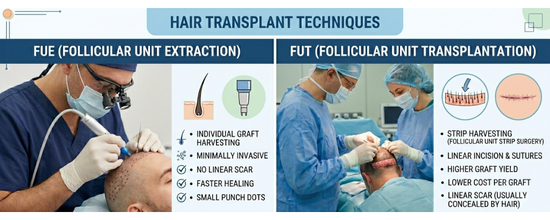
## **What Is FUE Hair Transplant? (And How Does It Work)**
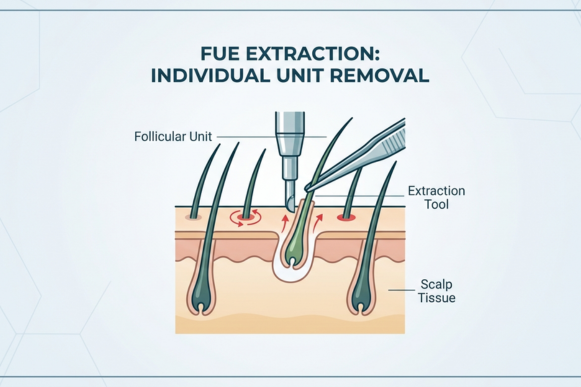
FUE stands for Follicular Unit Extraction. In this technique, individual hair follicles are taken out one by one from the back or sides of your scalp. These follicles are then planted into the thinning or bald areas. Here is what the process looks like step by step:
- **Step 1:** The donor area (usually the back of the scalp) is shaved and numbed with local anaesthesia.
- **Step 2:** A tiny circular punch tool (0.6mm to 1mm) is used to extract individual follicular units.
- **Step 3:** The extracted grafts are kept in a preservation solution.
- **Step 4:** Tiny incisions are made in the recipient area.
- **Step 5:** The grafts are placed carefully into these incisions.
The whole procedure can take anywhere from 6 to 8 hours, depending on how many grafts are needed.
> Dr. Nikitha Reddy says: “FUE is the most preferred technique today because it does not leave a linear scar. Patients can go back to their routine much faster, and the results look completely natural when done by an experienced surgeon.”
## **What Is FUT Hair Transplant? (And How Does It Work)**
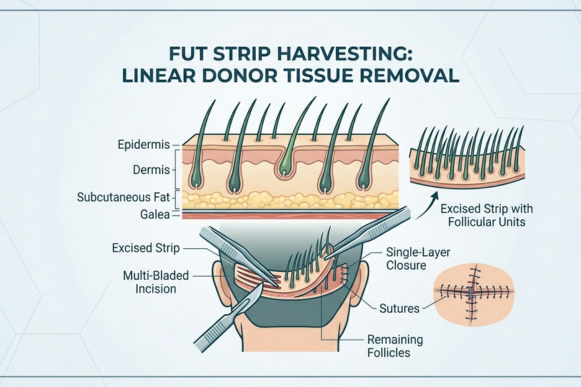
[FUT](https://dermaht.com/fut-hair-transplant-in-hyderabad/) stands for Follicular Unit Transplantation. It is also called the strip method. In FUT, a thin strip of scalp is surgically removed from the back of the head. This strip is then cut into smaller pieces under a microscope to separate individual follicular units. These units are then transplanted into the thinning or bald areas. Here is what the process looks like:
- **Step 1:** A strip of scalp (usually 15 to 30 cm long) is removed from the donor area.
- **Step 2:** The wound is stitched or stapled closed.
- **Step 3:** The strip is divided into individual grafts under magnification.
- **Step 4:** The grafts are planted into the recipient area.
Because a strip of skin is removed, FUT leaves a linear scar at the back of the head. This scar is usually hidden by surrounding hair, but it becomes visible if you shave your head very short.
## FUE vs FUT: A Side-by-Side Comparison
This table gives you a quick overview of how [FUE](https://dermaht.com/fue-hair-transplant-in-hyderabad/) and FUT differ across the most important factors.
| **Factor** | **FUE** | **FUT** |
|---|---|---|
| **Technique** | Individual follicle extraction | Strip of scalp is removed |
| **Scarring** | Tiny dot scars (not visible) | Linear scar at the back |
| **Recovery Time** | 5 to 7 days | 10 to 14 days |
| **Pain / Discomfort** | Minimal | Moderate (due to stitches) |
| **Number of Grafts** | Up to 3000-4000 per session | Up to 4000-5000 per session |
| **Best For** | Mild to moderate hair loss, short hair preference | Severe hair loss, maximum grafts needed |
| **Hair Shaving Required** | Yes (donor area) | No |
| **Cost** | Slightly higher | Slightly lower |
| **Natural Results** | Excellent | Excellent |
| **Suitability** | Most patients | Patients with large bald areas |
*As you can see, both techniques give excellent, natural-looking results. The right choice depends on your individual case.*
## **Which Technique Gives Better Results?**
This is probably the most searched question about hair transplants. And the answer is: both FUE and FUT give long-lasting, natural results when performed by a skilled surgeon. That said, results do depend on a few things: **Graft survival rate:** Both techniques have a high graft survival rate when handled correctly. Poor technique, not the method itself, is what causes bad results. **Hair density:** FUT can sometimes yield more grafts in a single session. So for patients with large bald areas, FUT may produce denser coverage faster. **Natural appearance:** With FUE, because grafts are placed individually, the hairline can be designed very precisely. This makes FUE popular for hairline restoration and eyebrow transplants as well.
> Dr. Nikitha Reddy says: “Both FUE and FUT can give you excellent results. What matters more than the technique is the skill and experience of the surgeon performing it. Always choose a qualified dermatologist-led clinic over a technician-run setup.”
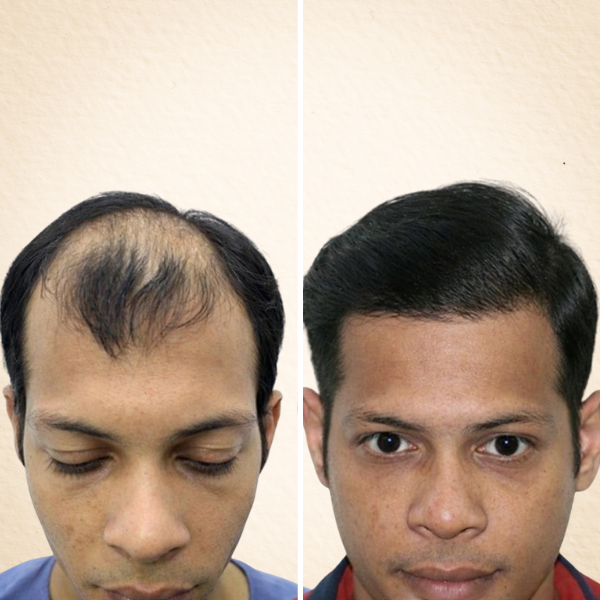
## **Who Is a Good Candidate for FUE?**
FUE works best for patients who:
- Have mild to moderate hair loss (Norwood Scale Grade 1 to 4)
- Want to keep their hair short or shaved after the procedure
- Prefer minimal downtime and a faster recovery
- Need a smaller number of grafts (1000 to 3000)
- Want eyebrow, beard, or body hair transplant
- Have a tight scalp (which makes FUT harder to perform)
FUE is also a good option for people who have already had a FUT procedure and want to cover the linear scar using individual grafts.
Not sure if FUE is right for you? Book a consultation with Dr. Nikitha Reddy at DermaHT Hair Transplant Clinic, Hyderabad.
[Book an Appointment](https://dermaht.com/contact-us/)
## **Who Is a Good Candidate for FUT?**
FUT works best for patients who:
- Have advanced hair loss (Norwood Scale Grade 5 to 7)
- Need a large number of grafts in a single session (3000 to 5000+)
- Do not mind a linear scar at the back (usually covered by hair)
- Have a good amount of scalp laxity (loose scalp skin)
- Are not concerned about keeping hair very short at the back
FUT is sometimes preferred when the donor area is limited. Because the grafts are extracted from a single strip, the yield per session can be higher compared to FUE in some cases.
## **Recovery: What to Expect After Each Procedure**
Recovery is one of the biggest deciding factors for many patients. Here is an honest breakdown:
### **FUE Recovery Timeline**
- **Day 1 to 3:** Mild swelling and redness in the treated areas. Tiny scabs form around each graft.
- **Day 5 to 7:** Most patients can return to work. Scabs start to fall off naturally.
- **Week 2 to 3:** Transplanted hairs may shed (this is completely normal and expected).
- **Month 3 to 4:** New hair growth begins.
- **Month 9 to 12:** Full results are visible.
### **FUT Recovery Timeline**
- **Day 1 to 5:** The donor area has stitches. Some tightness and discomfort is normal.
- **Week 2:** Stitches are removed. The linear scar is still healing.
- **Week 3 to 4:** Transplanted hairs begin to shed (again, completely normal).
- **Month 3 to 4:** New hair growth starts.
- **Month 9 to 12:** Full results are visible.
*FUE generally has a shorter, more comfortable recovery compared to FUT.*
## **FUE vs FUT Cost in Hyderabad: What Affects the Price?**
The cost of a [hair transplant in Hyderabad](https://dermaht.com/) depends on several factors, not just whether you choose FUE or FUT. Here is what affects the price:
- **Number of grafts needed:** More grafts = higher cost
- **Technique used:** FUE is typically priced slightly higher than FUT due to the precision required
- **Surgeon’s experience:** A qualified dermatologist-led clinic costs more than a technician-run centre, but the results are far better and safer
- **Clinic infrastructure and technology used**
- **Post-procedure care and follow-up included**
As a general range in Hyderabad, hair transplant costs can go from Rs. 40,000 to Rs. 1,50,000 or more, depending on the above factors. *Always be cautious of clinics offering very low prices. Low cost often means compromised technique, untrained staff, or poor graft handling, which directly affects your results.*
Want to know the exact cost for your case? Get a personalised graft estimate from Dr. Nikitha Reddy at DermaHT Hair Transplant Clinic, Kokapet, Hyderabad.
[Book an Appointment](https://dermaht.com/contact-us/)
## **What Does Dr. Nikitha Reddy Recommend?**
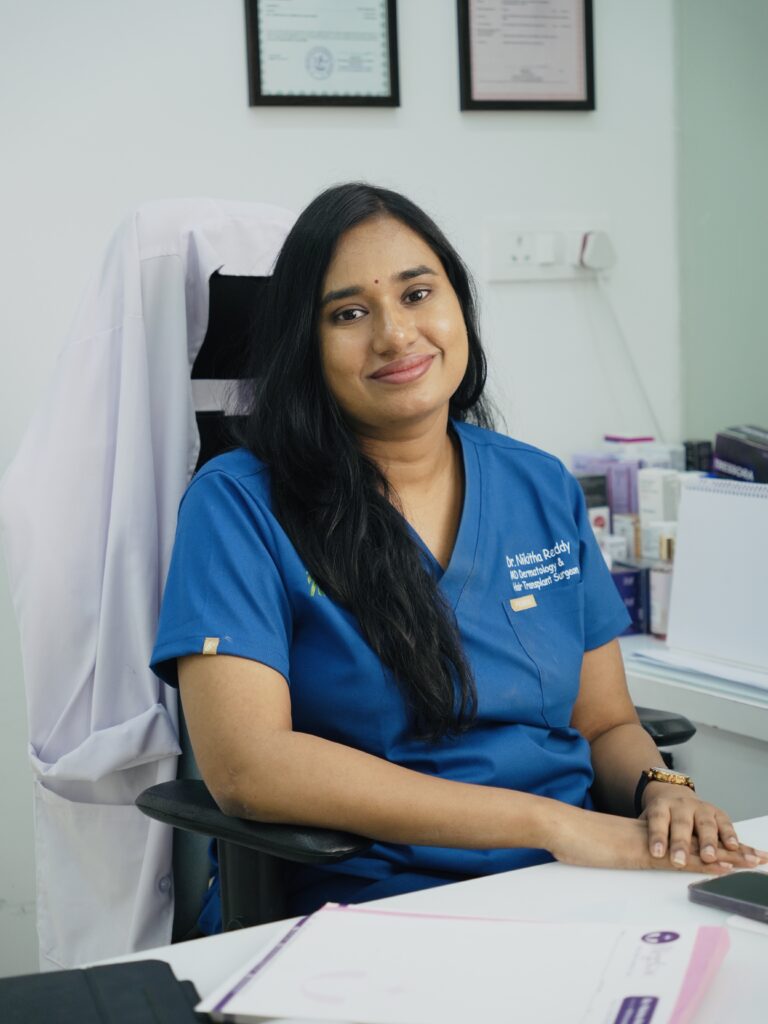
At DermaHT Hair Transplant Clinic in Hyderabad, every patient goes through a detailed scalp and hair analysis before a technique is recommended. There is no one-size-fits-all answer. Dr. Nikitha Reddy, MD Dermatologist and Hair Transplant Surgeon, evaluates:
- The grade and pattern of hair loss
- The donor area density and quality
- The patient’s lifestyle and recovery preference
- The number of grafts required for natural coverage
- Long-term hair loss progression
> Dr. Nikitha Reddy says: “I always tell my patients: the goal is not just to transplant hair. The goal is to give you a result that looks like it was always yours. That starts with an honest assessment, the right technique, and a surgeon who genuinely cares about the outcome.”
At DermaHT, procedures are led directly by Dr. Nikitha Reddy, not handed off to technicians. This is what sets a dermatologist-led clinic apart from others.
Ready to take the first step toward fuller hair? Visit Dr. Nikitha Reddy at DermaHT Hair Transplant Clinic, Kokapet, Hyderabad.
[Book an Appointment](https://dermaht.com/contact-us/)
## **Frequently Asked Questions (FAQs)**
### **1. Which is better, FUE or FUT hair transplant?**
Neither is universally better. FUE is less invasive and leaves no linear scar, making it the most popular choice today. FUT can deliver more grafts in a single session and may suit patients with advanced hair loss. The right technique depends on your hair loss grade, donor area, and lifestyle. A qualified hair transplant surgeon will guide you to the right choice.
### **2. Is FUE hair transplant permanent?**
Yes. Transplanted hair follicles are taken from the back and sides of the scalp, which are genetically resistant to hair loss. Once transplanted, these follicles retain their original characteristics and continue to grow naturally for a lifetime. However, it is important to note that existing non-transplanted hair can still thin over time due to ongoing hair loss, which is why a long-term treatment plan matters.
### **3. Does FUE leave a scar?**
FUE leaves very tiny, dot-like scars at the extraction sites. These are usually less than 1mm each and not visible to the naked eye, especially once the surrounding hair grows back. You can comfortably keep your hair very short after FUE without any visible scarring.
### **4. How many grafts can be done in one FUE session?**
In a single FUE session, typically 2000 to 3500 grafts can be safely extracted and transplanted. In some cases, up to 4000 grafts can be done depending on donor area quality and scalp characteristics. For patients needing more than 4000 grafts, a second session may be recommended.
### **5. What is the success rate of hair transplant in Hyderabad?**
When performed by an experienced, qualified dermatologist, the graft survival rate for hair transplants is between 90% and 95%. Results begin to show at 3 to 4 months, with full results visible at 9 to 12 months. Success depends heavily on the surgeon’s skill, graft handling, and post-procedure care.
## **References**
1. International Society of Hair Restoration Surgery (ISHRS) – FUE vs FUT Clinical Guidelines <https://ishrs.org/patients/hair-restoration-options/>
2. National Center for Biotechnology Information (NCBI) – Follicular Unit Extraction: Minimally Invasive Surgery for Hair Transplantation <https://www.ncbi.nlm.nih.gov/pmc/articles/PMC4158628/>
3. DermNet NZ – Hair Transplant Surgery <https://dermnetnz.org/topics/hair-transplant-surgery>
***Disclaimer:*** *The information shared in this content is for educational purposes only and not for promotional use.*
**Categories:** Blog
---
### [How Many Grafts Do I Need for FUE?](https://dermaht.com/blogs/how-many-grafts-do-i-need-for-fue/)
**Published:** April 19, 2026
**Author:** Dr. Nikitha Reddy
**Content:**
Most FUE patients need between 1,500 and 4,000 grafts, with the exact count depending on Norwood grade, total area needing coverage, and donor density. A Grade 2 recession sits around 1,500 to 2,000 grafts, Grade 3 to 4 pushes that to 2,000 to 3,000, and advanced Grade 5 to 6 cases often cross 3,500. Density goals also shift the number, since a dense hairline pulls more grafts than soft natural coverage.
> According to Dr. Nikitha Reddy, one of Hyderabad’s trusted dermatologists offering[ FUE Hair Transplant in Hyderabad](https://dermaht.com/about-us/),*“Graft counts aren’t something I estimate over a phone call. I map the scalp, check donor density per square cm, and only then give a number you can actually trust.”*
Book an Appointment
Worried your donor zone won’t give enough?
What decides the graft count for FUE?
Graft calculation follows anatomy, not guesswork. Four clinical factors shape every final plan a patient receives.
- **Norwood grade.** The recession pattern on your scalp sets the opening range for any plan, since different baldness stages expose very different recipient areas before any counting can start.
- **Recipient area.** Hairline coverage pulls fewer grafts than full crown work, and once the mid-scalp joins the map every zone needs its own density calculation worked out separately.
- **Donor density.** The back and sides of your head decide what’s actually available to harvest, so a thinner reserve tightens the ceiling on any plan no matter what the patient hopes for.
- **Desired look.** Thick dense coverage and soft natural blending are two different goals, and each option pulls a different graft volume from the donor reserve you have to work with.
Donor zone limits are real, which is why an advanced[ FUE hair transplant](https://dermaht.com/fue-hair-transplant-in-hyderabad/) plan gets built around your reserve first before anything else is decided.
Can donor density limit your graft count?
Donor density sits as the real ceiling on every FUE plan, so the honest answer is yes, it absolutely can limit how high the count goes.
- **Follicle count.** A healthy donor zone carries around 80 to 100 follicular units per square cm, and anything below that range drops extraction yield because the scalp can’t spare more without leaving gaps.
- **Safe zone.** Only the permanent donor area at the back and sides gets harvested for FUE, since crossing that boundary risks visible thinning in places that were never meant to be touched.
- **Redistribution.** When donor reserve falls short for the target area, a strip harvesting alternative may deliver better yield and the doctor will flag that route during your scalp assessment itself.
- **Single sitting.** Most cases get capped per session because pushing past safe limits stresses the donor zone and hurts graft survival, so bigger needs get split across two sittings months apart.
Pushing donor limits is how clinics leave scars patients notice years later, and if you’re weighing techniques before deciding, our guide on[ FUE vs FUT](https://dermaht.com/blogs/fue-vs-fut-hair-transplant/) breaks down which method suits different donor reserves.
Why Choose Dr. Nikitha Reddy?
[Dr. Nikitha Reddy](https://dermaht.com/) is an MD Dermatologist with 6+ years of hair transplant experience, registered with Telangana State Medical Council (TSMC/FMR/04492), and every graft plan at DermaHT is built after in-person scalp mapping and donor density check, not a phone quote. Patients don’t leave with “we’ll see how many we can do” because they leave with a number, an area map, and a clear plan, which is how good hair transplant results actually start.
Frequently Asked Questions
### **1. How many grafts are needed for a receding hairline?**
Most receding hairlines need 1,500 to 2,500 grafts.
### **2. Can I get 5,000 grafts in one sitting?**
Safe FUE sessions cap around 3,500 to 4,000 grafts, so no.
### **3. Does higher graft count mean better results?**
Donor quality and placement matter more than raw numbers, so not always.
### **4. How long does harvesting 3,000 grafts take?**
A typical 3,000-graft FUE session takes 6 to 8 hours.
**References:**
- National Center for Biotechnology Information. Follicular Unit Extraction Review.[ https://www.ncbi.nlm.nih.gov/pmc/articles/PMC3580999/](https://www.ncbi.nlm.nih.gov/pmc/articles/PMC3580999/)
- International Society of Hair Restoration Surgery. Donor Harvesting Guidelines.[ https://ishrs.org/](https://ishrs.org/)
**Categories:** Blog
---
### [FUE Recovery: Day 1 to Month 12](https://dermaht.com/blogs/fue-recovery-day-1-to-month-12/)
**Published:** April 19, 2026
**Author:** Dr. Nikitha Reddy
**Content:**
FUE recovery runs in predictable phases starting with mild swelling and redness during days 1 to 3, followed by scab formation and donor area healing across week 1 to 2, before shock loss sets in around week 3 to 4 when transplanted hairs shed to allow the follicle to enter its new growth cycle. New hair starts pushing through by month 3 to 4, visible thickening becomes obvious between month 6 to 8, and final density usually settles between month 9 to 12 with every phase being part of the normal biological timeline that no graft skips.
> According to Dr. Nikitha Reddy, one of Hyderabad’s trusted dermatologists offering[ FUE Hair Transplant in Hyderabad](https://dermaht.com/about-us/),*“Most patients panic around week three when transplanted hair starts shedding, but that’s not failure, that’s the follicle resetting, and I walk every patient through this before surgery so they know what’s coming.”*
Book an Appointment
Scared about the shedding phase?
What happens in the first month after FUE?
The opening month covers healing, early shock loss, and the transition into dormancy before regrowth begins, with four distinct stages playing out in that window.
- **Days 1 to 3.** Expect mild swelling across the forehead with slight redness at both recipient and donor sites, which is the scalp’s standard inflammatory response and settles within 72 hours on its own without any added intervention.
- **Week 1.** Tiny scabs form around each graft and start flaking off naturally within a few days, so the scalp should never be scratched or rubbed because that can loosen grafts that haven’t anchored yet.
- **Week 2.** Donor area healing moves ahead with no visible punch marks remaining by this stage, and most patients return to normal routine including office work by around the tenth day after surgery.
- **Week 3 to 4.** Shock loss sets in as transplanted hairs shed in preparation for the follicle’s new growth cycle, which looks alarming but is actually the expected biological reset every graft goes through before regrowth begins.
The scalp looks quieter by month end than it did on day one, and this dormant window is when a carefully planned[ FUE hair transplant](https://dermaht.com/fue-hair-transplant-in-hyderabad/) protocol shows its worth through proper aftercare guidance from the treating doctor.
How does hair growth progress from month 3 to month 12?
Growth follows a slow build rather than a switch, with regrowth arriving in waves and thickening gradually across the transplanted zone.
- **Month 3.** Fine baby hairs begin emerging through the recipient scalp but coverage still looks patchy and uneven, which is normal because different follicles come out of dormancy on different schedules depending on graft placement.
- **Month 5 to 6.** Texture and length both improve as the early hairs start gaining calibre, and this is the point where friends and family usually start noticing the change in mirror visibility before the patient notices themselves.
- **Month 7 to 9.** Density builds steadily with most follicles now in active growth phase, and the hairline direction becomes visible as each graft settles into the implanted angle that was planned during surgery.
- **Month 10 to 12.** Final maturation delivers full colour, thickness, and styling capability, which is when patients can cut, colour, and treat the new hair exactly like native scalp hair without any special handling needed.
Recovery timing shifts slightly from person to person, and our breakdown on[ how many grafts](https://dermaht.com/blogs/how-many-grafts-for-fue/) are placed during FUE also covers why graft volume directly influences the length and visibility of your recovery journey.
Why Choose Dr. Nikitha Reddy?
[Dr. Nikitha Reddy](https://dermaht.com/) is an MD Dermatologist with 6+ years of hair transplant experience registered with Telangana State Medical Council (TSMC/FMR/04492), and every FUE case at DermaHT comes with structured follow-up visits across the full 12-month recovery window rather than a one-time post-op check. Patients get scalp reviews at week 1, month 3, month 6, and month 12, which is how growth gets tracked honestly instead of being guessed from photos.
Frequently Asked Questions
### **1. When can I wash my hair after FUE?**
Gentle washing starts on day 3 with doctor-prescribed shampoo only.
### **2. Is shock loss after FUE permanent?**
Shock loss is temporary, and follicles regrow in the next cycle.
### **3. When can I return to the gym after FUE?**
Light workouts resume after 2 weeks, heavy lifting after 4 weeks.
### **4. How long until FUE looks completely natural?**
Full natural results settle between month 9 and month 12.
**References:**
- National Center for Biotechnology Information. Postoperative Care in Hair Transplant Surgery.[ https://www.ncbi.nlm.nih.gov/pmc/articles/PMC5868857/](https://www.ncbi.nlm.nih.gov/pmc/articles/PMC5868857/)
- International Society of Hair Restoration Surgery. Patient Recovery Guidelines.[ https://ishrs.org/](https://ishrs.org/)
**Categories:** Blog
---
### [Can I Get FUE Without Shaving My Head?](https://dermaht.com/blogs/can-i-get-fue-without-shaving-my-head/)
**Published:** April 19, 2026
**Author:** Dr. Nikitha Reddy
**Content:**
This is an extraction method called no-shave FUE, where a small window inside the donor zone gets trimmed while surrounding hair stays long enough to hide the cut area during recovery. FUE can be performed without shaving the full head, and it suits cases needing around 800 to 1,500 grafts. Bigger volumes usually still need complete donor exposure, since even and safe harvesting becomes difficult to manage through longer strands.
> According to Dr. Nikitha Reddy, one of Hyderabad’s trusted dermatologists offering[ FUE Hair Transplant in Hyderabad](https://dermaht.com/about-us/),*“No-shave FUE works beautifully for the right case, but I won’t force it on someone who needs 3,000 grafts because the donor zone has to be properly visible for safe extraction at that volume.”*
Book an Appointment
Still unsure if you qualify for no-shave FUE?
Who is the right candidate for no-shave FUE?
Candidacy for no-shave FUE comes down to graft count, donor density, and the kind of coverage the patient is actually expecting.
- **Graft volume.** Patients needing roughly 800 to 1,500 grafts fit the no-shave approach comfortably because that extraction load can sit within a small trimmed window without requiring the wider donor exposure that bigger sessions demand.
- **Long hair patients.** Women with longer hair and men who keep their hair above collar length are natural candidates since surrounding strands cover the trimmed zone almost immediately, making the donor work invisible within days of surgery.
- **Small area work.** Limited touch-ups on the hairline, temples, or beard transplants suit no-shave perfectly because those cases rarely need high graft volumes and the recipient area also doesn’t require any shaving for precise implantation.
- **Donor density.** A strong donor zone with healthy follicle reserves helps the surgeon pick and extract selectively without stressing the scalp, while weaker donors usually need a fully shaved field for careful unit-by-unit planning.
Selection decisions are always made during in-person assessment, and a proper[ FUE hair transplant](https://dermaht.com/fue-hair-transplant-in-hyderabad/) consultation covers whether no-shave suits your graft needs before anything else is confirmed.
What are the limitations of no-shave FUE?
There are clear clinical reasons no-shave FUE doesn’t suit every case, and the limitations mostly come down to extraction precision and procedure time.
- **Longer surgery time.** Extracting through longer hair takes significantly more time per graft since the surgeon has to navigate around strands, which is why no-shave cases often run longer than standard FUE sessions for the same count.
- **Graft count ceiling.** Cases above 2,000 to 2,500 grafts typically need full donor shaving because selective trimming alone won’t expose enough scalp surface for safe extraction at that volume without risking uneven harvesting.
- **Visibility for surgeon.** Full donor visibility helps the surgeon plan extraction patterns carefully to prevent over-harvesting any one area, while hidden zones under long hair can compromise the even distribution that protects donor cosmesis long term.
- **Higher cost.** No-shave FUE usually carries a higher per-graft cost since it demands more time, more precision, and often two surgeons working simultaneously, which is a trade-off worth knowing before booking the procedure.
Understanding trade-offs matters before choosing any technique, and our breakdown on[ FUE vs FUT](https://dermaht.com/blogs/fue-vs-fut-hair-transplant/) also covers how shaving requirements differ between the two main hair transplant methods.
Why Choose Dr. Nikitha Reddy?
[Dr. Nikitha Reddy](https://dermaht.com/) is an MD Dermatologist with 6+ years of hair transplant experience registered with Telangana State Medical Council (TSMC/FMR/04492), and every no-shave FUE candidate at DermaHT gets an honest assessment about whether the technique suits their graft requirement rather than a blanket approval. Patients are told upfront when full shaving gives better results, because protecting the final outcome matters more than meeting a preference that could compromise the procedure.
Frequently Asked Questions
### **1.Does no-shave FUE give the same results as shaved FUE?**
Yes, results can be just as natural if the graft requirement and donor area are suitable.
### **2.How many grafts are possible in no-shave FUE?**
Most cases are done within 800 to 1,500 grafts for safe and effective extraction.
### **3.Does no-shave FUE cost more than standard FUE?**
Yes, it usually costs more because the procedure takes longer and requires more precision.
### **4.Can women get FUE without shaving their head?**
Yes, it is especially suitable for women as longer hair helps conceal the donor area.
**References:**
- National Center for Biotechnology Information. Non-Shaven Follicular Unit Extraction Technique.[ https://www.ncbi.nlm.nih.gov/pmc/articles/PMC4335408/](https://www.ncbi.nlm.nih.gov/pmc/articles/PMC4335408/)
- International Society of Hair Restoration Surgery. FUE Technique Guidelines.[ https://ishrs.org/](https://ishrs.org/)
**Categories:** Blog
---
### [FUE for Receding Hairline: What to Expect](https://dermaht.com/blogs/fue-for-receding-hairline-what-to-expect/)
**Published:** April 19, 2026
**Author:** Dr. Nikitha Reddy
**Content:**
This is a frontal restoration procedure where follicles get pulled from the back of the scalp and placed along a freshly drawn hairline to fix the receded zone. Most cases need 1,500 to 2,500 grafts, and full results show up between month 9 and month 12. What decides the outcome isn’t graft count alone. It’s the hairline design, angle, and age-appropriate density that actually shape how the final result reads.
> According to Dr. Nikitha Reddy, one of Hyderabad’s trusted dermatologists offering[ FUE Hair Transplant in Hyderabad](https://dermaht.com/about-us/),*“The hairline is the most artistic part of any transplant I do. One millimetre off in the wrong direction and the whole face changes, which is why I draw every hairline by hand before starting surgery.”*
Book an Appointment
Noticing your hairline drifting back?
How is the new hairline designed for FUE?
Hairline design isn’t a formula. It pulls together face shape, age, hair type, and how the hair loss might progress later, all into one planned curve drawn on the scalp.
- **Age-matched positioning.** Your new hairline can’t sit where it did at 22, because a deep low hairline on a 40-year-old face reads fake instantly, and if the sides keep receding later, maintaining it becomes impossible anyway.
- **Facial symmetry.** Forehead width gets measured, eyebrow position gets checked, temple angles get factored in, so the hairline suits your actual face rather than copying some template off a chart.
- **Natural irregularity.** A dead-straight hairline is the first giveaway of a bad transplant. That’s why the design builds in small rough edges and a slightly uneven front line, because real hair has never grown in a perfect line.
- **Transition zone.** First 1 to 2 cm uses only single-hair grafts set at careful angles for a soft feathered edge, while the zone behind gets multi-hair units for weight and fullness.
Every design gets drawn straight on the scalp before anything else begins, and a properly planned[ FUE hair transplant](https://dermaht.com/fue-hair-transplant-in-hyderabad/) always starts with this decision before a single graft leaves the donor zone.
What results can you expect from FUE on a receding hairline?
Results don’t arrive in one burst. They roll out in stages across the full year of recovery, with each window bringing a different visible change.
- **Month 1 to 2.** The transplanted hair sheds during shock loss and the hairline looks close to how it was before surgery, which throws off most first-time patients though it’s fully expected biology.
- **Month 3 to 4.** Fine baby hair starts pushing through the front zone unevenly, since every follicle wakes from dormancy on its own schedule and patchy growth at this stage is normal.
- **Month 5 to 8.** Coverage thickens as grafts gain calibre and length, the hairline shape becomes obvious in the mirror, and most patients start getting noticed around month seven by friends and family.
- **Month 9 to 12.** Final density settles in with full colour, thickness, and styling ability, after which the hairline blends cleanly into native hair and can be cut or coloured like any other part of the scalp.
Recovery timing shifts slightly from person to person, and what each[ stage looks like](https://dermaht.com/blogs/fue-recovery-timeline/) from day one through to final hairline density at month twelve follows its own steady progression.
Why Choose Dr. Nikitha Reddy?
[Dr. Nikitha Reddy](https://dermaht.com/) is an MD Dermatologist with 6+ years of hair transplant experience, registered with Telangana State Medical Council (TSMC/FMR/04492), and every receding hairline case at DermaHT starts with a hand-drawn hairline planned around your face, age, and likely future recession pattern. Patients don’t walk out with templated hairlines because the front zone decides how the whole transplant reads, and at DermaHT the design time matters just as much as the surgery itself.
Frequently Asked Questions
### **1.How many grafts are needed for a receding hairline?**
Most receding hairline cases need between 1,500 and 2,500 grafts.
### **2.At what age can FUE be done for receding hairline?**
FUE is usually advised after 25 once hair loss stabilises.
### **3.Will my transplanted hairline look natural?**
With proper design and angle placement, results look fully natural.
### **4.Is a receding hairline reversible without surgery?**
Early recession can slow with medication, though real reversal needs FUE.
**References:**
- National Center for Biotechnology Information. Hairline Design in Hair Transplantation.[ https://www.ncbi.nlm.nih.gov/pmc/articles/PMC5782436/](https://www.ncbi.nlm.nih.gov/pmc/articles/PMC5782436/)
- **International Society of Hair Restoration Surgery. Clinical Guidelines for Hairline Restoration.[ https://ishrs.org/](https://ishrs.org/)**
**Categories:** Blog
---
### [Hair Transplant at 25: Too Young?](https://dermaht.com/blogs/hair-transplant-at-25-too-young/)
**Published:** April 19, 2026
**Author:** Dr. Nikitha Reddy
**Content:**
This is an age range where medical opinion leans cautious rather than restrictive. While 25 is often treated as the minimum age for a hair transplant, it isn’t automatically “too young” for everyone, though it’s usually considered early in the timeline of hair loss progression. Experts typically recommend waiting until 25 or older because pattern baldness is progressive, and predicting the final recession map before this age is difficult even with detailed scalp examination. Decisions get made based on stability, donor reserve, and how loss might behave across the next 15 to 20 years, not birthdate alone.
> According to Dr. Nikitha Reddy, one of Hyderabad’s trusted dermatologists offering[ FUE Hair Transplant in Hyderabad](https://dermaht.com/about-us/),*“I turn away more 23 and 24-year-olds than I operate on, because doing a transplant on someone whose hair loss hasn’t settled yet is how you end up with an island of transplanted hair surrounded by a bald scalp five years later.”*
Book an Appointment
Worried about your age for FUE?
Why does age matter for hair transplant candidacy?
Age isn’t just a number on the consent form. It signals how the hair loss pattern is still moving, which is what actually decides whether surgery makes sense right now.
- **Active progression.** Most male pattern baldness speeds up hardest between 18 and 25, so operating in that window risks chasing loss as it spreads, because what gets transplanted today won’t stop the sides and crown from thinning tomorrow.
- **Stability check.** A proper candidate shows at least 12 to 18 months of no new recession, which can be tracked through photo comparisons, scalp mapping, and sometimes a short medical therapy trial before surgery gets cleared.
- **Donor planning.** Donor reserve has to last a lifetime, not one session. Someone at 25 may need multiple transplants across decades, so the first one can’t drain the scalp of grafts that’ll be needed later.
- **Design foresight.** The hairline drawn at 25 must still look natural at 45, which means placing it slightly conservative rather than aggressively low, because maintaining a teenage hairline on an aging face becomes impossible eventually.
Candidate selection gets decided during scalp assessment, and a properly planned[ FUE hair transplant](https://dermaht.com/fue-hair-transplant-in-hyderabad/) always factors in age, stability, and donor longevity before any graft plan gets made.
What should a 25-year-old do before considering FUE?
Going straight to surgery at this age rarely makes clinical sense. A structured medical plan needs to come first, since skipping the groundwork usually leads to preventable problems surfacing within a few years of the transplant.
- **Medical stabilisation.** Finasteride and topical minoxidil are often started first to slow active loss, and most doctors want to see 6 to 12 months of response before clearing anyone for surgery at this age.
- **Photo documentation.** Dated scalp photos taken every 3 months show whether recession is still moving or has genuinely plateaued, giving real evidence rather than relying on the patient’s memory of how things looked last year.
- **Supportive therapies.** PRP and GFC injections can strengthen existing follicles and slow miniaturisation, which sometimes pushes back the need for transplant surgery by a few years entirely.
- **Realistic expectations.** Understanding that one FUE at 25 likely won’t be the last, because pattern baldness continues, is the kind of conversation every young patient deserves before signing the consent form.
Groundwork done right saves grafts and money both, and our breakdown on[ FUE vs FUT](https://dermaht.com/blogs/fue-vs-fut-hair-transplant/) also covers why technique choice matters more when donor reserve has to stretch across decades.
Why Choose Dr. Nikitha Reddy?
[Dr. Nikitha Reddy](https://dermaht.com/) is an MD Dermatologist with 6+ years of hair transplant experience, registered with Telangana State Medical Council (TSMC/FMR/04492), and every young patient at DermaHT gets a full stability assessment before surgery is even discussed as an option. Patients in their twenties often leave with a medical plan rather than an operation date, because protecting the long-term result matters more than scheduling a quick procedure that could go wrong.
Frequently Asked Questions
### **1.What is the minimum age for FUE hair transplant?**
Age 25 is the clinically accepted benchmark once pattern baldness has clearly stabilised.
### **2.Can hair loss continue after FUE at a young age?**
Untreated native hair around the transplanted zone often keeps thinning with age.
### **3.Should I try medication before FUE at 25?**
Finasteride and minoxidil are typically started 6 to 12 months prior.
### **4.Will I need another FUE later if done at 25?**
Progressive recession frequently requires a second session in later decades.
**References:**
- National Center for Biotechnology Information. Age Considerations in Hair Transplantation.[ https://www.ncbi.nlm.nih.gov/pmc/articles/PMC6396477/](https://www.ncbi.nlm.nih.gov/pmc/articles/PMC6396477/)
- International Society of Hair Restoration Surgery. Clinical Guidelines for Young Patients.[ https://ishrs.org/](https://ishrs.org/)
**Categories:** Blog
---
### [How Visible Is the FUT Scar?](https://dermaht.com/blogs/how-visible-is-the-fut-scar/)
**Published:** April 30, 2026
**Author:** Dr. Nikitha Reddy
**Content:**
This is a thin horizontal line that sits along the back of the scalp where the donor strip was removed and stitched closed during FUT surgery. Scar width usually settles between 1 mm and 3 mm with proper closure, and stays hidden under hair longer than around 1 cm. Closure technique, suture tension, scalp elasticity, and post-op care decide whether the line fades into surrounding hair or stays visible long term.
According to Dr. Nikitha Reddy, one of Hyderabad’s trusted dermatologists offering[ FUE Hair Transplant in Hyderabad](https://dermaht.com/about-us/),
> *“A good FUT scar is one the patient eventually forgets exists. Wide stretched scars usually come from rushed closure, and that’s a surgeon problem, not a technique problem.”*
Book an Appointment
Worried about visible marks on the scalp?
What decides how visible the FUT scar becomes?
Scar visibility isn’t down to luck. It’s shaped by surgical decisions made during closure, plus how the scalp responds while healing in the weeks that follow.
**Closure technique.** Trichophytic closure allows hair to grow through the scar line itself, which is the single most important factor in helping the mark blend with surrounding hair instead of reading as a pale visible stripe.
**Suture tension.** Closing the wound under tight pressure stretches the scar wider during healing, while a relaxed closure lets the skin edges knit cleanly together and keeps the final line as narrow as possible.
**Scalp elasticity.** Skin behaves differently in different patients, so those with tighter scalps usually heal with slightly wider scars compared to people whose skin moves more freely, regardless of how skilled the surgeon happens to be.
**Post-op care.** Avoiding heavy lifting, neck strain, and aggressive scalp movement during the first few weeks protects the closure line from widening while healing is still actively happening underneath.
Scar outcomes get planned inside the operating room itself, and a properly executed[ FUE hair transplant](https://dermaht.com/fue-hair-transplant-in-hyderabad/) or FUT always begins with a clear discussion about closure strategy before surgery starts.
How do patients hide or reduce the FUT scar?
A wider scar doesn’t have to stay obvious forever. There are several proven ways to bring down visibility or cover the line entirely if it becomes a concern later.
**Hair length above 1 cm.** Keeping hair longer than one centimetre at the back covers any standard FUT scar fully, which is why most surgeons advise patients to avoid permanently short crew cuts or full shaves after the procedure.
**Scalp micropigmentation.** This is a tattoo technique where pigment gets matched to surrounding follicle shadows, camouflaging a visible scar line so effectively that even shaved heads can mask older FUT marks convincingly.
**FUE into the scar.** Follicular units can be implanted directly into the FUT scar tissue to push hair growth through it, which softens or breaks up the line visually for patients who want to keep their hair very short.
**Revision surgery.** A widened scar can sometimes be surgically revised and closed again more cleanly, though this works best while the scar is still fresh and becomes less effective once mature scar tissue has fully formed.
Most patients never need any of these interventions, and choosing between techniques upfront matters as much as managing a scar later, which our breakdown on[ FUE vs FUT](https://dermaht.com/blogs/fue-vs-fut-hair-transplant/) covers in depth.
Why Choose Dr. Nikitha Reddy?
[Dr. Nikitha Reddy](https://dermaht.com/) is an MD Dermatologist with 6+ years of hair transplant experience registered with Telangana State Medical Council (TSMC/FMR/04492), and every FUT case at DermaHT is closed using trichophytic technique under controlled tension to keep the final scar narrow and hair-covered as much as clinically possible. Patients are shown exactly where the closure line will sit before surgery begins, because knowing what to expect is part of how honest hair transplant care actually works.
Frequently Asked Questions
###### **1.How wide is a typical FUT scar?**
A well-closed FUT scar sits between 1 mm and 3 mm wide.
###### **2. Can the FUT scar be completely removed?**
Complete removal isn’t possible, though scalp micropigmentation hides it very effectively.
###### **3. Will the scar show when I wear short hair?**
Hair shorter than 1 cm may expose part of the scar line.
###### **4. Does hair grow back on the FUT scar?**
Native hair doesn’t regrow on scar tissue, though FUE grafts can.
**References:**
1. National Center for Biotechnology Information. Trichophytic Closure in Hair Restoration Surgery.[ https://www.ncbi.nlm.nih.gov/pmc/articles/PMC4171912/](https://www.ncbi.nlm.nih.gov/pmc/articles/PMC4171912/)
2. International Society of Hair Restoration Surgery. FUT Scar Management Guidelines.[ https://ishrs.org/](https://ishrs.org/)
**Categories:** Blog
---
### [What Is GFC Hair Treatment?](https://dermaht.com/blogs/what-is-gfc-hair-treatment/)
**Published:** May 4, 2026
**Author:** Dr. Nikitha Reddy
**Content:**
This is a growth factor concentrate therapy where a specific layer of the patient’s own blood plasma gets isolated and injected into the scalp to strengthen weak follicles and trigger fresh hair growth. GFC delivers a higher concentration of growth factors compared to standard PRP, since the preparation method removes red and white blood cells more thoroughly. The treatment suits early to moderate hair thinning, post-transplant follicle support, and patients who want a non-surgical option before considering FUE.
According to Dr. Nikitha Reddy, one of Hyderabad’s trusted dermatologists offering[ GFC Treatment in Hyderabad](https://dermaht.com/),
> *“GFC isn’t a magic shot. It works on follicles that are still alive but weakening, which is why timing the treatment matters as much as the injection itself for getting actual results.”*
Book an Appointment
Dealing with thinning that hasn’t reached baldness yet?
How does GFC hair treatment actually work?
GFC therapy works by delivering concentrated growth factors directly into the follicle environment, where they signal weakened follicles to re-enter active growth phases. The full mechanism plays out across four stages.
**Blood collection.** A small sample of the patient’s blood gets drawn, usually 10 to 20 ml depending on scalp area being treated, which is then processed in a closed system to isolate the growth factor layer cleanly.
**Concentration step.** The processing step separates and concentrates platelet-derived growth factors, removing other blood components so the final injectable carries 4 to 6 times higher concentration than basic PRP preparations would deliver.
**Scalp injection.** The concentrate is injected at multiple points across thinning zones using fine needles, with the doctor mapping injection grids beforehand to cover affected follicle clusters evenly across the scalp surface.
**Follicle stimulation.** Growth factors signal dormant follicles to wake up, improve blood supply around active follicles, and reduce inflammation that contributes to ongoing miniaturisation in male and female pattern thinning.
Sessions are spaced around 4 to 6 weeks apart for the first round, and patients typically see early density changes between session two and four when the treatment is suitable for their hair loss stage.
Who is the right candidate for GFC treatment?
GFC works best on specific hair loss profiles where follicles are weakened but not lost. The wrong patient profile leads to disappointment regardless of how well the treatment is administered.
**Early-stage thinning.** Patients with diffuse thinning, early Norwood Grade 1 to 3 in men, or Ludwig Grade 1 in women respond best because the treatment has live follicles to work on rather than empty scalp areas.
**Post-FUE support.** Patients recovering from hair transplant surgery often get GFC sessions to support graft survival and accelerate regrowth, since the growth factors directly help the transplanted follicles settle into their new blood supply.
**Telogen effluvium.** Sudden temporary shedding from stress, illness, post-pregnancy, or nutritional deficiency responds well to GFC, especially when paired with addressing the underlying cause that triggered the shedding cycle.
**Female pattern hair loss.** Women with diffuse thinning and intact follicles often see meaningful density improvement, since female pattern loss tends to involve weakened follicles rather than complete miniaturisation in most cases.
GFC is rarely the standalone answer for advanced baldness, and patients with Norwood Grade 5 or higher usually do better with surgical options where regrowth potential matches expectations, which our[ FUE recovery timeline](https://dermaht.com/blogs/fue-recovery-timeline/) blog covers in detail.
Why Choose Dr. Nikitha Reddy?
[Dr. Nikitha Reddy](https://dermaht.com/about-us/) is an MD Dermatologist with 6+ years of hair restoration experience registered with Telangana State Medical Council (TSMC/FMR/04492), and every GFC patient at DermaHT goes through a hair loss staging assessment before being cleared for the treatment, rather than being booked in as a default option. Patients with hair loss too advanced for GFC are told upfront, because spending money on a treatment that won’t work is the fastest way to lose trust in clinical care.
📞 Call Now: +91 90639 77407
Frequently Asked Questions
###### **1. How is GFC different from PRP for hair?**
GFC has higher growth factor concentration with cleaner cell separation than PRP.
###### **2. How many GFC sessions are needed?**
Most patients need 4 to 6 sessions for visible density improvement.
###### **3. Is GFC treatment painful?**
Mild discomfort during injections is normal, with no major downtime needed.
###### **4. Can GFC stop hair loss completely?**
GFC slows shedding and improves density but doesn’t permanently stop pattern baldness.
**References:**
1. National Center for Biotechnology Information. Growth Factor Concentrate in Hair Restoration.[ https://www.ncbi.nlm.nih.gov/pmc/articles/PMC8743393/](https://www.ncbi.nlm.nih.gov/pmc/articles/PMC8743393/)
2. International Society of Hair Restoration Surgery. Non-Surgical Hair Loss Therapies.[ https://ishrs.org/](https://ishrs.org/)
**Categories:** Blog
---
### [FUT Recovery: Suture Care & Timeline](https://dermaht.com/blogs/fut-recovery-suture-care-timeline/)
**Published:** May 6, 2026
**Author:** Dr. Nikitha Reddy
**Content:**
FUT Recovery is a structured healing process that runs from the moment the donor strip is closed through to final hair density at month 12, with suture care being the most critical part of the early weeks. Sutures usually come out between day 10 and day 14, and the donor closure line needs gentle handling for the first 4 weeks to keep the scar narrow. Recovery moves through five clear phases that every FUT patient passes through, regardless of graft count or surgical setup.
According to Dr. Nikitha Reddy, one of Hyderabad’s trusted dermatologists offering[ FUT Hair Transplant in Hyderabad](https://dermaht.com/),
> *“FUT recovery is forgiving when patients follow suture care properly. Most wide scars I see during revision consults trace back to the patient lifting weights too early or sleeping flat instead of propped up.”*
Book an Appointment
Confused about how to handle the stitches at home?
How do you care for FUT sutures during the first two weeks?
Suture care decides how the closure line eventually heals, and most scar problems show up because of small mistakes made in the first ten days after surgery.
**Day 1 to 3.** Mild swelling and tightness around the donor area is expected, with the dressing usually removed within 24 to 48 hours by the clinic, after which gentle saline rinses begin to keep the suture line clean.
**Day 4 to 7.** Hair washing starts cautiously with doctor-prescribed shampoo, where water is poured rather than sprayed directly, and the closure line should never be scrubbed or rubbed even when scabs start lifting on their own.
**Day 8 to 10.** Scabs begin flaking off naturally and the donor zone starts feeling less tight, with patients usually returning to office work by this stage if the role doesn’t involve heavy physical activity.
**Day 11 to 14.** Sutures or staples are removed at the clinic depending on the closure type used, after which the scalp feels visibly more comfortable and the closure line begins entering the scar maturation phase.
Suture care is rarely complicated when patients follow instructions, and a properly executed[ FUT hair transplant](https://dermaht.com/fut-hair-transplant-in-hyderabad/) protocol always includes a written aftercare plan handed over before the patient leaves the clinic.
What does the full FUT recovery timeline look like?
Recovery doesn’t end with stitch removal. The full healing arc runs across 12 months, with each phase delivering different visible changes that compound into the final outcome.
**Week 3 to 4.** Shock loss kicks in as transplanted hairs shed before the follicles enter their new growth cycle, which patients often confuse with treatment failure though it’s actually a normal biological reset every graft passes through.
**Month 2 to 3.** The scalp looks quieter than it did pre-surgery and the donor line continues maturing, with most physical restrictions including heavy lifting and contact sports being lifted by the doctor around this stage.
**Month 4 to 6.** Fine baby hairs begin pushing through the recipient area unevenly, since different follicles wake from dormancy on their own schedules, and early density starts becoming visible in good lighting.
**Month 7 to 12.** Density builds steadily across the transplanted zone with full colour, thickness, and styling capability settling in, while the donor scar line continues maturing and softening across the same window.
Scar visibility through this period depends heavily on how the closure line was managed during recovery, and our breakdown on[ FUT scar visibility](https://dermaht.com/blogs/fut-scar-visibility/) covers what affects width and how to keep it minimal long term.
Why Choose Dr. Nikitha Reddy?
[Dr. Nikitha Reddy](https://dermaht.com/about-us/) is an MD Dermatologist with 6+ years of hair transplant experience registered with Telangana State Medical Council (TSMC/FMR/04492), and every FUT patient at DermaHT receives a written suture care protocol with scheduled follow-up visits at day 10, week 4, month 3, and month 6 to track healing progress directly. Patients aren’t left guessing whether something looks normal, because closure line problems caught early are easier to manage than ones spotted six months later.
📞 Call Now: +91 90639 77407
Frequently Asked Questions
###### **1. When are FUT sutures removed?**
Sutures are usually removed between day 10 and day 14 after surgery.
###### **2. Can I wash my hair with sutures still in?**
Gentle washing starts day 4 with poured water, no direct spray.
###### **3. How long until I can lift weights after FUT?**
Heavy lifting resumes after 4 weeks once the donor line stabilises.
###### **4. Is shock loss after FUT normal?**
Temporary shedding around week 3 to 4 is part of normal regrowth.
**References:**
1. National Center for Biotechnology Information. Growth Factor Concentrate in Hair Restoration.[ https://www.ncbi.nlm.nih.gov/pmc/articles/PMC8743393/](https://www.ncbi.nlm.nih.gov/pmc/articles/PMC8743393/)
2. International Society of Hair Restoration Surgery. Non-Surgical Hair Loss Therapies.[ https://ishrs.org/](https://ishrs.org/)
**Categories:** Blog
---
### [Can You Get a Second Hair Transplant?](https://dermaht.com/blogs/can-you-get-a-second-hair-transplant-2/)
**Published:** May 9, 2026
**Author:** Dr. Nikitha Reddy
**Content:**
A second transplant becomes possible when donor reserve still holds enough viable follicles, scalp elasticity allows further extraction, and the gap since the first surgery is at least 8 to 12 months. Decisions get based on donor capacity, recipient area condition, and how the original session healed.This is a follow-up surgical procedure performed when an earlier hair transplant needs supplementing, either because pattern baldness has progressed further or the original session didn’t deliver enough density for the patient’s expectations.
According to Dr. Nikitha Reddy, one of Hyderabad’s trusted dermatologists offering[ Hair Transplant in Hyderabad](https://dermaht.com/),
> *“Most second transplants happen because hair loss kept progressing after the first one, not because the first surgery failed. That’s why I plan donor reserve carefully even during the first session, knowing many patients return.”*
Book an Appointment
Considering a touch-up or second session?
When is a second hair transplant actually needed?
A second session isn’t always about correcting the first one. There are several clinical reasons patients return for further work, and recognising the right reason matters before deciding on surgery again.
**Progressive hair loss.** Pattern baldness keeps moving even after a transplant, so native hair around the transplanted zone may continue thinning across the next 5 to 10 years and create a visible gap that needs filling.
**Increased density goals.** Some patients are happy with the first transplant’s coverage but want stronger density in the same zone later, which a second session can build on top of the existing graft work without affecting the original placement.
**Hairline refinement.** Older transplant techniques sometimes left hairlines that look slightly off by current standards, so a second session can soften the front edge with single-hair grafts and add modern transition zone work.
**Crown coverage.** First transplants often prioritise the hairline because of donor limits, leaving the crown for a second session once the patient sees the front is settled and donor reserve is reassessed.
Donor planning is what makes second sessions possible without compromise, and our breakdown on[ hair transplant at 25](https://dermaht.com/blogs/hair-transplant-at-25/) covers why young patients especially need to think about future surgeries from the very first consultation.
What factors decide if you can get a second hair transplant?
Eligibility for a second session isn’t automatic. There are clinical checks that determine whether further surgery makes sense or whether other options should be considered first.
**Donor density check.** The back and sides of the scalp get reassessed for remaining follicle reserve, since the first transplant pulled grafts from the same zone, and over-harvesting now risks visible donor thinning that’s hard to fix.
**Scalp elasticity.** FUT cases need elastic scalp tissue for safe strip closure, so patients whose first surgery was FUT may have tighter donor scalps that don’t accommodate a second strip without widening scar lines significantly.
**Time gap.** Most surgeons require 8 to 12 months minimum between sessions, since donor zones need full healing before further extraction, and growth from the first session must be fully visible before planning the second one.
**Hair loss stability.** Second transplants only suit patients whose progression has slowed or stabilised, since operating during active rapid loss leads to the same chasing-the-loss problem that ruins many first transplants in younger patients.
Honest assessment matters more than any patient’s eagerness to book again, and our[ FUT scar visibility](https://dermaht.com/blogs/fut-scar-visibility/) blog also covers why repeat FUT cases need careful scalp evaluation before a second strip is taken.
Why Choose Dr. Nikitha Reddy?
[Dr. Nikitha Reddy](https://dermaht.com/about-us/) is an MD Dermatologist with 6+ years of hair transplant experience registered with Telangana State Medical Council (TSMC/FMR/04492), and every second-transplant consultation at DermaHT begins with a full donor density audit and review of the original surgery’s healing pattern before any new plan is offered. Patients are sometimes told their donor reserve isn’t ready yet, because protecting long-term scalp cosmesis matters more than scheduling another surgery prematurely.
📞 Call Now: +91 90639 77407
Frequently Asked Questions
###### **1. How soon after the first transplant can I get a second?**
A gap of 8 to 12 months is required between sessions usually.
###### **2. Is donor area enough for two transplants?**
Donor reserve depends on individual density and how the first session was planned.
###### **3. Can I switch from FUT to FUE for the second?**
Patients often switch to FUE if scalp elasticity has reduced post-FUT.
###### **4. Will a second transplant look different from the first?**
Modern hairline design may differ slightly, blending naturally with the first.
**References:**
1. National Center for Biotechnology Information. Repeat Hair Transplantation Outcomes.[ https://www.ncbi.nlm.nih.gov/pmc/articles/PMC5868857/](https://www.ncbi.nlm.nih.gov/pmc/articles/PMC5868857/)
2. International Society of Hair Restoration Surgery. Repeat Surgery Guidelines.[ https://ishrs.org/](https://ishrs.org/)
**Categories:** Blog
---
### [PRP vs GFC: Which Is Better for Hair Loss?](https://dermaht.com/blogs/prp-vs-gfc-which-is-better-for-hair-loss/)
**Published:** May 11, 2026
**Author:** Dr. Nikitha Reddy
**Content:**
This is a comparison between two non-surgical injectable therapies that both use the patient’s own blood to stimulate weakened follicles, with differences mainly in preparation method and final concentration. PRP delivers platelet-rich plasma with growth factors mixed alongside other blood components, while GFC isolates a cleaner, more concentrated layer of growth factors with red and white blood cells removed. The “better” choice depends on hair loss stage, budget, and how strong a stimulation the follicles actually need.
According to Dr. Nikitha Reddy, one of Hyderabad’s trusted dermatologists offering[ PRP Treatment in Hyderabad](https://dermaht.com/),
> *“GFC is the cleaner, stronger version of PRP, but that doesn’t mean every patient needs it. I match the therapy to the hair loss stage, not the patient’s willingness to pay for the newer option.”*
Book an Appointment
Confused which one suits your hair loss profile?
How do PRP and GFC actually differ?
The differences between PRP and GFC come down to preparation technique, growth factor concentration, and how clean the final injectable solution turns out to be.
**Preparation method.** PRP uses a single centrifugation step that separates plasma from the blood sample, while GFC uses a more refined dual-step process that further isolates and concentrates growth factors with cleaner separation from cellular debris.
**Concentration level.** GFC carries 4 to 6 times higher growth factor concentration compared to standard PRP preparations, since the additional processing step removes red and white blood cells that dilute the active components in basic PRP injections.
**Injection comfort.** Cleaner GFC preparations typically cause less inflammation at injection sites compared to PRP, which sometimes triggers post-injection redness or mild scalp irritation because of the residual blood cells in the mixture.
**Cost difference.** GFC sessions generally cost more than PRP because of the additional preparation kit, cleaner processing, and concentrated yield, with the price gap reflecting the technical complexity rather than just clinic preference.
Both treatments work on similar follicle profiles, and our explainer on[ GFC hair treatment](https://dermaht.com/blogs/what-is-gfc-hair-treatment/) covers exactly how the concentrated growth factor injection mechanism delivers results clinically.
Which one suits which patient profile?
The right choice between PRP and GFC depends on hair loss stage, response history, and what kind of follicle stimulation actually fits the patient’s profile.
**Early-stage thinning.** Patients with mild diffuse thinning or early Norwood Grade 1 to 2 often respond well to PRP since the stimulation needed is gentler, and budget concerns make PRP the practical first-line option in many cases.
**Moderate hair loss.** Norwood Grade 3 to 4 patients usually benefit more from GFC because weakened follicles at this stage need stronger growth factor stimulation, and the cleaner preparation produces more consistent visible results across sessions.
**Post-transplant support.** GFC tends to be the preferred choice after FUE or FUT surgery because the higher concentration directly helps transplanted follicles settle faster, with better blood supply development and improved early graft survival rates.
**PRP non-responders.** Patients who tried PRP earlier without meaningful results often switch to GFC, since the higher concentration sometimes triggers a stimulation response in follicles that didn’t respond to standard PRP injections previously.
Choosing between the two isn’t a tier-list decision, and our breakdown on[ FUE recovery timeline](https://dermaht.com/blogs/fue-recovery-timeline/) also covers when these injectables get added during post-surgery recovery for graft support.
Why Choose Dr. Nikitha Reddy?
[Dr. Nikitha Reddy](https://dermaht.com/about-us/) is an MD Dermatologist with 6+ years of hair restoration experience registered with Telangana State Medical Council (TSMC/FMR/04492), and every patient at DermaHT considering PRP or GFC goes through a hair loss staging assessment before being matched to the appropriate therapy rather than booked in by default. Patients are sometimes told neither option suits their hair loss stage, because honest treatment matching protects outcomes more than upselling the newer therapy as a default answer.
📞 Call Now: +91 90639 77407
Frequently Asked Questions
###### **1. Is GFC stronger than PRP for hair loss?**
GFC has 4 to 6 times higher growth factor concentration than PRP.
###### **2. Can I switch from PRP to GFC mid-treatment?**
Switching is possible after consultation if PRP isn’t producing visible results.
###### **3. How many sessions are needed for PRP and GFC?**
Most patients need 4 to 6 sessions for either treatment to show.
###### **4. Are PRP and GFC safe for women?**
Both are safe for women with diffuse thinning or female pattern loss.
**References:**
1. National Center for Biotechnology Information. PRP and GFC in Hair Restoration.[ https://www.ncbi.nlm.nih.gov/pmc/articles/PMC8743393/](https://www.ncbi.nlm.nih.gov/pmc/articles/PMC8743393/)
2. International Society of Hair Restoration Surgery. Non-Surgical Hair Loss Therapies.[ https://ishrs.org/](https://ishrs.org/)
**Categories:** Blog
---
### [Does Exosome Therapy Work for Hair Loss?](https://dermaht.com/blogs/does-exosome-therapy-work-for-hair-loss/)
**Published:** May 21, 2026
**Author:** Dr. Nikitha Reddy
**Content:**
Exosome therapy shows promise as a non-surgical treatment for hair loss by using stem cell signalling molecules to wake dormant follicles, trigger natural growth pathways, and improve overall scalp density. Clinical studies report measurable density gains and reduced shedding within 3 to 6 months of starting treatment, with most patients seeing visible improvement after the second or third session. Outcomes depend on hair loss stage, prior treatment response, and how viable the existing follicle reserve actually is at the time of injection.
According to Dr. Nikitha Reddy, one of Hyderabad’s trusted dermatologists offering [PRP Treatment](https://dermaht.com/) in Hyderabad,
> *“Exosomes carry signals stem cells use to communicate with each other. We’re injecting biological messages into the scalp, not just nutrients, which is why response patterns differ from PRP.”*
Book an Appointment
Curious whether exosomes suit your hair loss stage?
How does exosome therapy work for hair loss?
Exosome therapy works through a different biological mechanism compared to traditional PRP or GFC, since the active components signal follicles rather than directly nourishing them with growth factors alone.
**Cellular communication.** Exosomes act as messenger packets carrying instructions from stem cells to surrounding tissue, telling weakened follicles to repair, regenerate, and re-enter active growth phases through specific molecular signalling pathways.
**Sourcing process.** The exosomes used clinically come from purified mesenchymal stem cells in laboratory conditions, with the final injectable being cell-free and standardised, removing variability that can affect patient-derived treatments like PRP.
**Scalp injection.** The exosome solution is injected at multiple points across thinning zones using fine needles, with the doctor mapping injection grids beforehand to cover affected follicle clusters evenly across treatment areas.
**Biological response.** Within weeks of injection, treated follicles show reduced inflammation, improved blood supply, and signs of moving back into active growth, with visible density changes typically becoming noticeable after the second or third session.
Mechanism differences explain why responders and non-responders show up differently across these therapies, and our breakdown on [PRP vs GFC](https://dermaht.com/prp-treatment-in-hyderabad/) covers why concentration and preparation method affect injection outcomes for hair loss patients.
Who is the right candidate for exosome therapy?
Exosome therapy isn’t a one-size-fits-all solution. Patient selection plays a major role in whether the treatment delivers visible improvement or fails to meet expectations.
**Early to moderate thinning.** Patients with Norwood Grade 1 to 4 in men or Ludwig Grade 1 to 2 in women respond best, since the treatment needs viable follicles to signal back to, and complete baldness offers nothing for the exosomes to act upon.
**PRP and GFC non-responders.** Some patients show minimal response to PRP or GFC despite multiple sessions, and switching to exosome therapy sometimes triggers a response because the signalling-based mechanism reaches follicles that growth factor saturation didn’t activate.
**Post-transplant patients.** Exosomes added during the early recovery window after FUE or FUT often improve graft survival and accelerate regrowth, since the signalling helps transplanted follicles integrate with the new blood supply more efficiently.
**Sensitive scalp profiles.** Patients with sensitive scalps or those who experienced post-injection inflammation from PRP often tolerate exosomes better, since the cell-free preparation eliminates the inflammatory reaction triggered by residual blood components.
Realistic expectations matter as much as treatment selection, and our [FUE recovery](https://dermaht.com/blogs/fue-recovery-day-1-to-month-12/) timeline blog also covers when and why injectable therapies get added during post-surgery recovery to support graft results.
Why Choose Dr. Nikitha Reddy?
[Dr. Nikitha Reddy](https://dermaht.com/about-us/) is an MD Dermatologist with 6+ years of hair restoration experience registered with Telangana State Medical Council (TSMC/FMR/04492), and every patient considering exosome therapy at DermaHT goes through a hair loss staging assessment and prior-treatment review before being cleared for the injection rather than being booked in by default. Patients are sometimes told their hair loss has progressed beyond what exosomes can meaningfully treat, because honest treatment matching protects results far more than recommending the newest therapy as a default answer.
📞 Call Now: +91 90639 77407
Frequently Asked Questions
###### **How is exosome therapy different from PRP?**
Exosomes use stem cell signalling, while PRP uses platelet growth factors directly.
###### **How many exosome sessions are needed for results?**
Most patients need 3 to 4 sessions spaced 4 weeks apart.
###### **Is exosome therapy safe for hair loss?**
Cell-free preparations have shown strong safety profiles in clinical use so far.
###### **Can exosomes regrow hair on bald patches?**
Exosomes work on weakened follicles, not on completely bald scalp areas.
## **References:**
1. National Center for Biotechnology Information. Exosomes in Hair Restoration Therapy.[ https://www.ncbi.nlm.nih.gov/pmc/articles/PMC8743393/](https://www.ncbi.nlm.nih.gov/pmc/articles/PMC8743393/)
2. International Society of Hair Restoration Surgery. Regenerative Hair Loss Therapies.[ https://ishrs.org/](https://ishrs.org/)
**Categories:** Blog
---
### [What Is Scalp Mesotherapy?](https://dermaht.com/blogs/what-is-scalp-mesotherapy/)
**Published:** May 24, 2026
**Author:** Dr. Nikitha Reddy
**Content:**
Scalp mesotherapy is a non-surgical injection therapy that delivers a custom blend of vitamins, peptides, amino acids, and follicle-stimulating ingredients into the scalp’s mesodermal layer to slow hair loss and improve density. Treatment works by nourishing weakened follicles directly, improving local blood circulation, and triggering dormant follicles back into active growth phases over multiple sessions. Most patients see early improvement after 4 to 6 sessions, with results showing best on early to moderate thinning rather than advanced baldness.
> According to Dr. Nikitha Reddy, one of Hyderabad’s trusted dermatologists offering [PRP Treatment](https://dermaht.com/) in Hyderabad,*“Mesotherapy works on follicles that are still alive but malnourished. We’re delivering targeted nutrients straight to where they’re needed, bypassing the digestive route that oral supplements have to take.”*
Book an Appointment
Wondering if mesotherapy fits your hair loss stage?
How does scalp mesotherapy actually work?
Mesotherapy works through direct delivery of active ingredients into the scalp’s middle skin layer, where the formula reaches follicles without losing potency through digestion or topical absorption barriers.
**Custom formulation.** The injection blend is tailored to the patient’s hair loss profile, combining biotin, zinc, dexpanthenol, peptides, and amino acids in concentrations that match scalp deficiencies identified during examination.
**Targeted injection depth.** Fine needles deliver the solution at 2 to 4 mm depth into the mesoderm where hair follicles sit, ensuring active ingredients reach the follicle environment directly rather than staying on the surface.
**Improved circulation.** The injection itself triggers mild controlled inflammation that boosts local blood supply, bringing more oxygen and nutrients to the follicle base while flushing out factors that contribute to ongoing miniaturisation.
**Follicle reactivation.** Direct nutrient delivery combined with peptide signalling helps weakened follicles re-enter active growth phases, which gradually improves shaft thickness and reduces shedding rates across the treated zones.
Mechanism overlap with PRP and GFC sometimes confuses patients, and our breakdown on [PRP vs GFC](https://dermaht.com/gfc-treatment-in-hyderabad/) covers exactly how injectable scalp therapies differ in preparation and active ingredient profile.
Who is the right candidate for scalp mesotherapy?
Mesotherapy isn’t a universal solution for every hair loss case. Patient selection determines whether the treatment delivers visible improvement or fails to meet expectations within the standard session window.
**Early thinning patients.** Norwood Grade 1 to 2 in men and Ludwig Grade 1 in women respond best, since the treatment needs viable follicles to nourish, and complete baldness offers nothing for mesotherapy ingredients to act upon.
**Nutritional hair loss.** Patients losing hair due to vitamin deficiency, post-pregnancy shedding, stress-related telogen effluvium, or seasonal shedding often see strong response, since the treatment directly addresses the underlying nutrient gaps.
**Post-transplant support.** Mesotherapy added during early recovery after FUE or FUT helps strengthen surrounding native hair, reducing shock loss intensity and supporting the transplanted graft environment with consistent follicle nourishment.
**PRP non-responders.** Patients who didn’t respond well to PRP sometimes benefit from mesotherapy’s nutrient-based approach, since the deficiency-targeting mechanism can address what platelet-based therapy doesn’t always reach.
Realistic expectations matter more than treatment popularity, and our [FUT recovery timeline](https://dermaht.com/blogs/fut-recovery-suture-care-timeline/) blog also covers when mesotherapy gets added during post-surgery support to maintain regrowth quality.
Why Choose Dr. Nikitha Reddy?
[Dr. Nikitha Reddy](https://dermaht.com/about-us/) is an MD Dermatologist with 6+ years of hair restoration experience registered with Telangana State Medical Council (TSMC/FMR/04492), and every patient considering scalp mesotherapy at DermaHT goes through a deficiency assessment and hair loss staging review before being matched to a custom formulation rather than receiving a generic injection blend. Patients are sometimes told their hair loss has progressed beyond what mesotherapy can meaningfully treat, because honest treatment matching protects outcomes more than booking the easiest non-surgical option for every case.
📞 Call Now: +91 90639 77407
Frequently Asked Questions
###### **How is mesotherapy different from PRP?**
Mesotherapy uses vitamin and peptide blends, while PRP uses your blood platelets.
###### **How many mesotherapy sessions are needed?**
Most patients need 6 to 8 sessions for visible density improvement.
###### **Is scalp mesotherapy painful?**
Mild discomfort during injections is normal, with no major downtime needed.
###### **Can mesotherapy stop hair loss completely?**
Mesotherapy slows shedding and supports density but doesn’t permanently halt pattern baldness.
## **References:**
1. National Center for Biotechnology Information. Scalp Mesotherapy in Hair Restoration.<https://www.ncbi.nlm.nih.gov/pmc/articles/PMC8743393/>
2. International Society of Hair Restoration Surgery. Non-Surgical Hair Loss Therapies.[ https://ishrs.org/](https://ishrs.org/)
**Categories:** Blog
---
### [Non-Surgical Hair Loss Options for Women](https://dermaht.com/blogs/non-surgical-hair-loss-options-for-women/)
**Published:** May 30, 2026
**Author:** Dr. Nikitha Reddy
**Content:**
Hair loss in women rarely follows the same path as it does in men, and most cases respond to non-surgical care if the right therapy gets matched to the cause. Options covered include PRP, GFC, scalp mesotherapy, exosome therapy, and prescription topicals like minoxidil. Each one works on follicles differently, some by feeding them, some by signalling them, some by holding off the hormonal pressure pushing the hair into shedding cycles. Most women see real change between 3 to 6 months once the right plan starts.
> According to Dr. Nikitha Reddy, one of Hyderabad’s trusted dermatologists offering [PRP Treatment](https://dermaht.com/) in Hyderabad,*“Female hair loss is rarely just genetic. I check ferritin, thyroid, and hormones first because injecting growth factors won’t fix a thyroid problem, no matter how good the PRP kit is.”*
Book an Appointment
Seeing scalp showing through where it didn’t before?
What are the main non-surgical treatments for women?
Each of the main therapies works through a different biological route, so calling them all “hair loss treatments” hides what’s actually happening at the follicle.
**Topical minoxidil.** A daily 2 percent or 5 percent solution that widens scalp blood vessels and keeps follicles in their growth phase longer than they’d naturally stay. Works for diffuse thinning. Takes 3 to 4 months before shedding visibly drops, sometimes longer.
**PRP and GFC injections.** These deliver platelet growth factors straight into thinning zones using fine needles. PRP uses your blood with a single spin. GFC uses a cleaner double-step process with higher concentration. Both work best when follicles are weak but still alive.
**Scalp mesotherapy.** A custom blend of vitamins, peptides, and amino acids injected at 2 to 4 mm depth, going where oral supplements can’t always reach. Suits women dealing with deficiency-driven shedding, post-pregnancy hair fall, or stress-related thinning where the body just isn’t sending follicles what they need.
**Oral medications.** Spironolactone for hormonal cases, finasteride in selective post-menopausal cases, and iron or vitamin D when bloodwork flags a real deficiency. None of these are first-line for everyone, and prescription only follows after proper workup.
Choosing between these isn’t a tier ranking, and our breakdown on [FUE Hair Transplant](https://dermaht.com/fue-hair-transplant-in-hyderabad/) covers exactly how custom nutrient blends work for women whose scalp is starving rather than scarring.
Which option suits which type of female hair loss?
The cause tells you the treatment, not the other way around. That’s where most women lose months of progress, picking a therapy by popularity instead of by what’s actually driving the loss.
**Postpartum shedding.** Three to six months after delivery, hormones reset and shedding spikes. Mesotherapy plus oral support brings it back, usually within a year. No PRP needed unless the recovery stalls past month 12.
**Female pattern hair loss.** The widening part line. Crown thinning. This needs minoxidil for the long term, plus PRP or GFC every 4 to 6 weeks for the first year. Stopping early is the most common reason women say “the treatment didn’t work.”
**Telogen effluvium.** Sudden shedding after stress, fever, illness, or crash diets. Mesotherapy supports the regrowth phase, but the real fix is finding what triggered it. Without that, the cycle just repeats six months later.
**PCOS-related thinning.** Androgen sensitivity drives this one, and topical or injection therapy alone rarely cracks it. Spironolactone or hormonal management has to be part of the plan, otherwise you’re treating the symptom while the root cause keeps pushing back.
Treatment matching makes the difference between visible improvement and wasted sessions, and our [FUE recovery timeline](https://dermaht.com/blogs/fue-recovery-day-1-to-month-12/) blog also covers when these injectable therapies get added during post-surgery support if women eventually need transplant work down the line.
Why Choose Dr. Nikitha Reddy?
[Dr. Nikitha Reddy](https://dermaht.com/about-us/) is an MD Dermatologist with 6+ years of hair restoration experience registered with Telangana State Medical Council (TSMC/FMR/04492), and every female patient at DermaHT goes through a full hormonal and nutritional workup before being matched to non-surgical therapies rather than being booked into a default PRP protocol. Patients are sometimes told their hair loss needs internal treatment first, because injecting growth factors into a scalp that’s losing hair from a thyroid issue won’t fix the actual problem.
📞 Call Now: +91 90639 77407
Frequently Asked Questions
###### **Which non-surgical treatment works best for female hair loss?**
Cause decides the treatment, with mesotherapy and PRP being common starters.
###### **Can women use minoxidil long term?**
Daily 2 percent or 5 percent minoxidil is safe under medical supervision.
###### **Are PRP injections safe during pregnancy?**
PRP and most injectables are avoided during pregnancy and breastfeeding periods.
###### **How long until non-surgical treatments show results?**
Visible improvement typically appears between 3 to 6 months of consistent treatment.
## **References:**
1. National Center for Biotechnology Information. Non-Surgical Female Hair Loss Therapies.[ https://www.ncbi.nlm.nih.gov/pmc/articles/PMC8743393/](https://www.ncbi.nlm.nih.gov/pmc/articles/PMC8743393/)
2. International Society of Hair Restoration Surgery. Female Pattern Hair Loss Guidelines.[ https://ishrs.org/](https://ishrs.org/)
**Categories:** Blog
---
### [Hair Transplant Aftercare: Do's & Don'ts](https://dermaht.com/blogs/hair-transplant-aftercare-dos-donts/)
**Published:** June 4, 2026
**Author:** Dr. Nikitha Reddy
**Content:**
Aftercare during the first month decides how well grafts settle, how the donor zone heals, and whether the final result holds the density that surgery promised. Most graft loss in the early phase happens because of avoidable mistakes, not surgical errors, which is why post-op rules matter as much as the procedure itself. Sleeping position, washing technique, sun exposure, and physical activity all affect graft survival in different ways. Following the protocol the first 30 days is non-negotiable for protecting your investment in the procedure.
> According to Dr. Nikitha Reddy, one of Hyderabad’s trusted dermatologists offering [Hair Transplant](https://dermaht.com/) in Hyderabad,*“I tell every patient that surgery is half the work. The other half is what they do at home for 30 days, and skipping aftercare instructions costs more grafts than any surgical mistake I’ve ever seen.”*
Book an Appointment
Just got your transplant or planning one soon?
What should you do after a hair transplant?
The do’s of aftercare protect your grafts during the most fragile window. Each one matters because the first 10 to 14 days decide whether follicles anchor properly into their new position.
**Sleep elevated.** Use 2 to 3 pillows or a recliner for the first 5 nights to keep the head above heart level, which controls swelling, reduces forehead puffiness, and stops blood pooling around the recipient zone.
**Wash gently from day 3.** Pour lukewarm water from a small mug, never spray or rub, and use only the doctor-prescribed shampoo with fingertip dabbing across the recipient and donor zones for the first two weeks.
**Take prescribed medication on time.** Antibiotics, anti-inflammatories, and any specific post-op tablets need to be taken on schedule, since missing doses raises infection risk and slows down the natural healing process measurably.
**Attend follow-up appointments.** Day 1, day 10 for suture or scab review, week 4, and month 3 visits aren’t optional, since early identification of any healing issue makes the difference between minor adjustment and lasting damage.
Following these basics is the foundation of every successful procedure, and our [FUE recovery timeline](https://dermaht.com/blogs/fue-recovery-day-1-to-month-12/) blog covers exactly what each phase looks like across the full 12-month window.
What should you avoid after a hair transplant?
The don’ts of aftercare are the rules patients break most often, usually because someone said “it’s been a week, you’ll be fine.” Most early graft loss traces back to one of these mistakes.
**No scratching or rubbing.** Itching is normal between day 4 and day 14 as scabs form and lift, but scratching pulls grafts out of their channels before the follicles have anchored, ruining months of planning in seconds.
**Skip the gym for 4 weeks.** Heavy lifting, sweating, and bending raise scalp pressure and dislodge grafts, which is why most surgeons keep patients out of the gym for at least 30 days regardless of how good the patient feels.
**Avoid direct sunlight.** Wear a loose hat or cap when stepping out for the first 4 weeks, since UV exposure on a healing scalp can damage immature grafts and cause pigmentation changes around the recipient area.
**No alcohol or smoking.** Both interfere with blood flow to the scalp and slow healing measurably, and most surgeons recommend a strict no-smoking, no-alcohol window of 2 to 4 weeks for proper graft survival.
Sticking to these restrictions for a month sets up the entire growth journey, and our [FUT scar visibility](https://dermaht.com/fut-hair-transplant-in-hyderabad/) breakdown also covers why post-op activity restrictions directly affect how the donor closure line eventually heals.
Why Choose Dr. Nikitha Reddy?
[Dr. Nikitha Reddy](https://dermaht.com/about-us/) is an MD Dermatologist with 6+ years of hair transplant experience registered with Telangana State Medical Council (TSMC/FMR/04492), and every patient at DermaHT receives a written aftercare protocol along with scheduled follow-up visits at day 1, day 10, week 4, month 3, and month 6 to track healing directly. Patients aren’t left guessing whether something looks normal, because problems caught early are far easier to manage than ones spotted six months down the line.
📞 Call Now: +91 90639 77407
Frequently Asked Questions
###### **When can I touch my scalp after hair transplant?**
Gentle touching starts after day 10 once scabs have lifted naturally.
###### **Can I sleep on my side after hair transplant?**
Side sleeping is allowed cautiously after day 10 to avoid graft pressure.
###### **When can I wear a helmet after surgery?**
Helmets are usually safe to wear after the first 4 weeks completely.
###### **How long should I avoid hair colouring after FUE?**
Hair colouring should be avoided for at least 6 weeks after transplant.
## **References:**
1. National Center for Biotechnology Information. Postoperative Care Following Hair Restoration Surgery.[ https://www.ncbi.nlm.nih.gov/pmc/articles/PMC5868857/](https://www.ncbi.nlm.nih.gov/pmc/articles/PMC5868857/)
2. International Society of Hair Restoration Surgery. Patient Recovery Guidelines.[ https://ishrs.org/](https://ishrs.org/)
**Categories:** Blog
---
### [ Itching After Hair Transplant: Causes & Relief](https://dermaht.com/blogs/itching-after-hair-transplant/)
**Published:** June 5, 2026
**Author:** Dr. Nikitha Reddy
**Content:**
That maddening itch a week or two after your procedure? Almost everyone gets it. It feels like a setback, but it usually means the opposite. Your scalp is healing, nerves are waking up, and new follicles are settling in. Still, the urge to scratch can be hard to ignore, and scratching is exactly what you must not do.
This guide walks you through why the itching starts, how long it lasts, what actually helps, and the few warning signs worth a call to your surgeon for [hair transplant in Hyderabad](https://dermaht.com/).
Two weeks in and ready to claw your scalp off? → Book a quick scalp check
Hold that hand. Read on first, then let Derma HT settle your mind in five minutes flat.
Is Itching After a Hair Transplant Normal?
Yes. Itching is one of the most common things patients report in the first few weeks. It is part of the normal wound-healing response, not a sign that something has gone wrong.
When grafts are placed, tiny incisions are made across the recipient and donor areas. As these heal, the skin produces histamine and forms small scabs. Both trigger that familiar itchy feeling. Dry, flaking skin around the new grafts adds to it.
What Causes Itching After Hair Transplant?
Several things happen at once during recovery, and most of them feed the itch.
**Healing scabs.** Small crusts form over each graft. As they dry and loosen, they pull slightly on the skin and itch.
**Nerve regeneration.** The incisions briefly disturb tiny nerve endings. As nerves repair themselves, you may feel tingling, numbness, or itching. A reassuring sign, oddly enough.
**Dryness.** Hospitals and air-conditioned rooms dry the scalp. Dry skin is itchy skin.
**Histamine response.** Your body’s natural inflammation chemicals rise during healing and stimulate itch receptors.
Knowing the cause matters, because the fix depends on it. Persistent, worsening itch with redness or pus is a different story, covered further down.
> “Most patients are surprised when I tell them the itch is a healing signal, not a complication. The grafts are settling and the nerves are waking up. It’s the scratching, not the itching, that does the damage.” **–**[ **Dr. Nikitha Reddy**](https://dermaht.com/about-us/)**, Derma HT**
How Long Does the Itching Last?
For most people, the itch peaks somewhere between day 5 and day 14, then fades as the scabs fall away on their own. By the third or fourth week, the scalp usually feels calm again.
A rough timeline:
- **Days 1–4:** Mild tightness, little itching yet.
- **Days 5–14:** Peak itching as scabs form and dry.
- **Weeks 3–4:** Itching settles as the skin heals over.
- **Beyond 4 weeks:** Occasional itch is fine; constant or severe itch is worth checking.
Everyone heals at their own pace, so do not panic if your timeline runs slightly longer.
Stuck past week four and still itchy? → Talk to Dr. Nikitha Reddy about your timeline
That’s our cue, not yours.
How to Relieve Itching Safely
Here is the golden rule: do not scratch. Scratching can dislodge grafts in the first ten days and undo expensive, careful work. Try these instead.
**Follow your washing routine.** Gentle, surgeon-approved washing from around day 3 softens scabs and removes buildup that fuels itching. Pat, never rub.
**Keep the scalp moisturised.** A saline spray or a recommended moisturising lotion calms dryness. Ask before applying anything yourself.
**Use prescribed relief only.** Some surgeons suggest a mild antihistamine or a specific topical to ease the itch. Use only what your doctor approves.
**Stay cool and hydrated.** Heat and sweat make itching worse. Drink water and avoid hot, humid environments early on.
**Tap, do not scratch.** If the urge is unbearable, gently tap the area with a clean fingertip rather than scratching.
If you want a routine matched to your exact procedure, the team at Derma HT can map out a simple day-by-day aftercare plan for you.
> “I tell every patient the same thing: your hands are the biggest risk in the first ten days. Keep the scalp clean, keep it moisturised, and trust the routine we give you. The urge fades faster than people expect.” **– Dr. Nikitha Reddy, Derma HT**
When Should You See Your Doctor?
Most itching resolves on its own. A few signs, though, deserve professional attention:
- Itching that intensifies instead of fading after two weeks
- Spreading redness, swelling, or warmth
- Pus, oozing, or a bad smell
- Small painful bumps (possible folliculitis)
- Fever alongside scalp discomfort
These can point to infection, irritation, or an allergic reaction, all very manageable when caught early. A quick consultation clears things up fast.
Spotting any of these? → Reach Dr. Nikitha Reddy today, before it spreads
Don’t wait it out and don’t Google it at 2 a.m.
Conclusion
Itching after a hair transplant is usually a good sign. It means your scalp is healing and your new follicles are settling into their home. The discomfort is temporary, and with gentle care, the right washing routine, and a bit of patience, it passes within a few weeks.
The single most important thing you can do is resist the scratch. Beyond that, lean on your aftercare instructions and trust the process.
If you are unsure whether your itching is normal or you would simply like peace of mind, it never hurts to drop by Dr. Nikitha Reddy at Derma HT, for a quick check. A short visit can turn worry into reassurance, and keep your results on track. Your future hairline will thank you for the patience now.
Frequently Asked Questions
**Is itching after a hair transplant a sign of infection?**
Usually no. Mild itching is normal healing. Infection brings extra signs like spreading redness, pus, swelling, or fever
**Can I scratch my scalp if the itching is unbearable?**
No. Scratching can dislodge grafts in the first ten days. Gently tap the area with a clean fingertip instead.
**When can I wash my hair to reduce itching?**
Most surgeons allow gentle washing from around day 3. Follow the exact routine Derma HT gives you.
**How long does itching after a hair transplant last?**
It usually peaks between day 5 and day 14, then fades by week three or four as scabs fall away.
**Does itching mean my hair transplant is working?**
Often, yes. Itching and tingling can signal nerve regeneration and healing, both good signs in early recovery.
## **References:**
1. International Society of Hair Restoration Surgery (ISHRS) – Post-operative care and recovery guidance. <https://ishrs.org>
2. American Academy of Dermatology (AAD) – Hair transplant recovery and scalp wound healing. <https://www.aad.org>
3. National Library of Medicine (PubMed/NIH) – Wound healing, histamine response, and post-surgical pruritus. <https://pubmed.ncbi.nlm.nih.gov>
**Disclaimer:** The information shared in this content is for educational purposes only and not for promotional use.
**Categories:** Uncategorized
---
### [When Can I Exercise After Hair Transplant?](https://dermaht.com/blogs/when-can-i-exercise-after-hair-transplant/)
**Published:** June 8, 2026
**Author:** Dr. Nikitha Reddy
**Content:**
Returning to exercise after a hair transplant follows a graded timeline based on how each activity affects scalp pressure, sweating, and graft survival. Light walking is allowed after the first week, moderate cardio resumes around day 14, and full gym workouts including weights and contact sports usually start after 4 weeks. Sweat, raised blood pressure, helmet contact, and forward bending all create graft displacement risks during the early healing window, which is why exercise gets restricted in stages rather than blocked entirely.
> According to Dr. Nikitha Reddy, one of Hyderabad’s trusted dermatologists offering [Hair Transplant](https://dermaht.com/) in Hyderabad,*“Most graft loss I see in revision consults traces back to patients lifting weights at week two because they felt fine. Feeling fine doesn’t mean the grafts are anchored, and that gap costs follicles.”*
Book an Appointment
Wondering when you can hit the gym again?
What’s the safe exercise timeline week by week?
Each phase of recovery allows different types of physical activity, and pushing past the limit too early is the most common cause of graft loss in motivated patients.
**Week 1.** Only short walks at a slow pace are allowed, with no incline, no jogging, no stretching that raises the head below heart level, since blood pressure spikes during this phase still risk swelling and graft pressure.
**Week 2.** Light cardio comes back gradually, including walking on a flat treadmill or slow stationary cycling without head bending, while heavy breathing and sweating still need to be kept minimal during this transition phase.
**Week 3.** Moderate cardio resumes including jogging, brisk walking, and light yoga, though anything involving inversions, downward-facing positions, or strong neck flexion still has to wait until the next phase fully clears.
**Week 4 onwards.** Full gym work resumes including weights, HIIT, swimming, and contact sports, since by this point grafts are fully anchored and the donor zone has healed to the point of withstanding sweat, helmet pressure, and impact safely.
Following the timeline strictly is what protects your investment in the procedure, and our [hair transplant aftercare](https://dermaht.com/blogs/fut-recovery-suture-care-timeline/) breakdown covers every other do and don’t that runs alongside the exercise rules.
Why does exercise affect graft survival?
The reasons behind the restrictions aren’t arbitrary. Each banned activity in the early phase corresponds to a specific biological risk that can ruin months of surgical work.
**Sweat and infection risk.** Heavy sweating during the first 10 days exposes healing follicles to bacteria from the gym environment, which raises infection risk significantly when grafts are still in their fragile anchoring phase.
**Blood pressure spikes.** Strenuous cardio and lifting raise scalp blood pressure sharply, which can dislodge grafts that haven’t fully bonded yet and also cause swelling around the recipient zone in the early days.
**Helmet and equipment contact.** Cycling helmets, sports headgear, and even gym headbands rub directly on the recipient area, and any friction during the first 4 weeks can pull grafts out of their channels before the follicles anchor properly.
**Bending and inversions.** Yoga poses, deadlifts, and any forward-bending positions push blood toward the head, creating pressure that disrupts healing and sometimes causes immediate visible swelling around the transplant zone.
Recovery isn’t just rest, it’s structured restraint, and our [FUE treatment](https://dermaht.com/fue-hair-transplant-in-hyderabad/) blog also covers what each healing phase looks like alongside the exercise rules across the full year.
Why Choose Dr. Nikitha Reddy?
[Dr. Nikitha Reddy](https://dermaht.com/about-us/) is an MD Dermatologist with 6+ years of hair transplant experience registered with Telangana State Medical Council (TSMC/FMR/04492), and every patient at DermaHT receives a written week-by-week activity plan tailored to their fitness baseline rather than a generic copy-paste aftercare sheet. Patients are told upfront when each activity becomes safe, because guesswork around exercise timelines is what costs grafts in the first month after surgery.
📞 Call Now: +91 90639 77407
Frequently Asked Questions
###### **When can I run after hair transplant?**
Light jogging is allowed after the third week post-surgery.
###### **When can I lift weights after hair transplant?**
Heavy lifting resumes safely from week 4 once grafts are anchored.
###### **Is yoga safe after hair transplant?**
Light yoga starts at week 3, avoiding inversions until week 4.
###### **Can I swim after hair transplant?**
Swimming should be avoided for the first 4 weeks completely.
## **References:**
1. National Center for Biotechnology Information. Postoperative Activity and Hair Transplant Outcomes.[ https://www.ncbi.nlm.nih.gov/pmc/articles/PMC5868857/](https://www.ncbi.nlm.nih.gov/pmc/articles/PMC5868857/)
2. International Society of Hair Restoration Surgery. Patient Recovery Guidelines.[ https://ishrs.org/](https://ishrs.org/)
**Categories:** Blog
---
### [Hair Loss Treatment Postpartum](https://dermaht.com/blogs/postpartum-hair-loss-treatment/)
**Published:** June 8, 2026
**Author:** Dr. Nikitha Reddy
**Content:**
You had your baby. The sleepless nights, the feeds, the endless laundry. And then, around three or four months in, you notice clumps of hair on your pillow, in the shower drain, on your hairbrush. It feels alarming. Is something wrong?
The short answer is: probably not. Postpartum hair loss is one of the most common things new mothers experience, and in most cases it sorts itself out. But knowing that does not make it any less stressful when it is happening to you. In this blog, Dr. Nikitha Reddy, MD Dermatologist and Hair Transplant Surgeon at DermaHT, the clinic best known for[ hair transplant in Hyderabad](https://dermaht.com/), explains why postpartum hair loss happens, when it is normal, and what hair loss treatment postpartum actually works. No scary talk. Just clear, honest information.
What Is Postpartum Hair Loss? (And Why It Happens)
Postpartum hair loss has a proper medical name: *telogen effluvium*. It is not a disease. It is your body resetting itself after pregnancy. Here is what is actually going on, step by step:
- **During pregnancy:** High estrogen levels keep your hair in the growing phase for longer. Hair you would normally shed simply stays put. This is why so many women feel their hair looks thicker and fuller when pregnant.
- **After delivery:** Hormone levels drop sharply. All that hair which was “on hold” suddenly enters the shedding phase at the same time.
- **The result:** Around two to four months after delivery, you start losing that built-up hair all at once. It looks dramatic, but it is your hair cycle catching up.
So when you see more hair falling than usual, it is not that you are losing extra hair. It is that you are losing the hair you “saved” during pregnancy, all in one go.
Dr. Nikitha Reddy says: “Most new mothers panic when they see the shedding. I always reassure them first. In a vast majority of cases, this is a temporary phase that recovers on its own within six to twelve months. The job of a dermatologist is to rule out anything else going on and support the scalp while it recovers.”
When Does Postpartum Hair Loss Start and Stop?
This is the question almost every new mother asks. Here is an honest timeline:
- **Month 1 to 2:** Usually no major shedding yet. Hormones are still settling.
- **Month 3 to 4:** Peak shedding. This is when most women notice it and start worrying.
- **Month 6 to 9:** Shedding slows down. New baby hairs (those short wispy strands near the hairline) start appearing.
- **Month 12:** For most women, hair density returns close to normal.
Your shedding is still heavy beyond twelve months, or if you notice bald patches rather than overall thinning, that is your cue to see a dermatologist. It may not be simple postpartum shedding. Book your appointment now.
That’s our cue, not yours.
Is It Normal or Should You Worry?
Most postpartum hair loss is completely normal. But there are a few situations where it is worth getting checked. See a doctor if:
- The shedding continues heavily past one year
- You notice distinct **bald patches** rather than even thinning
- Your scalp is itchy, flaky, red, or painful
- You also feel constantly tired, cold, or low (this could point to thyroid issues or anaemia, both common after delivery)
- Your hairline is receding in a pattern (this could be female pattern hair loss, separate from postpartum shedding)
Dr. Nikitha Reddy says: “Pregnancy and breastfeeding drain your iron, vitamin D, and other nutrient stores. Sometimes what looks like simple postpartum shedding is actually a deficiency that is easy to correct. A quick blood test tells us a lot. Never self-diagnose, get the right tests done first.”
Hair Loss Treatment Postpartum: What Actually Works
The good news is that postpartum hair loss usually does not need aggressive treatment. The focus is on supporting recovery, not forcing it. Here is what genuinely helps:
- **Nutrition first:** Iron, protein, vitamin D, biotin, and zinc are the building blocks of healthy hair. A balanced diet rich in leafy greens, eggs, nuts, and lean protein does more than any expensive shampoo.
- **Correcting deficiencies:** If blood tests show low iron or vitamin D, supplements (prescribed by your doctor) make a real difference.
- **Gentle hair care:** Avoid tight ponytails, harsh chemical treatments, and excessive heat styling during this phase. Be kind to fragile new hair.
- **A safe scalp routine:** Mild, sulphate-free shampoos and a clean, healthy scalp environment support regrowth.
- **Patience:** This is the hardest one. In most cases, time is the real treatment.
For mothers who have finished breastfeeding and whose shedding has not recovered, a dermatologist may suggest in-clinic options. At DermaHT, treatments likescalp[ mesotherapy](https://dermaht.com/blogs/what-is-scalp-mesotherapy/) deliver vitamins and nutrients directly to the follicles, and regenerative options such asexosome therapy are discussed only when appropriate and safe for your stage of motherhood.
Not sure whether your shedding is normal or needs attention? Before you spend money on random hair products, get a proper scalp assessment from Dr. Nikitha Reddy at DermaHT Hair Transplant Clinic, Kokapet, Hyderabad. One honest consultation can save you months of worry. Book your appointment now.
That’s our cue, not yours.
What About Hair Transplant for Postpartum Hair Loss?
This is an important point, so read it carefully. **Postpartum hair loss is almost never treated with a hair transplant.** Telogen effluvium is temporary, and the hair grows back on its own. A transplant moves existing follicles around. It does nothing for a shedding cycle that is going to reverse anyway.
A hair transplant only comes into the conversation if, *separately* from your postpartum phase, you have genuine female pattern hair loss with permanent thinning that does not recover. Even then, a good dermatologist will first try non-surgical options and only consider surgery as a last step. Some women who have already had a procedure also ask whether a[ second hair transplant](https://dermaht.com/blogs/can-you-get-a-second-hair-transplant-2/) is possible later, which is a separate discussion entirely.
Dr. Nikitha Reddy says: “I tell every new mother the same thing: do not rush into any procedure during the postpartum phase. Your hair is still recovering. The smartest thing you can do right now is nourish your body, be patient, and let us monitor your scalp. Surgery, if ever needed, is a decision for much later, not for the middle of a shedding cycle.”
Simple Habits That Support Hair Recovery After Delivery
While you wait for your hair cycle to reset, these everyday habits genuinely help:
- Eat balanced, iron and protein rich meals (your hair and your energy both benefit)
- Stay hydrated through the day
- Take any prescribed postnatal supplements consistently
- Sleep whenever you can (easier said than done with a newborn, we know)
- Manage stress where possible, as high stress can prolong shedding
- Skip tight hairstyles and aggressive brushing for now
- Use a soft, wide-toothed comb on wet hair
None of these are miracle cures. But together, they create the right environment for your hair to bounce back faster.
What Does Dr. Nikitha Reddy Recommend?
At DermaHT Hair Transplant Clinic in Hyderabad, postpartum patients are never pushed toward procedures. The approach is calm, medical, and personalised. [Dr. Nikitha Reddy](https://dermaht.com/about-us/), MD Dermatologist and Hair Transplant Surgeon, typically:
- Confirms whether the shedding is genuine telogen effluvium or something else
- Recommends blood tests to check iron, vitamin D, and thyroid levels
- Guides nutrition and a gentle scalp care routine
- Monitors recovery over a few months
- Suggests in-clinic treatments only if recovery stalls and only when safe for your stage
Dr. Nikitha Reddy says: “Motherhood already comes with enough to worry about. Hair loss should not be one more thing keeping you up at night. With the right reassurance, the right tests, and a little patience, almost every mother I see gets her hair back. My role is to walk that journey with her, not to sell her a treatment she does not need.”
Frequently Asked Questions
**1. How long does postpartum hair loss last?**
For most women, postpartum hair loss begins around three to four months after delivery and resolves on its own within six to twelve months. If heavy shedding continues beyond a year, it is best to consult a dermatologist to rule out other causes like iron deficiency or thyroid issues.
**2. Will my hair grow back after pregnancy?**
Yes, in the vast majority of cases. Postpartum shedding (telogen effluvium) is temporary. As your hormones stabilise, your hair cycle returns to normal and the lost hair regrows. You may notice short “baby hairs” near your hairline as new growth begins.
**3. Can I do anything to stop postpartum hair loss?**
You cannot fully “stop” the natural shedding, but you can support faster recovery. A nutrient-rich diet, correcting any iron or vitamin D deficiency, gentle hair care, and managing stress all help. A dermatologist can guide you on what your specific scalp needs.
**4. Is hair transplant needed for postpartum hair loss?**
No. Postpartum hair loss is temporary and recovers naturally, so a hair transplant is not the treatment for it. Surgery is only considered for permanent hair loss, such as female pattern baldness, and only after non-surgical options have been explored.
**5. Are hair treatments safe while breastfeeding?**
Many in-clinic treatments are best postponed until after breastfeeding. This is why a personalised consultation matters. A qualified dermatologist will recommend only what is safe for your specific stage of motherhood and will never rush you into a procedure.
## **References:**
1. American Academy of Dermatology (AAD) – Hair Loss in New Mothers[ https://www.aad.org/public/diseases/hair-loss/insider/new-moms](https://www.aad.org/public/diseases/hair-loss/insider/new-moms)
2. National Center for Biotechnology Information (NCBI) – Telogen Effluvium: A Review[ https://www.ncbi.nlm.nih.gov/pmc/articles/PMC6315105/](https://www.ncbi.nlm.nih.gov/pmc/articles/PMC6315105/)
3. DermNet NZ – Telogen Effluvium[ https://dermnetnz.org/topics/telogen-effluvium](https://dermnetnz.org/topics/telogen-effluvium)
**Disclaimer:** The information shared in this content is for educational purposes only and not for promotional use.
**Categories:** Uncategorized
---
## Pages
### [Home](https://dermaht.com/)
**Published:** March 5, 2026
**Author:** cdshosting2026@gmail.com
**Content:**
# Hair Transplant in Hyderabad – DermaHT
Losing your hair changes how you see yourself, and most people carry that quietly before they ever book a consultation. If you’re looking for a hair transplant clinic in Hyderabad, you want more than a sales pitch – you want a straight answer about your scalp and a plan you can trust.
DermaHT Hair Transplant Clinic, located in Kokapet, Hyderabad brings surgical and non-surgical hair restoration together under one roof. Every patient is examined first, assessed honestly, and only then offered a treatment plan – built around what’s actually causing the hair loss, not around what’s profitable to sell. From FUE and FUT to DHI, PRP, GFC, Exosome Therapy and Mesotherapy, the clinic offers the full range of modern hair restoration options, backed by dermatologist-led medical oversight at every step.
Schedule Your Consultation
Is It Normal For Hair To Fall After Hair Transplant?
**Restore Your Hair with Confidence**
Now Get 30% OFF on Hair Transplant.
[Book Your Scalp Assessment](https://dermaht.com/contact-us/)
**Our Mission and Vision**
Mission
To give every patient in Hyderabad an honest, medically-led path to hair restoration – one where diagnosis always comes before the procedure, and every treatment plan is built to look natural for years, not just for the first few months.
.
Vision
To provide every patient in Hyderabad with a medically guided approach to hair restoration, where treatment decisions prioritize individual needs, avoid unnecessary procedures, and focus on natural-looking, long-term outcomes.
## Comprehensive Hair Restoration Services in Hyderabad
*DermaHT, a hair transplant clinic in Hyderabad, offers surgical and non-surgical hair restoration options, so treatment is matched to your specific hair loss pattern. From advanced surgery to non-surgical therapies, every option is available under one roof.*
Surgical Hair Restoration \[ba\_image\_carousel slide\_spacing=”20px” carousel\_spacing\_top=”0px” carousel\_spacing\_bottom=”0px” nav\_color=”gcid-8040a603-9e56-4d6b-b981-e6bf90d609eb” nav\_bg=”#FFFFFF” nav\_pos\_x=”-42px” icon\_left=”\|\|fa\|\|900″ icon\_right=”\|\|fa\|\|900″ slide\_count\_tablet=”” slide\_count\_phone=”1″ slide\_count\_last\_edited=”on\|phone” \_builder\_version=”4.27.7″ \_module\_preset=”default” title\_font=”\|600\|\|\|\|\|\|\|” title\_text\_color=”gcid-7de6fab9-12f6-4b3e-a90d-c49e46b48a90″ title\_font\_size=”20px” title\_line\_height=”1.6em” subtitle\_font\_size=”15px” subtitle\_line\_height=”1.5em” custom\_margin=”-90px\|\|\|\|false\|false” custom\_margin\_tablet=”-90px\|\|\|\|false\|false” custom\_margin\_phone=”-90px\|\|\|\|false\|false” custom\_margin\_last\_edited=”on\|desktop” animation\_style=”slide” animation\_direction=”bottom” global\_colors\_info=”{%22gcid-7de6fab9-12f6-4b3e-a90d-c49e46b48a90%22:%91%22title\_text\_color%22%93,%22gcid-8040a603-9e56-4d6b-b981-e6bf90d609eb%22:%91%22nav\_color%22%93}”\]\[ba\_image\_carousel\_child photo=”https://dermaht.com/wp-content/uploads/2026/08/FUE-Hair-transpalnt.jpg” photo\_alt=”Surgical Restoration – follicular unit extraction at DermaHT, Hyderabad” title=” FUE Hair Transplant” sub\_title=”Follicular Unit Extraction removes individual hair follicles from the donor area one at a time, leaving no linear scar, minimal downtime, and freedom to wear hair short.” content\_padding=”15px\|15px\|15px\|15px\|true\|true” \_builder\_version=”4.27.7″ background\_color=”#FFFFFF” background\_enable\_color=”on” custom\_button=”on” button\_text\_size=”14px” button\_text\_color=”gcid-8040a603-9e56-4d6b-b981-e6bf90d609eb” button\_bg\_color=”#FFFFFF” button\_border\_width=”2px” button\_border\_radius=”20px” height\_tablet=”” height\_phone=”440px” height\_last\_edited=”on\|phone” custom\_padding=”\|\|\|\|false\|false” link\_option\_url=”https://dermaht.com/fue-hair-transplant-in-hyderabad/” custom\_css\_image=”border-radius:15px;” border\_radii\_item=”on\|20px\|20px\|20px\|20px” border\_width\_all\_item=”1px” border\_color\_all\_item=”#bfbfbf” global\_colors\_info=”{%22gcid-8040a603-9e56-4d6b-b981-e6bf90d609eb%22:%91%22button\_text\_color%22%93}”\]\[/ba\_image\_carousel\_child\]\[ba\_image\_carousel\_child photo=”https://dermaht.com/wp-content/uploads/2026/08/FUT-Hair-Transplant.jpg” photo\_alt=”Non-surgical hair restoration treatments – PRP, GFC, exosomes and mesotherapy at DermaHT Hyderabad” title=”FUT Hair Transplant” sub\_title=”Follicular Unit Transplantation harvests a thin strip of donor scalp, dissected into individual grafts under microscopic view, ideal for patients needing extensive coverage in a single session.” content\_padding=”15px\|15px\|15px\|15px\|true\|true” \_builder\_version=”4.27.7″ background\_color=”#FFFFFF” background\_enable\_color=”on” custom\_button=”on” button\_text\_size=”14px” button\_text\_color=”gcid-53178284-15d3-41f6-b181-488dd091567b” button\_bg\_color=”#FFFFFF” button\_border\_width=”2px” button\_border\_radius=”20px” height\_tablet=”” height\_phone=”440px” height\_last\_edited=”on\|phone” custom\_padding=”\|\|\|\|false\|false” link\_option\_url=”https://dermaht.com/fut-hair-transplant-in-hyderabad/” custom\_css\_image=”border-radius:15px;” border\_radii\_item=”on\|20px\|20px\|20px\|20px” border\_width\_all\_item=”1px” border\_color\_all\_item=”#bfbfbf” global\_colors\_info=”{%22gcid-53178284-15d3-41f6-b181-488dd091567b%22:%91%22button\_text\_color%22%93}”\]\[/ba\_image\_carousel\_child\]\[ba\_image\_carousel\_child photo=”https://dermaht.com/wp-content/uploads/2026/08/DHI-Hair.jpg” photo\_alt=”An Honest Assessment at DermaHT Clinic, Kokapet, Hyderabad” title=”DHI (Direct Hair Implantation)” sub\_title=”Direct Hair Implantation uses a specialised pen to extract and implant each follicle in one motion, giving precise control over angle, depth, and density for natural results. ” content\_padding=”15px\|15px\|15px\|15px\|true\|true” \_builder\_version=”4.27.7″ background\_color=”#FFFFFF” background\_enable\_color=”on” custom\_button=”on” button\_text\_size=”15px” button\_text\_color=”gcid-7de6fab9-12f6-4b3e-a90d-c49e46b48a90″ button\_bg\_color=”#FFFFFF” button\_border\_width=”2px” button\_border\_radius=”20px” height\_tablet=”” height\_phone=”440px” height\_last\_edited=”on\|phone” custom\_padding=”\|\|\|\|false\|false” custom\_css\_image=”border-radius:15px;” border\_radii\_item=”on\|20px\|20px\|20px\|20px” border\_width\_all\_item=”1px” border\_color\_all\_item=”#bfbfbf” global\_colors\_info=”{%22gcid-7de6fab9-12f6-4b3e-a90d-c49e46b48a90%22:%91%22button\_text\_color%22%93}”\]\[/ba\_image\_carousel\_child\]\[/ba\_image\_carousel\] Non-Surgical Hair Restoration PRP (Platelet-Rich Plasma) Therapy
Your own blood is processed to concentrate its growth factors, then injected into the scalp to stimulate dormant follicles and gradually improve hair density and thickness over time.
GFC (Growth Factor Concentrate) Treatment
A concentrated derivative of PRP, GFC delivers a higher dose of growth factors directly to the scalp, often used for stronger stimulation or to maintain transplant results.
Exosome Hair Therapy
An advanced, cell-free regenerative therapy that delivers signalling molecules to the scalp, supporting follicle health and hair growth cycles — a newer option for non-surgical restoration.
Mesotherapy for Hair Loss
Micro-injections deliver a customised blend of vitamins, minerals, and nutrients directly into the scalp, nourishing follicles and supporting healthier, stronger hair growth over successive sessions.
Scalp Rejuvenation Treatment
A combination therapy that improves overall scalp health, addressing inflammation, poor circulation, or product buildup — issues that can silently accelerate hair thinning if left untreated.
Peptide Hair Therapy
Targeted peptide formulations designed to strengthen hair follicles and reduce shedding, typically recommended for early-stage thinning or as an ongoing maintenance therapy alongside other treatments.
Your Hair Story Starts With an Honest Answer
Skip the guesswork – get a real diagnosis before anyone talks treatment.
[Talk to Our Team](https://dermaht.com/contact-us/)
**Our Treatment Approach & Procedure**
Honest Assessment

Not everyone who walks in needs a transplant. Your scalp is examined first, using a detailed diagnostic process to identify the cause and stage of hair loss, and you get a straight answer about what will genuinely help.
Personalised Treatment Plan

Based on your hair loss pattern, donor area quality, age, and goals, you’re offered the treatment – or combination of treatments – best suited to you, along with a transparent breakdown of cost and expected outcomes.
The Procedure

Performed at the clinic under sterile conditions, using the surgical or non-surgical technique agreed on during your consultation, led personally by Dr Nikitha Reddy.
Recovery & Aftercare

Structured follow-up consultations track your healing and results through the full growth timeline, with guidance available whenever you need it.
**Advanced Technology & Equipment at DermaHT**
Hair transplant outcomes depend heavily on precision – in diagnosis, extraction, and implantation. DermaHT invests in equipment built for exactly that:
Trichoscopic Scalp Analysis
Before any treatment is recommended, your scalp and hair follicles are examined under magnification to assess miniaturisation, density, and donor area quality – giving a clearer diagnosis than a visual check alone.
Motorized FUE Extraction System
Follicles are extracted using a motorized punch system that maintains consistent depth and angle, reducing follicle transection rates and improving graft survival compared to manual extraction.
Digital Hairline Design
Hairline shape and density are planned and mapped out before the procedure begins, so the design is agreed with you in advance rather than decided in the moment.
DHI Implanter Pens
For DHI procedures, precision implanter pens allow grafts to be placed at controlled depth, angle, and direction in a single step, supporting natural-looking density in visible areas like the hairline.
Sterile, Single-Use Consumables
All extraction and implantation tools use sterile, single-use components for every patient, in line with standard surgical safety protocols.
Local Anaesthesia Protocols
Procedures are performed under local anaesthesia with a protocol designed to minimise discomfort throughout the session.
## Why Patients Trust DermaHT for Hair Transplant in Hyderabad
A Diagnosis-First Philosophy
Most clinics lead with a procedure. DermaHT leads with a diagnosis – you’re told honestly whether you need surgery, a non-surgical treatment, or nothing at all, before any recommendation is made.
Dermatologist-Led, Not Technician-Led
Every case is led by an MD Dermatologist and certified hair transplant surgeon, not handed off to a technician team – from your first scalp exam through to hairline design and the procedure itself.
Transparent Pricing
Consultation is ₹800, and treatment costs are explained clearly during your assessment – no vague estimates, no pressure to decide on the spot.
One Clinic, Every Option
Surgical and non-surgical treatments are available under the same roof, so your plan isn’t limited to whatever one technique the clinic happens to specialise in.
Easy to Reach, Easy to Visit
The clinic is centrally located in Kokapet, Hyderabad with ample parking, making follow-up visits and touch-ins genuinely convenient.
Structured Aftercare
Recovery is tracked through scheduled follow-ups across your full growth timeline, not a single post-op check and then silence.
## Hair Transplant Cost in Hyderabad
Cost is one of the first things people want to know before booking a hair transplant, and it is a fair question. At DermaHT, hair transplant in Hyderabad **starts from ₹75,000**. Your final cost depends on your hair loss and the plan that suits it, so we explain it to you openly during your assessment.
**What Affects the Cost of Your Hair Transplant?**
Number of grafts required
The larger the area to be covered, the more grafts are needed.
Extent and pattern of hair loss
A receding hairline needs a different approach from advanced baldness or crown thinning.
Extent and pattern of hair loss
A receding hairline needs a different approach from advanced baldness or crown thinning.
Donor area quality
The density and health of your donor hair decide how many grafts can be safely harvested.
Supporting treatments
Some patients benefit from PRP, GFC or other therapies alongside surgery to support growth and maintain results.
Aftercare and follow-up
- Post-procedure medication and review visits that support your recovery and results.
**Trust Begins with Clear Communication**
Understand your scalp concerns through a professional evaluation and clear, evidence-based information about your options.
Learn About the Treatment
## Real Results from Real Patients– Hair Transplant Before & After
View Full Gallery
## Hair Transplant Success Rates And Outcomes
Because transplanted follicles are DHT-resistant, the results are designed to last for the long term once fully grown in. A typical recovery and growth timeline looks like this:
**7–10 days**
**Return to normal daily activities**
**2 weeks**
**Initial redness and scabbing resolve**
**3–4 months**
**New hair growth becomes visible**
**12–18 months**
Final growth and visible density
## **Led by Dr Nikitha Reddy, MD Dermatologist**
Every procedure at DermaHT is led personally by Dr Nikitha Reddy, an MD Dermatologist and certified hair transplant surgeon with over 6 years of experience treating hair loss. She examines every patient’s scalp herself, designs each hairline herself, and stays involved through the full recovery process rather than handing follow-up care off to a technician team. Her approach starts with the cause of the hair loss, not the procedure – because a treatment plan built on the wrong diagnosis rarely holds up years later.
```
```
```
```
Patient Education
Read More
## Frequently Asked Questions About Hair Transplant in Hyderabad
How much does hair transplant cost in Hyderabad? The cost of hair transplant varies based on the number of grafts required and the technique used. At DermaHT, the consultation fee is ₹800, and Dr Nikitha Reddy provides transparent pricing during your assessment. FUE hair transplant costs depend on your specific hair loss pattern and restoration goals. Contact us for a personalized quote. Is FUE hair transplant permanent?
Yes, FUE hair transplant offers long-lasting results. The transplanted hair follicles are resistant to DHT (the hormone responsible for pattern baldness), so they continue growing naturally for a lifetime. However, maintaining overall hair health with proper care and following post-procedure instructions is important for optimal results.
How long does hair transplant recovery take? Most patients return to normal activities within 7-10 days after FUE hair transplant. Initial redness and scabbing resolve within 2 weeks. Transplanted hair may shed initially (shock loss), which is normal. New hair growth becomes visible around 3-4 months, with full, natural-looking results appearing in 12-18 months. What is the difference between FUE and other hair transplant methods? FUE (Follicular Unit Extraction) involves extracting individual hair follicles from the donor area without a linear incision. This results in minimal scarring, faster recovery, and more natural-looking results compared to older FUT (strip) methods. FUE is less invasive and allows patients to wear shorter hairstyles without visible scarring. Are non-surgical hair restoration treatments like PRP and GFC effective? Yes, treatments like PRP, GFC, Exosomes, and Mesotherapy can be highly effective for early-stage hair thinning, strengthening existing hair, and maintaining hair transplant results. They work by stimulating hair follicles and improving scalp health. Dr Nikitha Reddy assesses your specific condition to recommend the most suitable approach during consultation.
---
### [About Us](https://dermaht.com/about-us/)
**Published:** March 17, 2026
**Author:** cdshosting2026@gmail.com
**Content:**
# Dr Nikitha Reddy – Hair Transplant Surgeon in Hyderabad
Choosing who performs your hair transplant matters as much as choosing where. Dr Nikitha Reddy is an MD Dermatologist and certified hair transplant surgeon based in Hyderabad, with over 6 years of experience treating hair loss through both surgical and non-surgical methods. She founded DermaHT Hair Transplant Clinic in Kokapet on a simple principle: every treatment plan should start with an accurate diagnosis, not a sales conversation.
She personally examines every patient, designs every hairline, and stays involved through the full recovery process – from consultation to the final growth check.
Not Ready to Commit? Just Get a Real Opinion.
Fifteen minutes with Dr Reddy tells you more than fifty minutes of scrolling reviews.
Schedule Your Consultation
## Educational Background & Qualifications
Dr Nikitha Reddy’s journey in medicine began with a commitment to excellence that continues to this day. Medical Education
**MBBS (Bachelor of Medicine, Bachelor of Surgery)**
**Institution:** Mamata Medical College, Khammam
**University:** NTR University of Health Sciences
**Year:** 2013-2019
Postgraduate Specialization
**MD Dermatology**
**Institution:** AIMS (Adichunchanagiri Institute of Medical Sciences), Belur, Karnataka
**University:** Rajiv Gandhi University of Health Sciences
**Year:** 2019-2022
Professional Registration
**Telangana State Medical Council (TSMC)**
**Registration Number:** FMR/04492
## Experience in Hair Restoration
Dr Nikitha Reddy has over 6 years of specialised experience in dermatology and hair restoration. Her practice spans:
- Surgical hair restoration – FUE, FUT, and DHI techniques
- Non-surgical hair restoration – PRP, GFC, Exosome Therapy, and Mesotherapy
- Female pattern hair loss and hairline design
- General dermatology and scalp health conditions contributing to hair loss
Over this time, she has built DermaHT into a dermatologist-led alternative to technician-run hair transplant chains, treating patients across Hyderabad and beyond.
Dr. Nikitha Reddy Specializes In \[ba\_image\_carousel use\_pagi=”on” slide\_spacing=”20px” carousel\_spacing\_top=”0px” carousel\_spacing\_bottom=”0px” nav\_color=”gcid-53178284-15d3-41f6-b181-488dd091567b” nav\_bg=”#FFFFFF” nav\_pos\_x=”-42px” icon\_left=”\|\|fa\|\|900″ icon\_right=”\|\|fa\|\|900″ pagi\_height=”5px” slide\_count\_tablet=”” slide\_count\_phone=”1″ slide\_count\_last\_edited=”on\|phone” \_builder\_version=”4.27.6″ \_module\_preset=”default” title\_font=”\|600\|\|\|\|\|\|\|” title\_text\_color=”gcid-7de6fab9-12f6-4b3e-a90d-c49e46b48a90″ title\_font\_size=”20px” title\_line\_height=”1.6em” subtitle\_font\_size=”15px” subtitle\_line\_height=”1.5em” custom\_margin=”-90px\|\|\|\|false\|false” custom\_margin\_tablet=”-90px\|\|\|\|false\|false” custom\_margin\_phone=”-90px\|\|\|\|false\|false” custom\_margin\_last\_edited=”on\|desktop” animation\_style=”slide” animation\_direction=”bottom” global\_colors\_info=”{%22gcid-7de6fab9-12f6-4b3e-a90d-c49e46b48a90%22:%91%22title\_text\_color%22%93,%22gcid-53178284-15d3-41f6-b181-488dd091567b%22:%91%22nav\_color%22%93}”\]\[ba\_image\_carousel\_child photo=”https://dermaht.com/wp-content/uploads/2026/03/Picture1.jpg” photo\_alt=”FUE hair transplant surgery by Dr. Nikitha Reddy at DermaHT Clinic, Hyderabad” title=”FUE Hair Transplant Surgery” sub\_title=”Advanced follicular unit extraction for men and women experiencing pattern baldness, receding hairlines, or thinning hair. Dr Reddy has performed hundreds of successful FUE procedures, each customized to the patient’s unique hair characteristics and aesthetic goals.” content\_padding=”15px\|15px\|15px\|15px\|true\|true” \_builder\_version=”4.27.6″ background\_color=”#FFFFFF” background\_enable\_color=”on” custom\_button=”on” button\_text\_size=”14px” button\_text\_color=”gcid-8040a603-9e56-4d6b-b981-e6bf90d609eb” button\_bg\_color=”#FFFFFF” button\_border\_width=”2px” button\_border\_radius=”20px” height=”460px” height\_tablet=”” height\_phone=”” height\_last\_edited=”on\|phone” custom\_padding=”\|\|\|\|false\|false” custom\_css\_image=”border-radius:15px;” border\_radii\_item=”on\|20px\|20px\|20px\|20px” border\_width\_all\_item=”1px” border\_color\_all\_item=”#bfbfbf” global\_colors\_info=”{%22gcid-8040a603-9e56-4d6b-b981-e6bf90d609eb%22:%91%22button\_text\_color%22%93}”\]\[/ba\_image\_carousel\_child\]\[ba\_image\_carousel\_child photo=”https://dermaht.com/wp-content/uploads/2026/03/Picture2.jpg” photo\_alt=”Non-surgical hair restoration – PRP, GFC, exosome and mesotherapy at DermaHT Hyderabad” title=”Non-Surgical Hair Restoration” sub\_title=”For patients in early stages of hair loss or those seeking to maintain transplant results, Dr Reddy offers PRP (Platelet-Rich Plasma), GFC (Growth Factor Concentrate), Exosomes, and Mesotherapy treatments. These therapies stimulate existing hair follicles and promote natural regrowth.” content\_padding=”15px\|15px\|15px\|15px\|true\|true” \_builder\_version=”4.27.6″ background\_color=”#FFFFFF” background\_enable\_color=”on” custom\_button=”on” button\_text\_size=”14px” button\_text\_color=”gcid-53178284-15d3-41f6-b181-488dd091567b” button\_bg\_color=”#FFFFFF” button\_border\_width=”2px” button\_border\_radius=”20px” height=”460px” height\_tablet=”” height\_phone=”” height\_last\_edited=”on\|phone” custom\_padding=”\|\|\|\|false\|false” custom\_css\_image=”border-radius:15px;” border\_radii\_item=”on\|20px\|20px\|20px\|20px” border\_width\_all\_item=”1px” border\_color\_all\_item=”#bfbfbf” global\_colors\_info=”{%22gcid-53178284-15d3-41f6-b181-488dd091567b%22:%91%22button\_text\_color%22%93}”\]\[/ba\_image\_carousel\_child\]\[ba\_image\_carousel\_child photo=”https://dermaht.com/wp-content/uploads/2026/03/Picture4.jpg” photo\_alt=”Hairline design and reconstruction by Dr. Nikitha Reddy, DermaHT Hyderabad” title=”Hairline Design & Reconstruction” sub\_title=”Creating natural-looking hairlines requires both artistic vision and medical precision. Dr Reddy carefully designs each hairline to match the patient’s facial features, age, and personal preferences.” content\_padding=”15px\|15px\|15px\|15px\|true\|true” \_builder\_version=”4.27.6″ background\_color=”#FFFFFF” background\_enable\_color=”on” custom\_button=”on” button\_text\_size=”15px” button\_text\_color=”gcid-7de6fab9-12f6-4b3e-a90d-c49e46b48a90″ button\_bg\_color=”#FFFFFF” button\_border\_width=”2px” button\_border\_radius=”20px” height=”460px” height\_tablet=”” height\_phone=”” height\_last\_edited=”on\|phone” custom\_padding=”\|\|\|\|false\|false” custom\_css\_image=”border-radius:15px;” border\_radii\_item=”on\|20px\|20px\|20px\|20px” border\_width\_all\_item=”1px” border\_color\_all\_item=”#bfbfbf” global\_colors\_info=”{%22gcid-7de6fab9-12f6-4b3e-a90d-c49e46b48a90%22:%91%22button\_text\_color%22%93}”\]\[/ba\_image\_carousel\_child\]\[ba\_image\_carousel\_child photo=”https://dermaht.com/wp-content/uploads/2026/03/Picture5-1.png” photo\_alt=”Female pattern hair loss treatment by Dr. Nikitha Reddy – DermaHT Clinic, Hyderabad” title=”Female Pattern Hair Loss Treatment” sub\_title=”Women’s hair loss requires a different approach than men’s. Dr Reddy understands the unique challenges women face and provides specialized treatment plans that preserve hair density and femininity.” content\_padding=”15px\|15px\|15px\|15px\|true\|true” \_builder\_version=”4.27.6″ background\_color=”#FFFFFF” background\_enable\_color=”on” custom\_button=”on” button\_text\_size=”15px” button\_text\_color=”gcid-7de6fab9-12f6-4b3e-a90d-c49e46b48a90″ button\_bg\_color=”#FFFFFF” button\_border\_width=”2px” button\_border\_radius=”20px” height=”460px” height\_tablet=”” height\_phone=”” height\_last\_edited=”on\|phone” custom\_padding=”\|\|\|\|false\|false” custom\_css\_image=”border-radius:15px;” border\_radii\_item=”on\|20px\|20px\|20px\|20px” border\_width\_all\_item=”1px” border\_color\_all\_item=”#bfbfbf” global\_colors\_info=”{%22gcid-7de6fab9-12f6-4b3e-a90d-c49e46b48a90%22:%91%22button\_text\_color%22%93}”\]\[/ba\_image\_carousel\_child\]\[/ba\_image\_carousel\]
## Why Patients Choose Dr Nikitha Reddy
For patients looking for a hair transplant doctor in Hyderabad, Dr. Nikitha Reddy follows a dermatologist-led approach, prioritising scalp health, accurate diagnosis, and appropriate treatment planning before considering surgery.
Dermatologist-Led Expertise
Unlike many hair transplant clinics run by general surgeons, DermaHT is led by an MD Dermatologist. This means Dr Reddy brings deep knowledge of scalp health, hair biology, and skin conditions that can affect hair growth.
Read More.. She can diagnose underlying issues like androgenetic alopecia, telogen effluvium, or scalp infections that might be contributing to hair loss. Honest, Transparent Communication
Dr Reddy believes in setting realistic expectations from the very first consultation.She will never promise unrealistic results or pressure patients into unnecessary procedures.
Read More.. If a patient is not a good candidate for hair transplant, she will say so and suggest alternative treatments. Personalized Treatment Plans
No two patients are identical. Dr Reddy creates customized treatment plans based on:
- Degree and pattern of hair loss
- Hair characteristics (texture, density, color)
Read More..
- Donor area availability
- Patient’s age and future hair loss expectations
- Medical history and scalp condition
- Budget and recovery time preferences
This personalized approach ensures each patient receives treatment that is right for them, not a one-size-fits-all solution.
Advanced FUE Techniques
Dr Reddy uses the latest FUE technology and instruments to ensure:
- Minimal scarring (tiny dot marks that heal completely)
Read More..
- High graft survival rates (careful extraction and handling)
- Natural hair growth direction and angle
- Comfortable procedure with local anesthesia
- Faster recovery time (most patients resume normal activities within 7-10 days)
Comprehensive Aftercare Support
The relationship with patients does not end after the procedure. Dr Reddy provides:
- Detailed post-operative care instructions
Read More..
- Follow-up consultations to monitor healing and growth
- Recommendations for hair care products and treatments
- Ongoing support via phone and WhatsApp
- Maintenance treatments to preserve results
Schedule Your Consultation Today Our Vision
- Providing Dermatologist led Hair transplant procedure.
- To redefine hair transplant care through advanced technology, ethical practice, and patient-centric treatment.
Our Mission
- To deliver consistent, high-quality hair restoration through skilled expertise, advanced technology, and transparent patient education.
- Our mission is to understand each patient’s hair loss journey and provide customized, long-term solutions with honesty.
Schedule Your Consultation with Dr Nikitha Reddy If you are experiencing hair loss and wondering about your options, the first step is a consultation with Dr Nikitha Reddy. During your visit, you will receive:
Understanding Your Story
Scalp and Hair Assessment
Goal Setting
Personalized Advice
Your Questions Answered
Consultation Fee: ₹800 Clinic Hours: 10:30 AM to 7 PM (Monday to Sunday) Location: DermaHT Hair Transplant Clinic, 303, 3rd Floor, Raichandani Square, Kokapet, Hyderabad, Telangana – 500075. Book Appointment WhatsApp Us Call Now
## Frequently Asked Questions About Dr Nikitha Reddy
What are Dr Nikitha Reddy’s qualifications? Dr Nikitha Reddy holds an MBBS from Mamata Medical College (NTR University) and an MD in Dermatology from AIMS, Belur, Karnataka (Rajiv Gandhi University of Health Sciences). She is registered with the Telangana State Medical Council (TSMC/FMR/04492) and has 6 years of specialized experience in hair transplant surgery and dermatology. How many hair transplant procedures has Dr Nikitha Reddy performed? Dr Nikitha Reddy has performed hundreds of successful FUE hair transplant procedures over her 6 years of practice. Each procedure is customized to the patient’s unique needs, ensuring natural-looking results and high patient satisfaction. She continues to maintain excellent success rates and positive patient outcomes. What makes Dr Nikitha Reddy different from other hair transplant surgeons in Hyderabad? Dr Reddy is an MD Dermatologist, which means she has deep expertise in scalp health and hair biology beyond just surgical skills. She provides honest consultations, transparent pricing, and personalized treatment plans. Patients appreciate her gentle approach, clear communication, and commitment to natural-looking results. Her dermatology background allows her to diagnose and treat underlying scalp conditions that may affect hair growth. Patients searching for the best hair transplant doctor in Hyderabad consistently find Dr. Nikitha Reddy because of her dermatology background, honest approach, and natural-looking results. Does Dr Nikitha Reddy treat female hair loss? Yes, Dr Nikitha Reddy has extensive experience treating female pattern hair loss. Women’s hair loss requires a different approach than men’s, and Dr Reddy understands these unique challenges. She provides specialized treatment plans that preserve hair density while maintaining a natural, feminine appearance. Many female patients have successfully undergone hair restoration at DermaHT. How can I book a consultation with Dr Nikitha Reddy? You can book a consultation by calling +91 90639 77407, sending a WhatsApp message to the same number, or filling out the contact form on the website. The consultation fee is ₹800, and the clinic is open from 10:30 AM to 7 PM daily. DermaHT is located in Kokapet, Hyderabad, easily accessible from major areas like Gachibowli and Madhapur.
---
### [PRP Treatment in Hyderabad](https://dermaht.com/prp-treatment-in-hyderabad/)
**Published:** May 7, 2026
**Author:** Dr. Nikitha Reddy
**Content:**
PRP Treatment in Hyderabad
Stop Hair Loss. Stimulate Regrowth.
Your hair is thinning. You have tried shampoos, oils, and supplements. Nothing has worked the way you hoped. And now you are wondering if there is something more effective.
There is.
PRP – Platelet-Rich Plasma – is a proven, non-surgical hair loss treatment that uses your own blood’s growth factors to stimulate your follicles. No chemicals. No surgery. Just your body’s natural healing proteins, concentrated and delivered exactly where your hair needs them.
At DermaHT Hair Transplant Clinic, which offers [hair transplant in Hyderabad](https://dermaht.com/), Dr Nikitha Reddy, MD Dermatologist, offers PRP therapy as part of a personalised hair restoration plan. Based in Kokapet, Hyderabad, she works with patients at every stage of hair loss – whether you are just noticing early thinning or looking to maintain results after a transplant.
The first step is just a conversation. No commitment. No pressure.
Book an Appointment
MD
Qualified Dermatologist
**6+**
Years of Experience
**5,000+**
Grafts per Session
**Daycare**
Go Home Same Day
What is PRP Hair Treatment?
PRP stands for Platelet-Rich Plasma. Platelets are tiny cells in your blood that carry powerful proteins called growth factors. These growth factors help your body heal and regenerate tissue.
In PRP hair treatment, a small sample of your blood is drawn, processed in a centrifuge to concentrate the platelets, and then injected into your scalp. The high concentration of growth factors wakes up dormant hair follicles, improves blood supply to the roots, and encourages thicker, healthier hair growth.
The treatment uses your own blood, which means there is no risk of allergic reactions or rejection. It is safe, well-tolerated, and backed by growing clinical research in dermatology.
Why Patients in Hyderabad Choose DermaHT Hair Transplant Clinic for PRP
Most clinics offer PRP as a standard package. At DermaHT Hair Transplant Clinic, we do not work that way.
[Dr Nikitha Reddy](https://dermaht.com/about-us/) examines your scalp, understands the pattern and cause of your hair loss, and only recommends PRP if it is genuinely the right choice for you. She combines her dermatology background with hands-on clinical expertise to deliver targeted, effective results.
What Makes DermaHT Hair Transplant Clinic Different
PRP is administered personally by Dr Nikitha Reddy, MD Dermatologist with 6+ years of specialised experience
Scalp analysis is done before every session to track progress and adjust the treatment plan
Clinic is in Kokapet, Hyderabad – easily accessible from Gachibowli, HITEC City, and the Financial District
Transparent pricing with no hidden charges or unnecessary add-ons
Combination therapy available – [PRP with GFC](https://dermaht.com/blogs/non-surgical-hair-loss-options-for-women/), or as part of post-transplant maintenance
> “PRP works best when the treatment plan is built around what is actually happening on your scalp. I look at the density, the miniaturisation pattern, and the overall health of the follicles before recommending a course. That is what makes the difference between a treatment that helps and one that does not.” – Dr Nikitha Reddy, MD Dermatologist, DermaHT Hair Transplant Clinic, Kokapet, Hyderabad
How PRP Hair Treatment Works at DermaHT Hair Transplant Clinic – Step by Step
**01**
Blood Draw A small amount of blood, about 10 to 20 ml, is drawn from your arm. This is similar to a routine blood test and takes just a minute.
**02**
Centrifuge Separation The blood is placed in a centrifuge and spun at high speed. This separates the platelet-rich plasma from red blood cells and other components. The result is a concentrated liquid rich in growth factors.
**03**
Scalp Preparation The scalp is cleaned and a topical anaesthetic is applied to minimise discomfort during injections.
**04**
PRP Injections Dr Nikitha Reddy uses a fine needle to inject the PRP into targeted areas where hair thinning is most visible. The injections are placed at precise depths to reach the hair follicle bulge directly.
**05**
Post-Session Care The session is complete in about 45 to 60 minutes. You can go home the same day. Dr Nikitha Reddy provides clear aftercare instructions to protect the scalp and maximise results.
Who is PRP Hair Treatment Right For?
PRP works well for a specific group of patients. During your consultation, Dr Nikitha Reddy will assess whether PRP is the right choice based on your scalp condition, hair loss pattern, and overall health.
PRP is Generally Recommended for People Who Are in the early to moderate stages of hair thinning (Norwood Grade 1 to 3 in men, Ludwig Grade 1 in women) Have been diagnosed with androgenetic alopecia – male or female pattern baldness Are experiencing diffuse hair thinning or reduced hair density across the scalp Want to maintain or enhance results after a hair transplant Prefer a non-surgical option before considering transplantation Have active follicles that can be stimulated with growth factors PRP May Not Be Suitable If You Have a platelet disorder or are currently on blood thinners Have active scalp infections or certain skin conditions Have advanced baldness with no active follicles remaining in the target area
If PRP is not right for you, Dr Nikitha Reddy will tell you clearly and discuss the most suitable alternative, whether that is [GFC](dermaht.com/gfc-hair-treatment-in-hyderabad/), mesotherapy, or a hair transplant evaluation.
Not Sure if PRP is Right for You? Book a Scalp Assessment Today
Button – Book an Appointment
Book an Appointment What Results Can You Expect? – PRP Treatment Timeline
PRP is not a one-session treatment. It works gradually and consistently over several months. Here is a general timeline based on clinical experience at DermaHT Hair Transplant Clinic:
After 1st Session
Scalp feels nourished. Many patients notice reduced daily shedding within 2 to 3 weeks.
After 2nd to 3rd Session (Month 2 to 3)
Hair fall slows down noticeably. Fine new hair may begin to appear.
Month 4 to 6
Visible improvement in hair density and thickness. Existing hair looks fuller and stronger.
Month 6 to 12
Significant reduction in hair loss and visible regrowth in treated areas.
Maintenance (every 4 to 6 months)
Results are sustained and continued with periodic booster sessions.
Note: Results vary depending on the stage of hair loss, the number of sessions, and your individual response to treatment. Dr Nikitha Reddy will set realistic expectations during your consultation.
How Many PRP Sessions Do You Need?
Most patients at DermaHT Hair Transplant Clinic start with 3 to 4 sessions, spaced 4 weeks apart. After the initial course, Dr Nikitha Reddy reassesses your scalp and recommends a maintenance plan, usually one session every 4 to 6 months.
Some patients with significant or prolonged hair loss may need more sessions. Dr Nikitha Reddy adjusts the plan based on how your scalp responds, not a generic protocol.
PRP vs Other Hair Loss Treatments – At a Glance
| ****Treatment**** | ****How It Works**** | ****Best For**** | ****Sessions**** | ****Downtime**** |
|---|---|---|---|---|
| PRP | Concentrates blood’s own growth factors and injects into scalp | Early thinning, transplant maintenance | 3 to 4 initial, then maintenance | None |
| GFC | Higher concentration of growth factors than PRP, purer preparation | Moderate thinning, stronger results needed | 3 to 4 sessions | None |
| [Mesotherapy](https://dermaht.com/mesotherapy-for-hair-loss-in-hyderabad/) | Micro-injections of vitamins and nutrients into scalp | Scalp health, mild diffuse thinning | 6 to 8 sessions | None |
| [FUE Hair Transplant](https://dermaht.com/fue-hair-transplant-in-hyderabad/) | Surgical transplant of permanent hair follicles | Moderate to advanced baldness | One procedure | 7 to 10 days |
If you are unsure which treatment suits your condition, Dr Nikitha Reddy will guide you during your consultation at DermaHT Hair Transplant Clinic.
> “I often see patients who have been thinning for years and tried everything available over the counter. When they come in for a scalp assessment, we can usually identify whether PRP will benefit them or not. Honest guidance at this stage makes all the difference to the outcome.” – Dr Nikitha Reddy, DermaHT Hair Transplant Clinic, Hyderabad
PRP Hair Treatment Cost in Hyderabad
The cost of PRP at DermaHT Hair Transplant Clinic depends on the number of sessions needed and the specific treatment plan designed for you. Each patient’s requirements are different, so Dr Nikitha Reddy provides a clear plan and pricing after examining your scalp.
There are no hidden charges and no pressure to add treatments you do not need. The initial consultation fee is Rs 800.
> “I have seen patients come in after being quoted a price over the phone at another clinic, only to be told it has changed once they arrive. We do not do that. Your treatment plan and cost are shared after I examine your scalp in person. That is the only honest way.” – Dr Nikitha Reddy, MD Dermatologist, DermaHT Hair Transplant Clinic, Hyderabad
## Frequently Asked Questions About PRP Treatment in Hyderabad
**Get a Personalised PRP Cost Estimate – Book Your Consultation at DermaHT Hair Transplant Clinic, Kokapet, Hyderabad**
Book an Appointment Is PRP hair treatment painful? Most patients find PRP comfortable. A topical numbing cream is applied before the injections, which significantly reduces any discomfort. The procedure takes about 45 to 60 minutes and you can go home immediately after. How long does PRP take to show results?
You may notice reduced hair shedding within 2 to 4 weeks of the first session. Visible improvement in density and thickness is typically seen between months 3 and 6. Full results are assessed at the 6 to 12 month mark.
Does PRP work for female hair loss?
Yes. Dr Nikitha Reddy treats both men and women at DermaHT Hair Transplant Clinic. PRP is particularly effective for women with androgenetic alopecia, diffuse thinning, or postpartum hair loss. A detailed scalp assessment determines whether it is the right option for you.
Can PRP be combined with a hair transplant?
Absolutely. PRP is commonly used alongside FUE hair transplants at DermaHT Hair Transplant Clinic. It can be given at the time of the transplant to support graft survival, and it is also used in the months after to strengthen existing hair and improve density.
Is PRP safe?
Are there any side effects? PRP uses your own blood, so the risk of allergic reaction is extremely low. Temporary redness, mild soreness, or slight swelling at the injection sites may occur but usually resolves within 24 hours. Dr Nikitha Reddy reviews your health history before each session to ensure the treatment is safe for you.
---
### [Low Level Laser Therapy for Hair Loss in Hyderabad](https://dermaht.com/low-level-laser-therapy-for-hair-loss-in-hyderabad/)
**Published:** October 1, 2026
**Author:** Dr. Nikitha Reddy
**Content:**
# **Low Level Laser Therapy for Hair Loss in Hyderabad**
Not ready for needles or surgery? Low-level laser therapy, or LLLT, is one of the gentlest options out there for hair loss. No cuts, no injections, just specific wavelengths of red light working on the scalp at a cellular level.
The idea behind it is fairly simple. The light stimulates activity inside weakened hair follicles, which over repeated sessions can help slow down shedding and support regrowth in areas that are thinning but not yet bald. You sit under or wear a laser device for a set amount of time, and that’s the entire session, no downtime, no recovery needed afterward.
Dr Nikitha Reddy, MD Dermatologist, is known for her work as a specialist in [hair transplant in Hyderabad](https://dermaht.com/), and offers LLLT as one of several non-surgical options for patients dealing with early hair thinning. It’s also often used as a supportive therapy, either alongside treatments like PRP, or to help protect results after a transplant.
> “LLLT works best when hair loss is caught early, while follicles are still active but weakening. It’s not a fix for advanced baldness, and I make sure that’s clear before we start, so patients know exactly what this treatment can and can’t do for them.” – Dr Nikitha Reddy, MD Dermatologist, DermaHT Hair Transplant Clinic, Kokapet, Hyderabad
Book An Appointment
Wondering If Laser Therapy Could Work for Your Hair Loss? Find Out
MD
Qualified Dermatologist
**6+**
Years of Experience
0
Downtime
**Painless**
Non-Invasive Sessions
## What is Low Level Laser Therapy?
Patients looking into low level laser therapy in Hyderabad often ask whether it can reverse baldness completely. It can’t. Where it helps most is early to moderate thinning, when follicles are weakened but not gone entirely. Some patients also use it to support results after a transplant or alongside other regenerative treatments.
Over repeated sessions, this can help slow down shedding and support follicles that are still alive but not growing the way they used to.
It’s not a treatment that reverses complete baldness. Where it tends to help most is with early to moderate thinning, when follicles are weakened but not gone entirely. Some patients also use it to support results after a transplant or alongside [PRP](https://dermaht.com/prp-treatment-in-hyderabad/) and GFC sessions.
## Why Patients in Hyderabad Choose DermaHT Hair Transplant Clinic for LLLT
Getting real results from laser hair therapy in Hyderabad depends on using it consistently, at the right intensity, and as part of a plan suited to your stage of hair loss. [Dr Nikitha Reddy’s](https://dermaht.com/about-us/) approach here mirrors how she evaluates candidates for PRP, assessing follicle activity before recommending anything.
Dr Nikitha doesn’t recommend LLLT as a stand-alone fix for everyone. She looks at how much of your follicle activity is left before deciding whether it’ll genuinely help or whether something else should come first.
### **Here’s What Sets the Clinic Apart**
**A dermatologist decides if LLLT is even the right call.** Not every case of thinning responds well to laser therapy, and that distinction matters more than the treatment itself.
**Sessions are planned around your actual hair loss stage.** Early thinning gets a different approach than someone already using it to support a transplant.
**It’s rarely used in isolation.** Where it makes sense, LLLT is often paired with PRP or GFC treatment for a more complete plan rather than sold as a one-size answer.
**No pressure to commit to a long package upfront.** You get an honest sense of whether it’s working before being pushed into extended sessions.
**Easy to reach.** The clinic is in Kokapet, a short drive from Gachibowli, HITEC City, and the Financial District.
> “Laser therapy gets oversold sometimes, like it’s a fix for any kind of hair loss. It isn’t. It works best on follicles that are still active but tired. I’ll tell a patient upfront if their hair loss has gone past the point where this alone will make a real difference.”
>
> – Dr Nikitha Reddy, MD Dermatologist, DermaHT Hair Transplant Clinic, Kokapet, Hyderabad
## How LLLT Works at DermaHT
Consultation and scalp check Dr Nikitha examines your scalp and hair loss pattern to see whether your follicles are likely to respond to laser therapy. Session setup You sit comfortably while a laser cap or panel device is positioned over the scalp. No anaesthesia needed, since there’s nothing invasive about the treatment. The session itself. Each session usually runs 20 to 30 minutes. You can read, check your phone, or just relax while it’s running. Frequency Sessions are typically done a few times a week, and consistency matters more than any single session. Progress checks Dr Nikitha reviews your scalp periodically to track whether shedding is slowing down and whether the plan needs adjusting. Combining with other treatments If it makes sense for your case, LLLT sessions are scheduled alongside PRP or GFC to support a stronger overall response. Book An Appointment Not Sure If Laser Therapy Alone Will Be Enough? Let’s Find Out
## Is LLLT Right for You?
It’s generally a good fit if you:
- Are in the early to moderate stages of hair thinning
- Have follicles that are weak but still active
- Want a non-invasive option before considering PRP, GFC, or a transplant
- Are looking to support results after a hair transplant
- Prefer a treatment with zero downtime
It may not be enough on its own if you:
- Have completely bald patches with no active follicles left
- Are looking for a quick, one-session fix
- Have advanced baldness that realistically needs a transplant
For patients searching for a non-surgical hair loss treatment in Hyderabad, LLLT is often the starting point before considering something like [GFC treatment](https://dermaht.com/gfc-treatment-in-hyderabad/). If your hair loss has progressed past the point where light therapy alone will help, Dr Nikitha will say so directly.
## LLLT vs PRP vs GFC -How They Compare
| | **LLLT** | **PRP** | **GFC** |
|---|---|---|---|
| How it works | Red light stimulates follicle activity | Platelets from your blood boost growth signals | Concentrated growth factors from your blood |
| Invasiveness | Non-invasive | Minor injections | Minor injections |
| Sessions | Multiple sessions weekly, ongoing | 3 to 4 initial, then maintenance | 3 to 4 sessions |
| Downtime | None | None | None |
| Best for | Early thinning, supportive therapy | Early thinning, transplant maintenance | Moderate thinning |
Many patients looking for a hair regrowth treatment in Hyderabad don’t have to pick just one option. LLLT is often paired with treatments like [stem cell therapy](https://dermaht.com/stem-cell-therapy-for-hair-loss-in-hyderabad/) rather than used instead of them, since they work through different mechanisms entirely.
## LLLT Cost in Hyderabad
LLLT cost in Hyderabad depends on how many sessions your plan needs and whether it’s being combined with another treatment such as [FUE hair transplant](https://dermaht.com/fue-hair-transplant-in-hyderabad/). Since this varies person to person, Dr Nikitha shares an accurate estimate only after assessing your scalp.
> “People ask me how many sessions they’ll need before they’ve even come in. I get why, but it really depends on how your scalp responds, which I can’t predict without seeing it first. I’d rather give an honest plan than a rough guess that changes later.” – Dr Nikitha Reddy, MD Dermatologist, DermaHT Hair Transplant Clinic, Hyderabad
## LLLT Timeline – What to Expect
First 4 to 6 weeks Consistency matters most here. Some patients notice reduced hair fall, though visible regrowth usually takes longer. Month 4 to 6 Fine, new hair growth may start appearing in areas that were thinning, especially with consistent use. Ongoing Since LLLT works gradually and needs consistency, many patients continue periodic sessions to maintain results rather than stopping once improvement is seen. Month 2 to 3 Shedding continues to slow. Scalp often feels healthier overall. Month 6 and beyond Best results tend to show up here, provided sessions have been kept up consistently.
*Results vary depending on how advanced the hair loss was to begin with and how consistently sessions are followed. Dr Nikitha Reddy sets realistic expectations upfront.*
Book An Appointment
Ready to See If Laser Therapy Fits Your Hair Loss Stage?
## Frequently Asked Questions About Low Level Laser Therapy in Hyderabad
Is LLLT painful? No. There’s no needle, no cutting, and no anaesthesia involved. Most patients find it completely comfortable, some even relaxing. How many LLLT sessions will I need? It depends on your hair loss stage, but it’s generally used a few times a week over several months. Dr Nikitha Reddy sets a specific schedule based on your scalp assessment. Can LLLT be combined with PRP or GFC? Yes, and it often is. Since they work through different mechanisms, combining them can support a stronger overall response than using just one. Does LLLT work for advanced baldness? Not really on its own. It works best on follicles that are still active but weak. For completely bald areas, a hair transplant is usually the more realistic option. How soon will I see results from LLLT? Reduced shedding is often noticed within the first couple of months, while visible regrowth typically takes 4 to 6 months of consistent sessions.
---
### [Scalp Micropigmentation in Hyderabad](https://dermaht.com/scalp-micropigmentation-in-hyderabad/)
**Published:** September 30, 2026
**Author:** kshitij
**Content:**
Scalp Micropigmentation in Hyderabad
Thinning crown, receding hairline, or a scalp that’s just showing more than you’d like? Scalp micropigmentation gives you the look of denser hair, without surgery or downtime.
It works by placing tiny pigment dots across the scalp to mimic hair follicles. Done well, it’s not one flat tattoo, the pigment is layered in tones and depths so it reads as real stubble or density from a normal distance, not a solid patch.
Dr Nikitha Reddy, MD Dermatologist, is known for her work as a specialist in <u>[hair transplant in Hyderabad](https://dermaht.com/)</u>, and SMP has become one of the options she offers patients who aren’t ready for surgery, or simply don’t need it. Some choose it on its own. Others pair it with a transplant to add density around a thinning crown or camouflage a donor scar.
“SMP is about the appearance of density, not actual hair growth, and I make sure that distinction is clear before we start. Some patients come in expecting it to replace a transplant, and it’s important they know exactly what they’re getting.” – Dr Nikitha Reddy, MD Dermatologist, DermaHT Hair Transplant Clinic, Kokapet, Hyderabad
Whether it suits you depends on your scalp tone, hair colour, and how much coverage you actually need, which is what the first consultation sorts out.
Curious What Scalp Micropigmentation Would Look Like on You? Find Out
Book an Appointment
MD
Qualified Dermatologist
**6+**
Years of Experience
**Daycare**
Go Home Same Day
**Zero**
Surgical Downtime
What is Scalp Micropigmentation?
Scalp micropigmentation, often shortened to SMP, uses specialised pigments and fine needles to create thousands of tiny dots across the scalp. Each dot is meant to mimic the look of a hair follicle.
Done well, it’s not one flat tattoo. The pigment is layered in different tones and depths, so the result looks like actual stubble or density rather than a solid colour patch. That’s really the whole skill of it, matching the pattern and shade so it blends with your real hair.
It works for a few different situations. Thinning at the crown, a receding hairline, patchy areas from alopecia, or scars from an old transplant or injury can all be camouflaged this way. Some people also get it as a low-maintenance alternative to keeping a shaved look, since it holds that appearance permanently without needing an actual shave every few days.
Why Patients in Hyderabad Choose DermaHT Hair Transplant Clinic for Scalp Micropigmentation
Getting a natural-looking result from SMP treatment in Hyderabad depends heavily on pigment matching and technique, not just the equipment used. [Dr Nikitha Reddy](https://dermaht.com/about-us/) brings the same evaluative approach here as she does with, assessing your scalp before recommending a plan.
Dr Nikitha evaluates your scalp tone, hair colour, and the extent of thinning before deciding on a pigment shade and pattern, rather than using one preset look for everyone who walks in.
**Here’s What Sets the Clinic Apart**
**A dermatologist oversees your treatment, not just a technician.**
**Pigment and pattern are matched for your hair type, skin tone and shape of your hairline.**
**Pricing depends on the area actually covered.**
**Convenient to reach.**
> “People assume SMP is just about the ink, but it’s really about restraint. Going too dark or too dense too soon is the most common mistake, and it’s hard to undo. I’d rather build it up properly over a couple of sessions than rush it and have someone stuck with a result that looks fake.” – Dr Nikitha Reddy, MD Dermatologist, DermaHT Hair Transplant Clinic, Kokapet, Hyderabad
## **How Scalp Micropigmentation Works at DermaHT**
01
Consultation and design. Dr Nikitha Reddy examines your scalp, discusses the look you’re going for, and decides on a pigment shade that matches your natural hair colour.
02
Pattern mapping. Before any pigment goes in, the hairline and density pattern are mapped out on your scalp so both of you are working from the same plan.
03
First pigmentation session. Tiny dots are deposited into the scalp using a fine needle. Most patients describe it as mild discomfort rather than pain, similar to a light scratching sensation.
04
Healing gap. A short gap is left between sessions to let the pigment settle and the scalp heal properly.
05
Follow-up sessions. Additional sessions build up density and refine the pattern, usually 2 to 3 sessions in total depending on the area covered.
06
Aftercare. You’re given clear instructions on how to care for the scalp while it heals, including what to avoid in the first week or two. Not Sure If SMP or a Transplant is Right For You? Get a Straight Answer Book an Appointment Is Scalp Micropigmentation Right for You? It’s generally a good fit if you:
- Have thinning hair or a receding hairline and want the look of density without surgery
- Have scarring from a previous hair transplant, injury, or surgery
- Are dealing with patchy hair loss from conditions like [alopecia](https://dermaht.com/blogs/alopecia-causes-in-females/)
- Prefer a low-maintenance, permanently “shaved look” appearance
- Want to add visual density to a scalp with existing thin hair
It may not be the right choice if you:
- Want your hair to actually grow back, not just appear denser
- Have very long hair, since SMP is most effective on short or shaved styles
- Have certain active skin conditions on the scalp
For patients researching a non-surgical hair loss treatment in Hyderabad, SMP is often the preferred option when actual regrowth isn’t the goal. If your case would benefit more from regrowth than visual density, Dr Nikitha may suggest [GFC treatment](https://dermaht.com/gfc-treatment-in-hyderabad/) instead.
## **Scalp Micropigmentation vs Hair Transplant – What’s the Difference**
| | **Scalp Micropigmentation | **Hair Transplant |
|---|---|---|
| What it does | Creates the visual appearance of hair density | Actually regrows permanent hair follicles |
| Downtime | None | 2 to 10 days depending on technique |
| Sessions | 2 to 3 | One procedure |
| Best for | Thinning, scarring, shaved-look preference | Baldness needing actual hair regrowth |
| Maintenance | Touch-ups every few years as pigment fades | None once healed |
| Result | Visible in weeks | Visible over 9 to 12 months |
Some patients use both together, SMP to add density around a transplant scar or thinning crown, while the transplant itself handles the areas needing actual regrowth.
Scalp Micropigmentation Timeline – What to Expect Session 1
Base layer of pigment is added. The scalp may look slightly red for a day or two, which settles quickly.
Days 4 to 7
Some fading is normal as the top layer of skin heals. This is expected and doesn’t mean the treatment failed.
Session 2 (usually 1 to 2 weeks later)
Density is built up further and the pattern is refined based on how the first session settled.
Session 3, if needed
Final adjustments are made to get the density and blend exactly right.
Weeks after final session
The result settles into its permanent look, appearing as natural stubble or density depending on the style chosen.
If shedding continues in the surrounding hair even after SMP, Dr Nikitha Reddy may recommend pairing it with [PRP](https://dermaht.com/prp-treatment-in-hyderabad/) sessions to help slow down further thinning in that area.
Scalp Micropigmentation Cost in Hyderabad
Scalp micropigmentation cost in Hyderabad depends on how much of the scalp needs coverage and how many sessions the case requires. Patients combining it with a [FUE hair transplant](https://dermaht.com/fue-hair-transplant-in-hyderabad/) receive one combined estimate rather than two separate quotes.
> “SMP pricing really comes down to area and density, not a flat rate. I’d rather look at your scalp first and tell you exactly what it’ll take, instead of throwing out a number that changes once you’re actually in the chair.” – Dr Nikitha Reddy, MD Dermatologist, DermaHT Hair Transplant Clinic, Hyderabad
Ready to See What SMP Could Do For Your Scalp?
Book an Appointment
## Frequently Asked Questions About Scalp Micropigmentation in Hyderabad
Does scalp micropigmentation hurt? Most patients describe it as mild discomfort, closer to a scratching sensation than actual pain. It’s generally well tolerated without needing strong anaesthesia. How long does scalp micropigmentation last? It’s considered semi-permanent. The pigment gradually fades over several years, and a touch-up session keeps it looking sharp. Can SMP be done after a hair transplant? Yes. It’s often used to add density around thinning areas or to camouflage a scar from a previous transplant. Will scalp micropigmentation look like a tattoo? Not if it’s done well. A good SMP treatment uses varied dot depth and tone to mimic actual hair follicles, rather than looking like a solid, flat tattoo. Is SMP suitable for women too? Yes. Women dealing with thinning at the part line or diffuse hair loss can also benefit from SMP to create the appearance of denser hair.
---
### [Case Study](https://dermaht.com/case-study/)
**Published:** September 7, 2026
**Author:** shraddha
**Content:**
Case Study Hair Transplant with GFC Therapy for Receding Hairline
Nikhil, 32, an IT professional, was treated for a receding hairline caused by androgenetic alopecia at DermaHT Hair Transplant Clinic. Dr. Nikitha Reddy performed a hair transplant followed by Growth Factor Concentrate (GFC) therapy after diagnosis through clinical trichoscopy.
[Read More](https://dermaht.com/hair-transplant-gfc-receding-hairline-case-study/)
---
### [Hair Transplant with GFC Therapy for Receding Hairline](https://dermaht.com/hair-transplant-gfc-receding-hairline-case-study/)
**Published:** September 7, 2026
**Author:** shraddha
**Content:**
Hair Transplant with GFC Therapy for Receding Hairline
Nikhil, 32, an IT professional, was treated for a receding hairline caused by androgenetic alopecia at DermaHT Hair Transplant Clinic. Dr. Nikitha Reddy performed a hair transplant followed by Growth Factor Concentrate (GFC) therapy after diagnosis through clinical trichoscopy. The outcome was good, with the patient achieving strong density in the front and mid-scalp regions.
Patient Profile
| **Age** | 32 years |
|---|---|
| **Gender** | Male |
| **Occupation** | IT Employee |
| **Presenting Complaint** | Receding hairline |
| **Diagnosis** | Androgenetic Alopecia |
| **Previous Treatments** | None |
| **Diagnostic Method** | Trichoscopy |
| **Outcome** | Good, patient satisfied |
The Problem
### The Condition
Nikhil, a 32-year-old IT professional, noticed a gradually receding hairline over time, a common early presentation of androgenetic alopecia in men. Given his demanding work schedule, he sought a solution that would deliver visible, lasting results without extended downtime. On examination at [Hair Transplant in Hyderabad – DermaHT](https://dermaht.com/), trichoscopy was used to assess the pattern and extent of hair loss and confirm the underlying diagnosis.
The presentation was consistent with classic male-pattern hair loss affecting the frontal hairline and mid-scalp. A combined approach using hair transplantation and growth factor therapy was recommended to restore density and support the health of existing hair follicles.
Consultation and Treatment Plan What Was Assessed During the Consultation
- Pattern and stage of hair loss using trichoscopy
- Donor area density and hair characteristics
- Scalp health and follicle miniaturisation levels
- Patient’s lifestyle, expectations, and aesthetic goals
- Medical fitness for transplant and GFC procedures
> According to[ Dr. Nikitha Reddy](https://dermaht.com/about-us/) at DermaHT, *“For patients with early-stage androgenetic alopecia and a receding hairline, combining transplantation with GFC therapy gives both immediate structural correction and long-term support for surrounding follicles. It’s about restoring the hairline naturally while protecting what’s already there.”*
Why Hair Transplant with GFC Was Chosen
- Trichoscopy-guided diagnosis: Precise evaluation of hair loss pattern before planning the procedure
- Natural hairline design: Frontal hairline planned to match facial structure and age-appropriate design
- Transplant for density: Grafts placed in the front and mid-scalp to rebuild coverage in thinning areas
- GFC for follicle support: Growth Factor Concentrate used post-transplant to strengthen existing hair and support graft survival
For patients presenting with androgenetic alopecia and a receding hairline, DermaHT follows this same structured approach: diagnose, transplant, and support with GFC.
Before and After
Pre-procedure and post-procedure clinical photographs documenting the hairline at presentation and the result following hair transplant and [GFC therapy](https://dermaht.com/gfc-treatment-in-hyderabad/) at DermaHT. Faces have been masked to protect patient identity.
*Hairline design, donor and recipient area planning, and progressive density over the recovery period.*
*Before, immediately after, and 6-month result — Dr. Nikitha Reddy, Hair Transplant Surgeon & MD Dermatologist.*
Procedure Details Step-by-Step Overview
- Trichoscopy examination completed; diagnosis confirmed as androgenetic alopecia
- Treatment plan explained to patient, including hairline design and graft estimation
- [Hair transplant](https://dermaht.com/fut-hair-transplant-in-hyderabad/) performed to restore density in the front and mid-scalp
- GFC therapy administered post-transplant to support follicle health and graft survival
- Post-procedure care instructions provided, including do’s and don’ts
- Minoxidil recommended to sustain and support long-term results
- Follow-up schedule established for regular checkups
Procedure Facts
| **Procedure** | Hair Transplant followed by GFC |
|---|---|
| **Diagnostic Tool** | Trichoscopy |
| **Areas Treated** | Front and mid-scalp |
| **Anesthesia** | Local anesthesia |
| **Intraoperative Complications** | None |
| **Hospital Stay** | Outpatient (day procedure) |
Post-Procedure Results
The hair transplant and GFC therapy were completed with no complications. Nikhil achieved good density in the front and mid-scalp regions, restoring a natural-looking hairline. The outcome was assessed as good, with high patient satisfaction.
Outcomes at a Glance
| **Outcome Metric** | **Result** |
|---|---|
| Hairline Restoration | ✔ Achieved in front scalp region |
| Density | ✔ Good density achieved in front and mid-scalp |
| Follicle Support | ✔ Strengthened through GFC therapy |
| Maintenance Routine | ✔ Regular checkups and minoxidil use established |
| Patient Satisfaction | ✔ Good outcome, patient satisfied |
| Complications | ✔ None |
*For more on the early signs and causes of androgenetic alopecia, read our blog on male pattern hair loss.*
Patient Feedback
Recorded during clinical follow-up at DermaHT.
> *“I’m happy with how natural the results look. The team explained everything clearly, and the density in the front has really improved my confidence.”*
**~ Profile:** Nikhil • Male • 32 years • IT Employee
**~ Procedure:** Hair Transplant followed by GFC • DermaHT
**~ Surgeon:** Dr. Nikitha Reddy • DermaHT Hair Transplant Clinic
Verified patient review
Post-Procedure Care and Recovery Instructions Given to Patient
- Follow the prescribed post-transplant hair care routine, including gentle washing as advised
- Avoid direct sun exposure and strenuous exercise for the initial recovery period
- Use minoxidil regularly as recommended to sustain and support results
- Avoid scratching or rubbing the transplanted area
- Complete any prescribed medication in full
- Attend scheduled follow-up appointments for progress checks
- Report any unusual redness, swelling, or discomfort between appointments
Recovery Timeline
| **Timeframe** | **What to Expect** |
|---|---|
| Days 1-3 | Mild redness and scalp sensitivity in the transplanted area. Rest recommended. |
| Week 1-2 | Scabbing subsides. First follow-up to assess healing. |
| Week 3-4 | Transplanted hair sheds temporarily; this is a normal part of the growth cycle. |
| Month 2-3 | New hair growth begins. GFC follow-up sessions continue as planned. |
| Month 6 onwards | Visible density improvement in front and mid-scalp. Regular checkups and minoxidil use continued. |
## Frequently Asked Questions
Q1. What is a hair transplant with GFC therapy?
A hair transplant relocates hair follicles from a donor area to thinning or balding regions, while GFC (Growth Factor Concentrate) therapy uses concentrated growth factors from the patient’s own blood to support follicle health and improve graft survival.
Q2. How long does it take to see results after hair transplant and GFC at DermaHT?
Initial shedding of transplanted hair is normal within the first month. New growth typically begins around month 2-3, with visible density improvements continuing to develop over 6 to 12 months.
Q3. Is the procedure painful?
The procedure is performed under local anesthesia. Patients may experience mild scalp sensitivity for a few days afterward, which typically resolves with prescribed care.
Q4. Why is GFC combined with hair transplant?
GFC supports the health of existing hair follicles and can improve the survival and growth of transplanted grafts, contributing to better overall density and results.
Q5. Why choose DermaHT for hair transplant in this case?
Dr. Nikitha Reddy at DermaHT combines trichoscopy-guided diagnosis with a structured transplant and GFC protocol, tailoring the hairline design and treatment plan to each patient’s hair loss pattern and aesthetic goals.
Noticing your hairline receding? DermaHT diagnoses hair loss with trichoscopy and builds a structured plan to restore density.
Book an Appointment
---
### [Press Releases](https://dermaht.com/press-releases/)
**Published:** May 4, 2026
**Author:** Dr. Nikitha Reddy
**Content:**
Press Releases
Why Gen Z Is Seeking Hair-Loss Treatment Earlier Than Previous Generations
MD Dermatologist Dr. Nikitha Reddy Brings Medical-Grade Hair Transplant Care to Hyderabad’s Kokapet with DermaHT Hair Transplant Clinic \| Republic News India
MD Dermatologist Dr. Nikitha Reddy Brings Medical-Grade Hair Transplant Care to Hyderabad’s Kokapet with DermaHT Hair Transplant Clinic
MD Dermatologist Dr. Nikitha Reddy Brings Medical-Grade Hair Transplant Care to Hyderabad’s Kokapet with DermaHT Hair Transplant Clinic
MD Dermatologist Dr. Nikitha Reddy Brings Medical-Grade Hair Transplant Care to Hyderabad’s Kokapet with DermaHT Hair Transplant Clinic
MD Dermatologist Dr. Nikitha Reddy Brings Medical-Grade Hair Transplant Care to Hyderabad’s Kokapet with DermaHT Hair Transplant Clinic
---
### [Beard Transplant in Hyderabad](https://dermaht.com/beard-transplant-in-hyderabad/)
**Published:** August 21, 2026
**Author:** Dr. Nikitha Reddy
**Content:**
Beard Transplant in Hyderabad
Patchy beard, slow growth on the cheeks, or a jawline that just won’t fill in no matter how long you wait? For a lot of men, that’s just how their beard grows naturally, and no amount of oil or supplements is going to change it. A beard transplant can.
It’s a simple, permanent way to add density exactly where you need it, whether that’s the cheeks, jawline, moustache, or the whole beard.
Dr Nikitha Reddy, MD Dermatologist, is known for her precise, natural-looking work as a specialist in [hair transplant in Hyderabad](https://dermaht.com/), and beard transplants follow the same principle. Every hair is placed by hand, angled to match your natural growth direction, so the result doesn’t look “done.”
No two beards grow the same way, so the plan starts with a proper look at your face and your donor hair, not a standard package.
Wondering If You’re a Good Candidate for a Beard Transplant?
Find Out in One Visit
Book an Appointment
MD
Qualified Dermatologist
**6+**
Years of Experience
**90–95%**
Graft Survival Rate
**Daycare**
Go Home Same Day
What is a Beard Transplant?
A beard transplant works on the same principle as a hair transplant. Individual hair follicles are taken from a donor area, usually the back and sides of the scalp, and implanted one by one into the beard area that needs more density.
Because the hair comes from your own scalp, it grows just like your natural beard hair does, and it’s permanent. Once it’s settled in, it grows, sheds, and regrows on its own, the same way the rest of your beard hair does.
Most patients come in for one of a few reasons. Some have naturally patchy growth on the cheeks. Some have scarring from acne or an old injury that left a bare patch. Others simply want a fuller, denser beard than what genetics gave them.
Why Patients in Hyderabad Choose DermaHT Hair Transplant Clinic for Beard Transplant
A beard transplant lives or dies on the details. A few degrees off in angle, or slightly uneven density, and it starts to look obviously done. Get those details right, and nobody can tell it’s not natural.
That’s the part [Dr Nikitha Reddy](https://dermaht.com/about-us/) spends the most time on. Before a single follicle is placed, she designs the beard line herself, based on your face shape and the direction your existing facial hair already grows.
Here’s What Sets the Clinic Apart
**A dermatologist, not a technician, plans your beard.** Dr Nikitha Reddy is a qualified MD Dermatologist, which means she understands the biology of facial hair growth, not just the mechanics of placing grafts.
**Your beard line is drawn for your face, not copied from a chart.** No two jawlines are the same, so no two beard designs should be either.
**Smaller punch tools mean gentler healing.** The clinic uses precision micro-punch tools between 0.6 and 0.9 mm, which reduces trauma to the donor area and helps the scalp heal faster and cleaner.
**You get a real number, not a guess.** Pricing is shared only after your face and donor area have actually been examined, so there are no surprises later.
**Easy to reach, wherever you’re coming from.** The clinic is located in Kokapet, a short drive from Gachibowli, HITEC City, and the Financial District.
> “I don’t recommend stem cell therapy to everyone who walks in asking for it. If your follicles are already gone, no injection is going to bring them back. My job is to tell you honestly whether this will help, or whether you’re better off with something else.”
– Dr Nikitha Reddy, MD Dermatologist, DermaHT Hair Transplant Clinic, Kokapet, Hyderabad
## **How Beard Transplant Works at DermaHT Hair Transplant Clinic**
Consultation and design Dr Nikitha Reddy looks at your existing beard growth, checks your donor area on the scalp, and discusses the density and shape you’re going for.
01
Beard line drawn first. Before anything starts, the new beard outline is drawn on your face. This is the step that decides how natural the final result looks.
02
Local anaesthesia. Both the donor area and the beard area are numbed. You won’t feel pain during the procedure itself.
03
Follicle extraction. Individual follicular units are extracted one by one from the scalp using a fine micro-punch tool. No stitches, no linear scar.
04
Sorting under a microscope. Each graft is checked and sorted so that single-hair grafts go where fine detail is needed, like the hairline of the beard, and denser grafts go where more coverage is wanted.
05
Implantation Every follicle is placed at the exact angle your facial hair naturally grows in, which is what makes the beard blend in rather than stand out.
06
Aftercare. The whole procedure takes a few hours depending on the area covered. You go home the same day with clear aftercare instructions.
Not Sure If Your Beard Needs a Fix or a Full Transplant?
Let’s Talk
Book an Appointment Is a Beard Transplant Right for You? It’s generally a good fit if you have:
- Patchy or thin beard growth on the cheeks or jawline
- A scar from acne, an accident, or a previous surgery that left no hair growth
- A naturally sparse beard and want more density or a fuller shape
- A healthy donor area on the scalp with enough hair to spare
It may not be the right time if you:
- Have an active skin condition or infection in the beard area
- Have very limited donor hair on the scalp
- Are looking for results without any healing or downtime at all
If a beard transplant isn’t the right call yet, Dr Nikitha Reddy will tell you honestly and suggest what might help first, whether that’s addressing an underlying skin issue or simply waiting for facial hair growth to mature with age.
## **Beard Transplant FUE vs FUT – Which One is Used for Beards**
| | **FUE (used for beard transplant)** | **FUT** |
|---|---|---|
| Scar | Tiny dot marks, not visible | Thin linear scar on scalp |
| Recovery | 2 to 3 days | 7 to 10 days |
| Best for | Beard, moustache, precise facial design | Larger scalp areas needing more grafts |
| Anaesthesia | Local, daycare procedure | Local, daycare procedure |
| Result visibility | Full growth by month 9 to 12 | Full growth by month 9 to 12 |
FUE is almost always the preferred technique for beard work, since it avoids any scar on the donor area and gives more control over placing individual hairs for a natural beard line. Beard Transplant Recovery Timeline
This isn’t an overnight fix. Follicles take time to repair and re-enter their growth phase, so results build up in stages.
Week 1 to 2 Small scabs form where the follicles were placed. This is completely normal and they fall off on their own. Avoid picking at them. Week 2 to 4 The transplanted hair sheds. This is called shock loss, and it’s expected. The follicle underneath is still alive and settling in. Month 3 to 4 New, fine hair starts to grow back in the transplanted area. Month 6 to 9 Growth thickens noticeably and starts to blend with your existing beard. Month 9 to 12 Full, mature results. The beard looks and behaves like your natural facial hair, because at this point, it is.
*Growth speed varies from person to person, so Dr Nikitha Reddy will walk you through what to realistically expect for your case.*
Beard Transplant Cost in Hyderabad
The cost depends on how many grafts are needed and how much of the beard area needs coverage. A small patch job costs less than a full beard transplant, so Dr Nikitha Reddy gives an accurate estimate only after examining your face and donor area.
There are no phone quotes and no hidden charges added later. The initial consultation fee is Rs 800.
> “I’ve had patients ask for a rough number over a phone call, but a beard transplant really depends on how much area needs filling in and how dense you want it. That’s not something I can guess without seeing your face first. I’d rather give you an honest number than a quick one.”
– Dr Nikitha Reddy, MD Dermatologist, DermaHT Hair Transplant Clinic, Hyderabad
Ready to See What a Fuller Beard Would Actually Cost You?
Book an Appointment
## Frequently Asked Questions About Beard Transplant in Hyderabad
Is a beard transplant permanent? Yes. The follicles come from the permanent donor zone on your scalp, so once they’ve settled in, they grow for life just like your natural beard hair. Does a beard transplant hurt? Both the donor area and the beard area are numbed with local anesthesia, so you won’t feel pain during the procedure. Some mild soreness for a day or two afterward is normal. How many grafts does a beard transplant usually need? It depends on how much area needs coverage. Filling in a few patches needs far fewer grafts than a full beard transplant. Dr Nikitha Reddy gives an exact number after assessing your face. Will the transplanted beard hair look different from the rest? No, since the hair comes from your own scalp, it grows and behaves like natural hair. Careful placement and angling during the procedure are what make it blend in seamlessly. How soon can I shave after a beard transplant? You’ll need to avoid shaving the transplanted area for the first few weeks while it heals. Dr Nikitha Reddy gives specific timelines based on how your skin is healing at your follow-up visit.
---
### [Stem Cell Therapy for Hair Loss in Hyderabad](https://dermaht.com/stem-cell-therapy-for-hair-loss-in-hyderabad/)
**Published:** August 20, 2026
**Author:** shraddha
**Content:**
Stem Cell Therapy for Hair Loss in Hyderabad
If your hair is thinning, that doesn’t necessarily mean the follicles are dead. Most of the time, they’re just under-fed and stuck in a resting phase they can’t snap out of on their own. Stem cell therapy is built around fixing exactly that.
It’s one of the more advanced options in hair restoration today. Rather than adding anything artificial, it uses cells from your own body to nudge weak, sluggish follicles back into active growth.
Dr Nikitha Reddy, MD Dermatologist, offers this as part of a broader, non-surgical approach to hair restoration, alongside her work as a specialist in [hair transplant in Hyderabad](https://dermaht.com/). She sees patients at every stage, from the early “am I actually losing hair?” worry to people who’ve already had a transplant and want to protect what they’ve got.
No two scalps respond the same way, so nothing gets decided until she’s actually looked at yours.
Want To Know If Your Follicles Can Still Bounce Back?
Book an Appointment
MD
Qualified Dermatologist
**6+**
Years of Experience
**5,000+**
Grafts per Session
**Daycare**
Go Home Same Day
What is Stem Cell Therapy for Hair Loss?
Stem cells are basically the body’s repair kit. They can turn into different cell types when needed, and along the way they release growth signals that tell surrounding tissue to heal and rebuild.
For hair loss, these cells are usually taken from your own fat tissue or the scalp itself, processed, then injected back into the areas that are thinning.
Once injected, they don’t just sit there doing nothing. They improve blood flow to the follicle, nudge dormant follicles back into activity, and support the natural cycle your hair is supposed to be going through anyway.
This is different from a transplant. Nothing is being moved from one part of the scalp to another. The goal here is to make the follicles you already have work better.
Why Patients in Hyderabad Choose DermaHT Hair Transplant Clinic for Stem Cell Therapy
This is a technique-sensitive procedure. How the cells are handled, and who’s actually administering the treatment, matters as much as the treatment itself.
[Dr Nikitha Reddy](https://dermaht.com/about-us/)doesn’t hand this out as a standard package to anyone who asks for it. She checks your scalp condition and how far the hair loss has progressed first, then decides if it’s actually going to help you.
Here’s What Sets the Clinic Apart
**Dr Nikitha Reddy handles it herself, start to finish.** Nothing is delegated to junior staff. She brings over 6 years of hands-on dermatology experience to every treatment plan.
**Your scalp gets assessed before anything is decided, not after.** The treatment plan follows the assessment, not the other way around.
**Easy to reach from most parts of the city.** The clinic is in Kokapet, a short drive from Gachibowli, HITEC City, and the Financial District.
**Pricing is upfront.** No add-ons that show up halfway through your treatment plan.
**It doesn’t have to work alone.** Stem cell therapy can be paired with [PRP](https://dermaht.com/prp-treatment-in-hyderabad/)or GFC treatment, or used to support recovery after a hair transplant.
> “I don’t recommend stem cell therapy to everyone who walks in asking for it. If your follicles are already gone, no injection is going to bring them back. My job is to tell you honestly whether this will help, or whether you’re better off with something else.” – Dr Nikitha Reddy, MD Dermatologist, DermaHT Hair Transplant Clinic, Kokapet, Hyderabad
## **How Stem Cell Therapy Works at DermaHT Hair Transplant Clinic**
01
Consultation and scalp check.
Dr Nikitha Reddy looks at your scalp, checks how the hair loss is patterned, and tells you honestly whether your follicles are likely to respond.
02
Cell collection.
A small sample is taken, usually from fat tissue under local anaesthesia, sometimes from a small patch of the scalp. It’s minor, and it’s done under sterile conditions.
03
Lab processing.
The sample goes through processing to isolate and concentrate the stem cells and the growth factors they carry.
04
Numbing the scalp
A topical anaesthetic is applied before anything happens, so the injections themselves are far less uncomfortable than people expect.
05
Injecting the solution
The processed solution is injected into the areas that need it most, guided by what was found during your scalp check.
06
Going home.
The whole session runs about 60 to 90 minutes. You walk out the same day, with clear instructions on how to care for your scalp afterward.
Still Wondering If Your Hair Loss Can Be Reversed? Ask Dr Reddy Directly
Book an Appointment Is Stem Cell Therapy Right for You?
Not every case of hair loss is a good fit for this, and Dr Nikitha Reddy won’t pretend otherwise.
It tends to work well if you have:
- Early to moderate pattern hair loss, in men or women
- Diffuse thinning where the follicles are weak but not dead
- An interest in avoiding surgery for now
- Already had a transplant and want to protect the results
- Tried PRP or GFC and didn’t get the results you hoped for
Exosome Therapy May Not Be Suitable If You
- Have areas that are completely bald with no active follicles left
- Currently have a scalp infection or certain skin conditions
- Have a condition affecting blood clotting or wound healing
- Are hoping for a permanent fix to long-standing, advanced baldness
If it’s not right for you, Dr Nikitha Reddy will say so and point you toward a better option, whether that’s PRP, GFC, or a hair transplant evaluation.
## **Stem Cell Therapy vs Other Hair Restoration Options**
| **Treatment** | **How It Works** | **Best For** | **Sessions** | **Downtime** |
|---|---|---|---|---|
| Stem Cell Therapy | Uses your own regenerative cells to revive weak follicles | Weak but active follicles, early to moderate thinning | 1 to 3, spaced weeks apart | Minimal |
| [GFC](https://dermaht.com/gfc-treatment-in-hyderabad/) | Concentrated growth factors drawn from your blood | Moderate thinning needing a stronger push | 3 to 4 sessions | None |
| PRP | Platelet-rich plasma from your own blood | Early thinning, post-transplant maintenance | 3 to 4 initial, then top-ups | None |
| [FUE Hair Transplant](https://dermaht.com/fue-hair-transplant-in-hyderabad/) | Surgical relocation of permanent follicles | Moderate to advanced baldness | One procedure | 7 to 10 days |
Not sure which one applies to you? That’s exactly what the consultation is for.
Stem Cell Therapy Timeline – What to Expect
This isn’t an overnight fix. Follicles take time to repair and re-enter their growth phase, so results build up in stages.
First few weeks:
Scalp generally feels better, and some patients notice hair fall slowing down already.
Month 2 to 3:
Shedding drops further. You might spot fine new strands coming through in areas that were thinning.
Month 4 to 6:
Density and thickness start to show a real difference. Existing hair looks fuller.
Month 6 to 12:
This is usually where the biggest visible change shows up.
After that:
Depending on how your scalp responded, a follow-up session might be recommended to hold onto the results.
*Results vary from person to person based on how much hair loss there was to begin with and how your body responds. Dr Nikitha Reddy talks you through realistic expectations at the consultation, not after.*
Is Stem Cell Therapy Safe?
Fair question, and it deserves a direct answer.
Since the cells come from your own body, the risk of an allergic reaction is very low. Some redness or mild tenderness around the injection site is normal and usually fades within a day or two.
Worth being upfront about one thing: stem cell therapy for hair loss is still a developing area of dermatology, and research is ongoing. Dr Nikitha Reddy keeps up with where the evidence actually stands and only suggests it to patients who are genuinely likely to benefit, rather than selling it as a miracle fix.
Stem Cell Therapy Cost in Hyderabad
Cost depends on how many sessions you need and what the treatment plan looks like once your scalp has actually been examined. Two people with similar-looking hair loss can end up needing very different plans, so Dr Nikitha Reddy doesn’t quote a number before that.
No hidden charges, no upselling treatments you don’t need. The consultation itself costs Rs 800.
> “People sometimes want a price over the phone before I’ve even seen their scalp. I won’t do that, because it isn’t an honest number. What you pay should reflect what your hair actually needs, not a standard rate card.” – Dr Nikitha Reddy, MD Dermatologist, DermaHT Hair Transplant Clinic, Hyderabad
Curious What This Would Actually Cost For You? Come In and Find Out
Book an Appointment
## Frequently Asked Questions About Stem Cell Therapy in Hyderabad
Does stem cell therapy hurt?
Not much. A numbing cream goes on before the injections, so most people describe it as mild discomfort at worst. You’re in and out within about 90 minutes.
What’s the difference between this and PRP or GFC?
PRP and GFC work with growth factors pulled from your blood. Stem cell therapy goes further and uses actual regenerative cells, which tend to have a stronger, longer-lasting effect on follicles that have gone dormant.
How many sessions will I actually need?
Most patients need somewhere between 1 and 3 sessions. Dr Nikitha Reddy decides the exact number once she’s seen your scalp.
Can this be combined with a hair transplant?
Yes, it often is. It can support graft survival and strengthen the hair around the transplanted area, either during the procedure or afterward.
Will it work if I’m already quite bald?
Not really. It works on follicles that are still alive but weak. If an area has no active follicles left, a hair transplant is usually the better route.
---
### [Peptide Hair Therapy in Hyderabad](https://dermaht.com/peptide-hair-therapy-in-hyderabad/)
**Published:** July 21, 2026
**Author:** Dr. Nikitha Reddy
**Content:**
Peptide Hair Therapy in Hyderabad **Targeted Signals. Stronger Roots. No Surgery.**
Peptide hair therapy in Hyderabad is a non-surgical treatment where hair-growth peptides, short chains of amino acids that act as messengers, are delivered directly into the scalp. They signal weak follicles to stay in the growth phase, improve blood supply to the roots, and help thinning hair grow back stronger. That is the short answer.
Now the part that matters to you. If your hair fall has been creeping up and shampoos and serums have done nothing, peptide therapy could be the step you take before ever thinking about surgery. At DermaHT, one of the trusted names for hair transplant in Hyderabad, Dr Nikitha Reddy, MD Dermatologist, uses peptide therapy as part of a proper hair restoration plan, not as an off-the-shelf package.
She is based in Kokapet, Hyderabad. She examines your scalp first. Then she tells you honestly whether peptides will help your hair or not.
Your hair is sending signals. Let us send better ones back. Book an Appointment
MD
Qualified Dermatologist
**6+**
Years of Experience
**20-30 min**
Per Session, No Downtime
**Daycare**
Walk In, Walk Out
What is Peptide Hair Therapy?
Peptides are short chains of amino acids, the same building blocks that make up the proteins in your body, including keratin, the protein your hair is made of. In hair therapy, specific peptides are used as biological messengers. Each one carries a simple instruction for your follicle cells: repair, grow, hold on to this hair.
During the treatment, a peptide solution is delivered into the middle layer of the scalp using fine micro-injections or a microneedling device. This places the peptides exactly where the follicles live, instead of hoping a serum soaks through the skin.
Once there, the peptides work in a few ways:
They support the growth phase.
Certain peptides encourage follicles to stay in the active growth (anagen) phase for longer, so hair grows before it sheds.
They improve blood supply.
Better circulation around the root means more oxygen and nutrients reaching the follicle.
They strengthen anchoring.
Some peptides support the proteins that hold the hair shaft firmly in the scalp, which helps reduce daily shedding.
They calm the scalp.
Peptides can reduce low-grade inflammation around follicles, a common but overlooked factor in thinning.
Peptide therapy sits in the same family as PRP, GFC, and mesotherapy. The difference is the ingredient. PRP and GFC use growth factors from your own blood. Mesotherapy uses vitamins and minerals. Peptide therapy uses precisely designed lab-made messenger molecules chosen for hair growth.
Why Patients in Hyderabad Choose DermaHT for Peptide Hair Therapy
Many clinics offer scalp treatments as fixed packages. Same formula, same schedule, for every patient. We do not work that way.
At DermaHT, peptide therapy is planned and performed by Dr Nikitha Reddy, an MD Dermatologist registered with the Telangana State Medical Council (TSMC/FMR/04492). Your scalp is her specialty, not a side service. Patients describe her as warm, honest, and genuinely thorough.
**Dermatologist-led, every session.** Dr Nikitha Reddy assesses your scalp and delivers the treatment herself. You are never handed over to a technician.
**A plan built for your scalp.** The peptide protocol is chosen after studying your hair loss pattern and its likely cause, not pulled from a menu.
**Honest recommendations.** If peptide therapy will not help your case, she says so. You may be advised PRP, GFC, or a hair transplant evaluation instead.
**Progress tracked at every visit.** Your scalp is reviewed before each session so the plan adjusts as your hair responds.
**Convenient Kokapet location.** DermaHT is at 303, Raichandani Square, Kokapet, Hyderabad 500075. Easy to reach from Gachibowli, HITEC City, and the Financial District.
> *“Peptides are precise. Each one carries a specific instruction for the follicle. That is exactly why they should never be given as a random cocktail. I look at what a patient’s scalp actually needs, and then I choose the peptides that answer that need. That is the difference between a treatment and a gimmick.”
**– Dr Nikitha Reddy, MD Dermatologist, DermaHT Hair Transplant Clinic, Kokapet, Hyderabad
## **How Peptide Hair Therapy Works at DermaHT, Step by Step**
01
Scalp Consultation Dr Nikitha Reddy examines your scalp, maps the thinning pattern, and identifies the likely cause of your hair fall. This first step decides whether peptide therapy is right for you at all.
02
Peptide Protocol Selection. Based on your scalp condition, the right peptide combination and number of sessions are planned for you.
03
Scalp Preparation. The treatment area is cleaned and a numbing cream is applied so the session stays comfortable throughout.
04
Targeted Delivery. Using a fine needle or microneedling device, the peptide solution is placed across the thinning zones at the exact depth where the follicles sit.
05
You Go Home A session takes around 20 to 30 minutes. No bandage, no bed rest. You walk out and return to your day right after.
06
Post-Session The full session takes around 45 to 60 minutes. You can leave immediately and return to your normal routine the same day. Thirty minutes in the chair. Months of stronger growth ahead. Book an Appointment Is Peptide Hair Therapy Right for You? Peptide therapy works best for a specific group of people. During your consultation, Dr Nikitha Reddy will tell you if you are one of them. It usually helps if you
- Are in the early or moderate stage of hair thinning
- Have diffuse thinning or reduced density across the scalp
- Notice increased daily hair fall or weak, breakage-prone hair
- Want a non-surgical option before considering a transplant
- Want to support and maintain results after a hair transplant
- Have follicles that are still active and can respond to signals
It may not be the right choice if you
- Have advanced baldness with no active follicles left in the area
- Have an active scalp infection or certain skin conditions
- Are pregnant or have a medical condition your doctor advises against
## **Peptide Therapy vs Other Hair Loss Treatments**
| **Treatment | **How It Works | **Best For | **Sessions | **Downtime |
|---|---|---|---|---|
| Peptide Therapy | Delivers lab-designed messenger peptides that signal follicles to grow | Early to moderate thinning, weak or shedding hair | 6 to 8 sessions | None |
| PRP | Concentrates growth factors from your own blood | Early thinning, transplant maintenance | 3 to 4, then maintenance | None |
| GFC | Higher, purer concentration of growth factors from your blood | Moderate thinning, stronger results needed | 3 to 4 sessions | None |
| Mesotherapy | Injects vitamins, amino acids, and minerals into the scalp | Scalp health, mild diffuse thinning | 6 to 8 sessions | None |
| FUE Hair Transplant | Surgically moves permanent follicles to bald areas | Moderate to advanced baldness | One procedure | 7 to 10 days |
Not sure which one your scalp needs? Dr Nikitha Reddy often combines treatments, for example peptides with PRP or GFC, when your scalp will benefit from both. She will guide you during your consultation at DermaHT Hair Transplant Clinic.
Peptide Hair Therapy Results Timeline, What to Expect
Peptide therapy is gradual. It works with your hair’s natural growth cycle, so improvement builds over months, not days. Here is a realistic picture.
Week 2 to 4
The scalp feels calmer and healthier. Many patients notice slightly less hair on the pillow and in the shower drain.
Month 2 to 3
Daily shedding slows down noticeably. Existing hair starts to feel stronger and less prone to breakage.
Month 3 to 6
Fine new hair may begin to appear. Density and overall hair quality improve in the treated areas.
Month 6 to 12. Fuller, thicker coverage with sustained results when the full course is completed. Maintenance (every few months). Periodic booster sessions keep the results steady over time.
Note: results depend on your stage of hair loss, the number of sessions you complete, and how your body responds. Dr Nikitha Reddy sets honest expectations from day one.
> *“Patients sometimes expect one session to change everything. I am upfront with them. Hair grows on its own biological clock. What peptides do is quietly improve the environment the follicle lives in, month after month. The patients who commit to the full course are the ones who see the real difference.”
**– Dr Nikitha Reddy, DermaHT Hair Transplant Clinic, Hyderabad
Which Peptides Are Used for Hair Growth?
This is the question most clinics never answer. Here is a simple look at the peptide families dermatologists commonly use for hair, explained without the jargon.
**Copper peptides (GHK-Cu).** One of the most studied peptides in skin and hair care. Copper peptides support blood vessel formation around the follicle and help enlarge miniaturised follicles, which is why they are a core ingredient in many hair restoration protocols.
**Biotinoyl tripeptide-1.** A biotin-linked peptide that supports the structures anchoring the hair root in the scalp. Stronger anchoring means less hair lost to everyday combing and washing.
**Acetyl tetrapeptide-3.** A peptide studied for its effect on the tissue directly surrounding the follicle, helping create a healthier base for the hair to grow from.
Peptide Hair Therapy Cost in Hyderabad
The cost of peptide hair therapy at DermaHT depends on the number of sessions you need and the protocol planned for your scalp. Every patient is different, so the plan and price are shared after Dr Nikitha Reddy examines you in person.
There are no hidden charges and no pressure to add treatments you do not need. The initial consultation fee is Rs 800.
We do not give prices over the phone without seeing your scalp. A number without an examination tells us nothing useful about your case.
> *“I have met patients who were quoted one price on a call and a different one in the chair. We do not do that here. Your plan and your cost come after I have actually looked at your scalp. That is the only fair way to do it.”
**– Dr Nikitha Reddy, MD Dermatologist, DermaHT Hair Transplant Clinic, Hyderabad
Stop feeding your hair guesswork. Give it a plan instead. Book an Appointment
## Frequently Asked Questions About Scalp Rejuvenation Treatment in Hyderabad in Hyderabad
Is peptide hair therapy painful? Not really. A numbing cream is applied before the session, so most patients feel only a light prick or mild tingling. The session takes 20 to 30 minutes and you can go straight back to your day. How many peptide therapy sessions do I need? Most patients at DermaHT start with 6 to 8 sessions, spaced two to four weeks apart. After the initial course, Dr Nikitha Reddy reviews your scalp and sets a maintenance schedule, often one session every few months. Is peptide therapy better than PRP for hair loss? Neither is universally better. PRP uses growth factors from your own blood, while peptide therapy uses precisely designed messenger molecules. They work through different routes and are often combined for a stronger effect. Dr Nikitha Reddy recommends the right option after examining your scalp. Does peptide hair therapy work for female hair loss? Yes. Dr Nikitha Reddy treats both men and women at DermaHT. Peptide therapy can help women with diffuse thinning, reduced density, or increased shedding, including after pregnancy. A scalp assessment confirms whether it suits your case. Are the results of peptide therapy permanent? Peptide therapy strengthens and maintains the hair you have, but it does not switch off the underlying cause of hair loss forever. Periodic maintenance sessions help you hold on to the results over time. For advanced baldness, a hair transplant remains the permanent option.
---
### [Scalp Rejuvenation Treatment in Hyderabad](https://dermaht.com/scalp-rejuvenation-treatment-in-hyderabad/)
**Published:** July 20, 2026
**Author:** Dr. Nikitha Reddy
**Content:**
Scalp Rejuvenation Treatment in Hyderabad
**Healthier Scalp, Stronger Hair Growth**
Before hair can grow thick and strong, the scalp underneath it needs to be healthy. That is the whole idea behind scalp rejuvenation.
Scalp rejuvenation treatment is a non-surgical procedure that restores blood circulation, clears follicle blockages, and rebuilds a healthy environment for hair to grow. It is often the missing step for patients who have tried shampoos, oils, and supplements without much change.
At DermaHT, one of the trusted names for [hair transplant in Hyderabad](https://dermaht.com/), Dr. Nikitha Reddy, MD Dermatologist, combines advanced techniques like scalp micro-needling, growth factor infusion, and low-level laser therapy to revive dull, thinning scalps. Many patients visiting DermaHT Hair Transplant Clinic in Kokapet, Hyderabad start their hair restoration journey here, well before they are ready for surgery.
No incisions. No downtime. Just science-backed care that gets your scalp working the way it should again.
> ***“Hair transplant in Hyderabad has become far more advanced, but very few people talk about scalp health first. I always tell my patients, fix the soil before you plant the seed.” – Dr Nikitha Reddy, MD Dermatologist, DermaHT Hair Transplant Clinic, Kokapet, Hyderabad***
Your Follicles Are Still in There. Let’s Wake Them Up. Book an Appointment
MD
Qualified Dermatologist
**6+**
Years of Experience
**5,000+**
Grafts per Session
**Daycare**
Go Home Same Day
What is Scalp Rejuvenation Treatment?
Scalp rejuvenation is a combination therapy designed to restore the health of your scalp before hair loss gets worse. Over time, factors like poor circulation, clogged pores, product buildup, and inflammation weaken the follicles, even before visible thinning starts.
At DermaHT Hair Transplant Clinic, scalp rejuvenation typically combines two or more of the following, depending on your scalp condition:
Scalp micro-needling to stimulate collagen and improve absorption Growth factor or PRP infusion to nourish weakened follicles Low-level laser therapy (LLLT) to boost circulation Deep scalp cleansing to clear follicle blockages
Think of it as preparing the soil before planting a seed. A healthy scalp gives every other hair treatment, whether that is [PRP](https://dermaht.com/prp-treatment-in-hyderabad/), GFC, or a transplant, a much better chance of working well.
Why Patients Choose DermaHT for Scalp Rejuvenation in Hyderabad
**Personalised assessment.** Dr Nikitha Reddy examines your scalp condition using trichoscopy before recommending a plan, not a one-size-fits-all package.
**Combination approach.** Treatments are combined based on what your scalp actually needs, not sold as a fixed bundle.
**Doctor-led, not technician-led.** Every session is planned and monitored by an MD Dermatologist.
**Transparent process.** You are told honestly whether scalp rejuvenation alone will help, or whether it should be paired with another treatment.
**Comfortable, daycare procedure.** No surgery, no long recovery, and you resume your day right after.
## **How Scalp Rejuvenation Works at DermaHT Hair Transplant Clinic – Step by Step**
01
Scalp Assessment Dr Nikitha Reddy examines your scalp using trichoscopy to check follicle density, circulation, and signs of inflammation or buildup.
02
Deep Scalp Cleansing The scalp is cleansed to clear excess oil, product residue, and debris that block follicle openings.
03
Micro-needling Fine, sterile needles create controlled micro-injuries across the scalp. This triggers the skin’s natural healing response and boosts collagen production.
04
Growth Factor or PRP Infusion A concentrated growth factor solution is applied or injected into the scalp immediately after micro-needling, when absorption is at its highest.
05
Laser Therapy (if recommended) Low-level laser therapy may be added to further stimulate blood flow to the follicles.
06
Post-Session The full session takes around 45 to 60 minutes. You can leave immediately and return to your normal routine the same day. Who is Scalp Rejuvenation Treatment Right For?
> Scalp rejuvenation is suitable for a wide range of patients, especially those catching hair thinning early. [Dr Nikitha Reddy](https://dermaht.com/about-us/) evaluates your scalp before confirming if it is the right fit.
Generally Recommended For
- Patients noticing early thinning, excess shedding, or a visibly dull scalp
- Those with an oily, flaky, or itchy scalp affecting hair health
- Patients preparing their scalp before a hair transplant
- Individuals who have completed a transplant and want to protect existing hair
- Anyone who wants to improve scalp circulation and follicle strength naturally
May Not Be Suitable If You
- Have an active scalp infection or skin condition that needs treatment first
- Have a bleeding disorder or are on blood-thinning medication
- Have completely bald areas with no active follicles
If scalp rejuvenation is not the right starting point for you, Dr Nikitha Reddy will explain why and recommend what will genuinely help, whether that is PRP, GFC, or a transplant evaluation.
> “A lot of patients come to me thinking hair fall only needs oils or supplements. Once I show them what is actually happening on their scalp under the trichoscope, they finally understand why nothing worked before. Scalp rejuvenation fixes that starting point.” – Dr Nikitha Reddy, DermaHT Hair Transplant Clinic, Hyderabad
Not Sure What Your Scalp Needs? Get a Trichoscopy Assessment with Dr Nikitha Reddy Book an Appointment
## **Scalp Rejuvenation vs PRP vs GFC – What is the Difference?**
| | **Scalp Rejuvenation** | **PRP** | **GFC** |
|---|---|---|---|
| Main focus | Overall scalp health and circulation | Platelet-rich plasma for follicle nourishment | Concentrated growth factors, purer preparation |
| Includes micro-needling | Yes, usually combined | Sometimes | Sometimes |
| Best for | Early thinning, dull or unhealthy scalp | Early to moderate hair loss | Moderate thinning needing stronger results |
| Downtime | None | None | None |
| Sessions needed | 4 to 6 initial sessions | 3 to 4 initial, then maintenance | 3 to 4 initial, then maintenance |
In simple terms, scalp rejuvenation focuses on fixing the environment your hair grows in, while PRP and [GFC](https://dermaht.com/gfc-treatment-in-hyderabad/) focus more directly on feeding the follicles themselves. Many patients at DermaHT Hair Transplant Clinic use them together for better results.
Results Timeline – What to Expect from Scalp Rejuvenation
Scalp rejuvenation works gradually, as it is restoring the scalp’s underlying health rather than forcing quick growth.
Week 2 to 3 Reduced scalp itchiness, less oiliness, visibly cleaner scalp. Month 1 to 2 Noticeably reduced hair fall during washing and combing. Month 2 to 4 Fine, baby hair growth becomes visible in thinning patches. Month 4 to 6 Improved hair density and thickness in treated areas. Maintenance (every 3 to 4 months) Periodic sessions to sustain scalp health and continued growth. Note: Results depend on the extent of scalp damage, hair loss stage, and how consistently the treatment plan is followed. Dr Nikitha Reddy reviews progress at each visit. Scalp Rejuvenation and Hair Transplant – How They Work Together
Scalp rejuvenation is not just a standalone treatment. It plays an important role alongside an [FUE hair transplant](https://dermaht.com/fue-hair-transplant-in-hyderabad/).
**Before a transplant.** A few sessions beforehand improve scalp circulation, making the donor and recipient areas healthier for surgery.
**After a transplant.** Rejuvenation sessions support faster healing and help protect the surrounding native hair from further thinning.
**Standalone use.** For patients not yet ready for a transplant, it can meaningfully slow down hair loss and improve scalp condition on its own.
Scalp Rejuvenation Treatment Cost in Hyderabad
The cost of scalp rejuvenation at DermaHT Hair Transplant Clinic depends on the techniques combined in your plan and the number of sessions needed. Dr Nikitha Reddy shares a clear, personalised cost breakdown after your scalp assessment. There are no hidden charges.
> “I always tell my patients, healthy hair cannot grow from an unhealthy scalp. Once we rejuvenate the scalp, every other treatment we do afterward works so much better.” – Dr Nikitha Reddy, MD Dermatologist, DermaHT Hair Transplant Clinic, Hyderabad
Your Hairline Isn’t Done Fighting. Neither Are We – Book Your Assessment Today Book an Appointment
## Frequently Asked Questions About Scalp Rejuvenation Treatment in Hyderabad in Hyderabad
What is scalp rejuvenation treatment for hair loss? Scalp rejuvenation is a non-surgical treatment that improves scalp circulation, clears follicle blockages, and restores a healthy environment for hair growth. It usually combines micro-needling, growth factor infusion, and sometimes laser therapy, tailored to your scalp condition. How many sessions of scalp rejuvenation do I need? Most patients need 4 to 6 initial sessions, spaced 2 to 3 weeks apart. Dr Nikitha Reddy reviews your scalp response after the initial course and recommends maintenance sessions every 3 to 4 months. Is scalp rejuvenation treatment painful? Most patients feel only mild discomfort during the micro-needling and infusion steps. Numbing cream is applied beforehand for comfort. There is no downtime and you can resume your day right after the session. Can scalp rejuvenation be combined with a hair transplant? Yes. It is commonly done before a transplant to improve scalp health for surgery, and after a transplant to support healing and protect existing hair. Dr Nikitha Reddy will advise on the right timing for your case. Is scalp rejuvenation the same as PRP treatment? No. Scalp rejuvenation is a broader combination approach focused on overall scalp health, while PRP is specifically about injecting platelet-rich plasma to nourish follicles. They are often used together for better results.
---
### [FUT Hair Transplant in Hyderabad](https://dermaht.com/fut-hair-transplant-in-hyderabad/)
**Published:** April 1, 2026
**Author:** cdshosting2026@gmail.com
**Content:**
FUT Hair Transplant in Hyderabad
Maximum coverage. Highest graft yield. The gold standard for advanced hair loss.
If you have been told your hair loss is too advanced for a transplant, or that you need more grafts than one session can offer, FUT may be exactly what you have been looking for. Many patients with Grade 4 to 7 hair loss come to us after visiting multiple clinics and leaving with vague answers. At DermaHT, we do things differently.
We offer [hair transplant in Hyderabad](https://dermaht.com/) that is fully dermatologist-led, from the first consultation to the last follow-up. Dr. Nikitha Reddy, MD Dermatologist and Hair Transplant Surgeon, personally designs your hairline, oversees the procedure, and stays involved throughout your recovery. You are not handed over to a technician at any stage.
FUT, or Follicular Unit Transplantation, is the gold standard for patients who need a higher number of grafts in a single session. At DermaHT Hair Transplant Clinic in Kokapet, Hyderabad, we combine surgical precision with honest, patient-first care. Because a good result is not just about how many grafts are placed. It is about how well every single one of them is handled.
Significant hair loss is not the end of the road. For many patients, it is exactly where the right solution begins. Book an Appointment
MD
Qualified Dermatologist
**6+**
Years of Experience
**5,000+**
Grafts per Session
**Daycare**
Go Home Same Day
What is FUT Hair Transplant?
FUT stands for Follicular Unit Transplantation. It is also known as the strip method. A narrow strip of scalp is removed from the back of the head, where hair is permanently resistant to falling out. The strip is then dissected under a microscope into individual follicular units, which are implanted into the areas experiencing hair loss.
FUT is the preferred method when a patient needs a larger number of grafts, typically above 3,000, in a single session. It allows for higher graft yield with excellent survival rates.
The donor area is closed with trichophytic suturing, a technique designed to minimise scar visibility. The resulting scar is a thin horizontal line that sits under normal hair length.
Why Choose DermaHT for FUT in Hyderabad?
FUT requires real surgical skill, a disciplined team, and precision microscopic dissection. At DermaHT, every aspect of the procedure is led by [Dr. Nikitha Reddy](https://dermaht.com/blogs/), MD Dermatologist.
Dermatologist-led procedure
Your FUT is not handed over to technicians. Dr. Nikitha Reddy personally designs your hairline and oversees every stage of the procedure.
Trichophytic closure
We use this advanced suturing technique to minimise the donor scar. Hair grows into the scar line, making it far less visible over time.
Microscopic graft dissection
Our team dissects every graft under high-powered microscopes. This improves graft quality and survival rate significantly.
Honest consultation
Dr. Nikitha Reddy recommends FUT only when it genuinely offers you the best outcome. If FUE is better for you, she will say so.
Convenient Kokapet location
DermaHT is located at 303, Raichandani Square, Kokapet, Hyderabad 500075. Easily accessible from Gachibowli, HITEC City, and the Financial District.
How FUT Works at DermaHT
**01**
Consultation and Scalp Assessment
Dr. Nikitha Reddy evaluates your hair loss stage using the Norwood scale, examines donor density, and creates a personalised treatment plan.
**02**
Hairline Design
Before surgery begins, your new hairline is carefully drawn. It is designed to look natural, proportionate, and age-appropriate for your face.
**03**
Local Anaesthesia
The scalp is fully numbed. There is no general anaesthesia, no hospital admission, and no overnight stay.
**04**
Donor Strip Removal
A narrow strip of scalp is removed from the permanent donor zone at the back of the head. The area is immediately closed using trichophytic suturing to minimise scarring.
**05**
Microscopic Graft Dissection
The strip is passed to a trained team who dissects it under microscopes. Each follicular unit is carefully sorted by graft size.
**06**
Implantation
Every graft is placed at the correct depth, angle, and direction in the recipient area to produce a fully natural result.
**07**
Suture Removal and Follow-Up
Sutures are removed 10 to 14 days post-procedure. Dr. Nikitha Reddy schedules follow-up visits to track your recovery and results.
How FUT Works at DermaHT
FUT is particularly recommended if you:
Have Norwood Grade 4 to 7 hair loss (advanced baldness) Need 3,000 or more grafts in a single session Are comfortable wearing hair at a medium length to cover the donor scar Have previously had FUE and want to maximise graft numbers Have good scalp laxity in the donor area
If you are unsure whether FUE or FUT is better for you, a one-on-one consultation with Dr. Nikitha Reddy will give you a clear, honest answer based on your specific scalp condition.
Understanding the Norwood Scale
The Norwood scale classifies male pattern baldness from Grade 1 (minimal) to Grade 7 (extensive). FUT is typically recommended for Grade 4 and above because these patients need a higher graft count to achieve meaningful density.
During your consultation, Dr. Nikitha Reddy uses the Norwood scale to plan your procedure precisely and determine the number of grafts required.
DermaHT Clinic � Kokapet, Hyderabad
## Norwood Scale Calculator
Answer 4 quick questions to find your hair loss grade
Question 1 of 4
Where is your hairline right now?
Look at the top of your forehead in a mirror.
**Hairline is intact**No visible recession at temples or forehead
**Slight recession at temples**Corners are pulling back slightly
**Clear M-shaped recession**Both temples clearly receded
**Hairline significantly back**Front is noticeably further back than before
Back Next
Dr. Nikitha Reddy � MD Dermatologist � 303, Raichandani Square, Kokapet, Hyderabad � 9063977407
' + '
**'+opt.label+'**'+opt.sub+'
'; div.onclick = (function(d,i){ return function(){ document.querySelectorAll('.dht-opt').forEach(function(o){ o.classList.remove('dht-selected'); }); d.classList.add('dht-selected'); dhtSelected = i; document.getElementById('dht-next').disabled = false; }; })(div,idx); opts.appendChild(div); setTimeout((function(cid,hp){ return function(){ var c = document.getElementById(cid); if(c) dhtDrawScalp(c, hp); }; })(canvasId, opt.hp!==undefined ? opt.hp : \[0,25,55,85\]\[idx\]), 0); }); document.getElementById('dht-next').textContent = dhtCurrent===dhtQuestions.length-1 ? 'See My Result' : 'Next';}window.dhtNext = function(){ if(dhtSelected===null) return; dhtAnswers.push(dhtQuestions\[dhtCurrent\].opts\[dhtSelected\].score); if(dhtCurrent < dhtQuestions.length-1){ dhtCurrent++; dhtRender(); } else dhtShowResult();};window.dhtBack = function(){ if(dhtCurrent>0){ dhtAnswers.pop(); dhtCurrent--; dhtRender(); }};function dhtShowResult(){ var total = dhtAnswers.reduce(function(s,a){ return s+a; },0); var grade; if(total<=1) grade=1; else if(total<=3) grade=2; else if(total<=5) grade=3; else if(total<=7) grade=4; else if(total<=9) grade=5; else if(total<=11) grade=6; else grade=7; var g = dhtGrades\[grade\]; document.getElementById('dht-quiz').style.display = 'none'; var res = document.getElementById('dht-result'); res.style.display = 'block'; /\* ── OPTIONAL: send result to your CRM / backend ──────────────────── Uncomment and replace YOUR\_ENDPOINT with your form handler URL. fetch('YOUR\_ENDPOINT', { method: 'POST', headers: { 'Content-Type': 'application/json' }, body: JSON.stringify({ grade: grade, gradeName: g.name, treatment: g.tx }) }); ────────────────────────────────────────────────────────────────────── \*/ res.innerHTML = '
' +' ' +' Grade
' +'
'+g.label+'
' +'
' +'
' +'
### '+g.name+'
' +'
'+g.desc+'
' +'
' +'
' +'
' +'
#### What this means for you
' +'
**Recommended approach:** '+g.rec+'
' +'
**Transplant option:** '+g.tx+'
' +'
' +'
' +'
This is a self-assessment guide, not a medical diagnosis. **Dr. Nikitha Reddy will examine your scalp in person and give you a clear, honest picture of your options.**
' +'[Book an Appointment](https://dermaht.com/contact-us/)' +'
' +'
This calculator is for educational purposes only and is not a substitute for a clinical diagnosis by a qualified dermatologist.  • Disclaimer: The information shared here is for educational purposes only and not for promotional use.
' +'Start over';}window.dhtRestart = function(){ dhtCurrent=0; dhtAnswers=\[\]; dhtSelected=null; document.getElementById('dht-result').style.display = 'none'; document.getElementById('dht-quiz').style.display = 'block'; dhtRender();};dhtRender();})();
| | **FUE** | **FUT** |
|---|---|---|
| **Scar type** | Thin linear scar (concealed under hair) | Tiny dot marks (fade over time) |
| **Grafts per session** | Up to 4,000 to 5,000 | Up to 3,000 to 4,000 |
| **Recovery time** | 7 to 10 days | 2 to 3 days |
| **Best for** | Advanced baldness, large areas | Smaller areas, short hairstyles |
| **Graft survival** | Excellent (microscopic dissection) | Excellent (individual extraction) |
| **Anaesthesia** | Local, daycare procedure | Local, daycare procedure |
| **Full results** | 9 to 12 months | 9 to 12 months |
*“For a patient with Grade 6 or 7 hair loss, FUE alone may not give them the density they are hoping for. That is when FUT becomes the right choice. The ability to transplant a larger number of healthy grafts in one session can be genuinely life-changing for someone who has struggled with baldness for years.â€*
---
### [Exosome Hair Therapy in Hyderabad](https://dermaht.com/exosome-hair-therapy-in-hyderabad/)
**Published:** June 5, 2026
**Author:** Dr. Nikitha Reddy
**Content:**
Exosome Hair Therapy in Hyderabad
**Regenerate. Restore. Without Surgery.**
Exosome hair therapy is one of the most advanced non-surgical hair loss treatments available today. It uses tiny messenger particles called exosomes to signal your hair follicles to repair, grow, and stay active. No surgery. No downtime. Just targeted regenerative science delivered straight to your scalp.
If you have been searching for a hair transplant in Hyderabad but are not ready for surgery, this may be the step before it.
At DermaHT [hair transplant clinic in Kokapet, Hyderabad](https://dermaht.com/), Dr Nikitha Reddy, MD Dermatologist, offers exosome therapy as part of a personalised hair restoration plan. She recommends it for patients who want stronger regenerative support than PRP or GFC can offer on their own.
Your follicles may be weak. They are not always gone. Exosomes help wake them up.
Curious if your follicles can still be saved? Book a scalp assessment with Dr Nikitha Reddy.
Book an Appointment
MD
Qualified Dermatologist
**6+**
Years of Experience
**5,000+**
Grafts per Session
**Daycare**
Go Home Same Day
What is Exosome Hair Therapy?
Exosomes are microscopic particles released by stem cells. Think of them as tiny delivery packets. Inside them sit growth factors, proteins, and genetic signals that tell your cells what to do.
In hair therapy, a purified exosome solution is injected into the scalp. These exosomes communicate directly with your hair follicle cells. They reduce inflammation around the follicle, improve blood supply, and signal dormant follicles to re-enter the active growth phase.
Here is the simple difference. [PRP](https://dermaht.com/prp-treatment-in-hyderabad/) and GFC supply growth factors from your own blood. Exosome therapy supplies a far higher and more concentrated dose of regenerative signals, sourced and purified in a lab.
The result is stronger stimulation, especially for follicles that have stopped responding to other treatments.
Why Patients in Hyderabad Choose DermaHT Hair Transplant Clinic for Exosome Therapy
Most clinics offer one fixed package and apply it to everyone. That is not how Dr Nikitha Reddy works.
She examines your scalp first. She studies the pattern of thinning, the health of your follicles, and the actual cause of your hair loss. Only then does she decide whether exosome therapy is the right call for you.
What Makes DermaHT Hair Transplant Clinic Different
Exosome therapy is administered personally by Dr Nikitha Reddy, MD Dermatologist with 6+ years of specialised experience
Scalp analysis is done before every session to track progress and fine-tune your plan
Clinic is in Kokapet, Hyderabad, easily reachable from Gachibowli, HITEC City, and the Financial District
Transparent pricing with no hidden charges and no unnecessary add-ons
Combination therapy available, exosomes alongside [GFC](https://dermaht.com/gfc-treatment-in-hyderabad/) or as part of post-transplant care
> “[Exosome therapy](https://dermaht.com/blogs/does-exosome-therapy-work-for-hair-loss/) is not for everyone, and I am honest about that. It works best when there are still active follicles to signal. I check the scalp closely before recommending it. That single step decides whether the treatment actually helps or just adds to your costs.” – Dr Nikitha Reddy, MD Dermatologist, DermaHT Hair Transplant Clinic, Kokapet, Hyderabad
## **How Exosome Hair Therapy Works at DermaHT Hair Transplant Clinic, Step by Step**
01
Scalp Assessment
Dr Nikitha Reddy examines your scalp and confirms exosome therapy suits your hair loss pattern. This step is never skipped.
02
Scalp Preparation
The treatment area is cleaned and a topical numbing cream is applied so the session stays comfortable.
03
Exosome Preparation
A purified, ready-to-use exosome concentrate is prepared. Unlike PRP or GFC, this does not require a blood draw, as the exosomes are lab-purified.
04
Targeted Injection
Using a fine needle or microneedling device, Dr Nikitha Reddy delivers the exosome solution into thinning zones at the precise depth of the follicle.
05
Same-Day Discharge
The full session takes about 45 to 60 minutes. You go home the same day with clear aftercare instructions.
Who is Exosome Hair Therapy Right For? Exosome Therapy is Generally Recommended For
- Men and women in early to moderate stages of hair thinning
- Patients with androgenetic alopecia who want strong regenerative support
- People who have tried PRP or [GFC](https://dermaht.com/gfc-treatment-in-hyderabad/) and want a more powerful next step
- Patients looking to strengthen follicles before or after a hair transplant
- Those who prefer a non-surgical option before considering surgery
Exosome Therapy May Not Be Suitable If You
- Have completely bald areas with no active follicles remaining
- Have an active scalp infection or certain skin conditions
- Have specific medical conditions your doctor advises against
If exosome therapy is not right for you, Dr Nikitha Reddy will say so clearly and discuss what will actually work, whether that is GFC, PRP, or a hair transplant evaluation.
> “Exosome therapy is a genuine step forward in regenerative hair care. But it has to be the right fit. My job at that first consultation is to look at your scalp, explain what is happening, and tell you honestly whether exosomes will help you or not.” – Dr Nikitha Reddy, DermaHT Hair Transplant Clinic, Kokapet, Hyderabad
Not sure if exosomes can help your hair? Get a clear answer in one scalp assessment.
Book an Appointment
## **Exosome Therapy vs Other Hair Loss Treatments, At a Glance**
| **Treatment** | **How It Works** | **Best For** | **Sessions** | **Downtime** |
|---|---|---|---|---|
| Exosome Therapy | Delivers lab-purified regenerative signals to follicle cells | Patients needing stronger stimulation than PRP or GFC | 3 to 4 sessions | None |
| GFC | Higher concentration of growth factors from your own blood | Moderate thinning, stronger results needed | 3 to 4 sessions | None |
| PRP | Concentrates your blood’s own growth factors | Early thinning, transplant maintenance | 3 to 4 initial, then maintenance | None |
| [FUE Hair Transplant](https://dermaht.com/fue-hair-transplant-in-hyderabad/) | Surgical transplant of permanent hair follicles | Moderate to advanced baldness | One procedure | 7 to 10 days |
If you are unsure which treatment fits your condition, Dr Nikitha Reddy will guide you during your consultation at DermaHT Hair Transplant Clinic.
What Results Can You Expect from Exosome Therapy? Treatment Timeline
Exosome therapy works gradually. Improvement builds over months, not days. Here is what most patients experience at DermaHT Hair Transplant Clinic:
Week 2 to 4
Reduced daily hair fall. The scalp feels healthier and calmer.
Month 2 to 3
Shedding slows noticeably. Fine new hair may begin to appear
Month 3 to 6
Visible improvement in hair density. Existing hair looks fuller and thicker
Month 6 to 12
Stronger, denser coverage in treated areas with sustained results.
Maintenance (every 4 to 6 months)
Results are maintained with periodic booster sessions.
*Note: Results vary based on the stage of hair loss, the number of sessions, and your individual response. Dr Nikitha Reddy sets realistic expectations during your consultation.*
Exosome Therapy and Hair Transplant, How They Work Together Before a Hair Transplant
Exosome sessions in the months before surgery strengthen existing hair and improve scalp health. This builds a better environment for new grafts to survive.
At the Time of Transplant
Exosomes applied to the grafts and recipient area can support graft survival and speed up early healing.
After a Hair Transplant
Post-transplant exosome sessions protect transplanted hair and reduce further loss in untreated zones. Many patients continue therapy for 6 to 12 months for the best long-term outcome.
Exosome Hair Therapy Cost in Hyderabad
The cost of exosome therapy at DermaHT Hair Transplant Clinic depends on the number of sessions you need and the plan designed for your specific condition. [Dr Nikitha Reddy](https://dermaht.com/about-us/) shares a clear plan and transparent pricing after examining your scalp.
There are no hidden charges. You receive a full cost breakdown before any treatment begins.
> **Doctor Quote 3:** “I have seen patients quoted a price over the phone, only to be told it changed once they arrived. We do not work that way at DermaHT. Your exosome treatment plan and cost are shared only after I examine your scalp in person. That is the only honest way to do this.” – Dr Nikitha Reddy, MD Dermatologist, DermaHT Hair Transplant Clinic, Hyderabad
Get a personalized exosome therapy cost estimate. Book your consultation at DermaHT, Kokapet, Hyderabad.
Book an Appointment
## Frequently Asked Questions About Exosome Hair Therapy in Hyderabad in Hyderabad
Is exosome hair therapy better than PRP?
Exosome therapy delivers a higher and more concentrated dose of regenerative signals than PRP. It often works for follicles that no longer respond well to PRP. Dr Nikitha Reddy recommends it for patients who want stronger stimulation from a non-surgical option.
Is exosome hair therapy painful?
Most patients find it comfortable. A topical numbing cream is applied before the session, which greatly reduces any discomfort. The procedure takes about 45 to 60 minutes and you can go home immediately after.
How many exosome therapy sessions do I need?
Most patients begin with 3 to 4 sessions spaced a few weeks apart. After the initial course, Dr Nikitha Reddy reviews your scalp response and recommends a maintenance plan suited to your hair.
When will I see results from exosome therapy?
You may notice reduced shedding within 2 to 4 weeks. Visible improvement in density usually appears between months 3 and 6. Full results are assessed at the 6 to 12 month mark.
Can exosome therapy be combined with a hair transplant?
Yes. Exosome therapy is commonly used before, during, and after an FUE hair transplant at DermaHT. It supports graft survival and strengthens existing hair. Dr Nikitha Reddy advises the right timing for your case.
---
### [Mesotherapy for Hair Loss in Hyderabad](https://dermaht.com/mesotherapy-for-hair-loss-in-hyderabad/)
**Published:** June 8, 2026
**Author:** Dr. Nikitha Reddy
**Content:**
Mesotherapy for Hair Loss in Hyderabad
Mesotherapy for hair loss in Hyderabad is a non-surgical treatment where tiny doses of vitamins, amino acids, and growth factors are injected straight into your scalp. It nourishes weak follicles, slows shedding, and helps thinning hair grow back stronger. That is the short answer.
Now the part that matters to you. If your hair is thinning and you are not ready for surgery, this could be the step before a transplant. At DermaHT, one of the trusted names for [hair transplant in Hyderabad](https://dermaht.com/), Dr. Nikitha Reddy, MD Dermatologist, uses mesotherapy as part of a proper hair restoration plan, not as a quick-fix package.
She is based in Kokapet, Hyderabad. She looks at your scalp first. Then she tells you honestly whether mesotherapy will help you or not.
Your follicles are still alive. Let us prove it.
Book an Appointment
MD
Qualified Dermatologist
**6+**
Years of Experience
20-30 min
Per Session, No Downtime
**Daycare**
Walk In, Walk Out
What is Mesotherapy for Hair Loss?
Mesotherapy is a treatment where a fine needle delivers a custom blend of nutrients into the middle layer of your scalp skin. This is the layer where your hair follicles live.
The blend usually includes:
- **Vitamins** (especially B-group) that support normal follicle function
- **Amino acids** that act as building blocks for keratin, the protein your hair is made of
- **Minerals** like zinc and copper that help keep the hair structure strong
- **Growth factors and peptides** that improve blood flow to the roots
The idea is simple. Instead of relying on a serum to soak through the skin, the nutrients are placed exactly where the follicle can use them. Better blood supply, better nourishment, healthier growth.
It was first developed in France in the 1950s. Today, dermatologists use it for hair thinning, dull hair, and scalp health.
Why Patients Choose DermaHT for Mesotherapy in Hyderabad
Most clinics in Hyderabad offer mesotherapy as a fixed package. Same blend for everyone. We do not work like that.
At DermaHT, the treatment is planned and given by [Dr. Nikitha Reddy](https://dermaht.com/about-us/), an MD Dermatologist. Your scalp is her specialty, not a side service.
Dermatologist-led, every session
Dr. Nikitha Reddy assesses your scalp and gives the injections herself. No handing you over to a technician.
A blend made for your scalp
The nutrient mix is chosen after looking at your hair loss type and cause. Not a one-size formula.
Honest recommendations
If mesotherapy will not help your case, she says so. You may be advised PRP, GFC, or a transplant evaluation instead.
Progress tracked every visit
Your scalp is checked before each session so the plan can be adjusted as you respond.
Convenient Kokapet location
DermaHT is at 303, Raichandani Square, Kokapet, Hyderabad. Easy to reach from Gachibowli, HITEC City, and the Financial District.
“People think any injection into the scalp is the same. It is not. What you put in the syringe is everything. I choose the blend based on what that specific scalp is missing, which is why two of my patients rarely get the exact same mix.”
– Dr. Nikitha Reddy, MD Dermatologist, DermaHT Clinic, Kokapet, Hyderabad
How Mesotherapy Works at DermaHT, Step by Step
**01**
**Scalp Consultation** Dr. Nikitha Reddy examines your scalp, checks the thinning pattern, and identifies the likely cause. This decides whether mesotherapy suits you.
**02**
**Custom Blend Preparation** Based on your scalp, a nutrient cocktail is prepared. The mix targets what your follicles actually need.
**03**
**Scalp Preparation** The area is cleaned. A numbing cream is applied so the injections stay comfortable.
**04**
**Micro-Injections** Using a fine needle or meso-gun, small amounts of the blend are placed across the thinning zones, at the correct depth.
**05**
**You Go Home** The session takes around 20 to 30 minutes. No bandage, no rest needed. You return to your day right after.
Twenty minutes today. Stronger hair in the months ahead.
Start Your Plan Is Mesotherapy Right for You?
Mesotherapy works for a specific group of people. During your visit, Dr. Nikitha Reddy decides if you are one of them.
It usually helps if you: Are in the early or moderate stage of hair thinning Have diffuse thinning or reduced density across the scalp Notice increased daily hair fall Want a non-surgical option before considering a transplant Want to support and maintain results after a hair transplant Have follicles that are still active It may not be the right choice if you: Have advanced baldness with no active follicles left in the area Have a scalp infection or certain skin conditions Are on blood thinners or have a bleeding disorder
If mesotherapy is not for you, Dr. Nikitha Reddy will explain the better option clearly. No false promises.
Mesotherapy vs Other Hair Loss Treatments
| Treatment | How It Works | Best For | Sessions | Downtime |
|---|---|---|---|---|
| Mesotherapy | Injects vitamins, amino acids, and minerals into the scalp | Early to moderate thinning, scalp health | 6 to 8 sessions | None |
| PRP | Uses growth factors from your own blood | Early thinning, transplant support | 3 to 4, then maintenance | None |
| GFC | Higher, purer concentration of growth factors | Moderate thinning, stronger results | 3 to 4 sessions | None |
| FUE Transplant | Surgically moves permanent follicles | Moderate to advanced baldness | One procedure | 7 to 10 days |
If you are unsure which one suits you, Dr. Nikitha Reddy will guide you during your consultation.
Mesotherapy Results Timeline, What to Expect
Mesotherapy is gradual. It is not a one-session fix. Here is a realistic timeline.
**After 1st Session** The scalp feels refreshed. Some patients notice less daily shedding within a few weeks.
**Session 2 to 3 (Month 1 to 2)** Hair fall slows down. The scalp starts responding to the nutrients.
**Month 3 to 4** Existing hair looks healthier and feels thicker. Fine new hair may begin to appear.
**Month 4 to 6** Visible improvement in density and overall hair quality in treated areas.
**Maintenance (every few months)** Booster sessions keep the results steady over time.
**Note:** results depend on your stage of hair loss, how many sessions you complete, and how your body responds. Dr. Nikitha Reddy sets honest expectations from day one.
How Many Mesotherapy Sessions Will You Need?
Most patients at DermaHT start with 6 to 8 sessions, usually spaced one to two weeks apart at first.
After this initial course, Dr. Nikitha Reddy reviews your scalp and sets a maintenance schedule, often one session every few months. People with more advanced thinning may need a longer plan.
The number is never random. It is based on how your scalp responds, not a fixed package count.
Mesotherapy Cost in Hyderabad
The cost of mesotherapy at DermaHT depends on the number of sessions you need and the blend planned for your scalp. Every patient is different, so the plan and price are shared after Dr. Nikitha Reddy examines you in person.
There are no hidden charges. No pressure to add treatments you do not need. The initial consultation fee is Rs 800.
We do not give prices over the phone without seeing your scalp. A number without an examination tells us nothing useful about your case.
I have met patients who were quoted one price on a call, then a different one in the chair. We do not do that here. Your plan and your cost come after I have actually looked at your scalp. That is the only fair way to do it.”
– Dr. Nikitha Reddy, MD Dermatologist, DermaHT Clinic, Hyderabad
## Frequently Asked Questions About Mesotherapy Treatment in Hyderabad
Book an Appointment Is mesotherapy for hair loss painful? Not really. A numbing cream is applied first, so most patients feel only a light prick or tingling. The session is quick and comfortable, and you can leave right after. How long does mesotherapy take to show results? Many patients notice reduced shedding within a few weeks. Visible improvement in density usually appears between month 3 and month 6, depending on your scalp and the number of sessions. Does mesotherapy work for female hair loss? Yes. Dr. Nikitha Reddy treats both men and women. Mesotherapy can help women with diffuse thinning, reduced density, or hair fall after pregnancy. A scalp assessment confirms if it suits you. Is mesotherapy better than PRP? Neither is universally better. Mesotherapy uses external nutrients, while PRP uses your own growth factors. The right choice depends on your scalp. Dr. Nikitha Reddy may even combine them. Are the results of mesotherapy permanent? Mesotherapy maintains and improves the hair you have, but it does not stop the underlying cause forever. Periodic maintenance sessions help hold the results over time.
---
### [GFC Treatment in Hyderabad](https://dermaht.com/gfc-treatment-in-hyderabad/)
**Published:** May 8, 2026
**Author:** Dr. Nikitha Reddy
**Content:**
GFC Treatment in Hyderabad
Concentrated Growth Factors, Stronger Results
You may have heard of PRP. GFC is the next step forward.
GFC – Growth Factor Concentrate – is an advanced, non-surgical hair loss treatment that delivers a significantly higher concentration of growth factors than standard PRP. The preparation is purer, the delivery is more targeted, and the results in clinical studies have been consistently stronger.
At DermaHT Hair Transplant Clinic in Kokapet, Hyderabad, Dr. Nikitha Reddy, MD Dermatologist, offers GFC as part of a personalised hair restoration programme. She recommends it to patients who want to go beyond basic non-surgical options. Patients also exploring a [hair transplant in Hyderabad](https://dermaht.com/) often start with GFC to first strengthen existing hair before making any surgical decision.
No surgery. No downtime. Just a smarter, more concentrated approach using what your own blood already carries.
Talk to Dr Nikitha Reddy About GFC – Visit DermaHT Hair Transplant Clinic in Kokapet, Hyderabad today
Book an Appointment
MD
Qualified Dermatologist
**6+**
Years of Experience
**5,000+**
Grafts per Session
**Daycare**
Go Home Same Day
What is GFC? How is it Different from PRP?
GFC stands for Growth Factor Concentrate. Like [PRP](https://dermaht.com/prp-treatment-in-hyderabad/), it starts with your own blood. However, the processing method is more advanced and the final concentration is significantly higher.
In PRP, blood is centrifuged to separate the platelet-rich plasma layer. In GFC, the process goes a step further. An activation agent causes the platelets to release their growth factors directly into the surrounding liquid. This growth-factor-rich concentrate is then collected separately and injected into the scalp.
The [key difference](https://dermaht.com/blogs/prp-vs-gfc-which-is-better-for-hair-loss/) is concentration and purity.
| | ****PRP**** | ****GFC**** |
|---|---|---|
| Base material | Your own blood | Your own blood |
| Processing method | Centrifuge to separate platelet-rich layer | Centrifuge + platelet activation to extract growth factors |
| Growth factor concentration | Moderate | High (approximately 4 to 6 times higher) |
| Red blood cell contamination | Present (can cause minor inflammation) | Absent – purer preparation |
| Injection comfort | Good | Better – fewer reactive components |
| Sessions needed | 3 to 4 initial, then maintenance | 3 to 4 initial, then maintenance |
| Best for | Early thinning, general hair loss | Moderate thinning, stronger results needed |
In simple terms, GFC delivers more of what your hair follicles need, with less of what they do not.
How GFC Hair Treatment Works at DermaHT Hair Transplant Clinic – Step by Step
**01**
Blood Collection About 8 to 16 ml of blood is drawn from your arm. The amount is small and the process takes just a minute.
**02**
Processing in GFC Preparation Kit The blood is transferred into a specialised GFC preparation kit. An activation agent causes the platelets to release their growth factors into the surrounding plasma. This is the step that sets GFC apart from standard PRP.
**03**
Centrifugation The activated sample is centrifuged. This isolates the pure growth-factor-rich concentrate and separates it from red blood cells and other components.
**04**
Scalp Preparation and Injection Dr Nikitha Reddy cleans the scalp and applies a numbing cream for your comfort. The GFC is then injected precisely into thinning areas using a fine needle, targeting the hair follicle bulge where it will have the most impact.
**05**
Post-Session The entire procedure takes approximately 45 to 60 minutes. You can leave the clinic immediately and resume your normal daily routine the same day.
Who is GFC Hair Treatment Right For?
GFC suits a wide range of patients looking for effective, non-surgical hair restoration. [Dr Nikitha Reddy](https://dermaht.com/about-us/) assesses your scalp carefully before recommending it.
GFC is Generally Recommended For Men and women with androgenetic alopecia in early to moderate stages Patients who have previously tried PRP and want a more concentrated, effective therapy Individuals with significant hair fall who want more visible results Patients who want to improve scalp health and follicle strength before or after a hair transplant Those who prefer a clean, additive-free treatment that uses only their own biological material GFC May Not Be Suitable If You Have a low platelet count or an existing blood disorder Are pregnant or have certain autoimmune conditions affecting blood Have completely bald areas with no remaining follicular activity
If GFC is not the right fit for your condition, Dr Nikitha Reddy will explain clearly and discuss what will actually work for you, whether that is PRP, [mesotherapy](https://dermaht.com/mesotherapy-for-hair-loss-in-hyderabad/), or a hair transplant evaluation.
Is GFC Right for Your Hair Loss? Book a Scalp Assessment today Book an Appointment What Results Can You Expect from GFC? – Treatment Timeline
GFC delivers progressive, gradual improvement across several months. Here is what most patients experience at DermaHT Hair Transplant Clinic:
Week 2 to 4 Reduced daily hair fall. Scalp feels healthier and less sensitive. Month 2 to 3 Visible reduction in shedding. Fine hair begins to thicken noticeably. Month 3 to 6 Noticeable increase in hair density. Existing hair appears fuller and stronger. Month 6 to 12 Thicker, denser hair with improved coverage in treated areas. Maintenance (every 4 to 6 months) Results are sustained and continued with periodic booster sessions. Note: Results vary based on the extent of hair loss, individual response, and adherence to the treatment plan. Dr Nikitha Reddy monitors your progress at each visit and adjusts accordingly. Is GFC Clinically Proven?
Most patients at DermaHT Hair Transplant Clinic start with 3 to 4 sessions, spaced 4 weeks apart. After the initial course, Dr Nikitha Reddy reassesses your scalp and recommends a maintenance plan, usually one session every 4 to 6 months.
Some patients with significant or prolonged hair loss may need more sessions. Dr Nikitha Reddy adjusts the plan based on how your scalp responds, not a generic protocol.
> “GFC is a refinement of PRP. The growth factor concentration is significantly higher and the preparation is cleaner. For patients who want the benefits of biological hair restoration but need stronger results, GFC is usually my first recommendation. Most patients are surprised by how comfortable and quick the procedure actually is.” – Dr Nikitha Reddy, MD Dermatologist and Hair Transplant Surgeon, DermaHT Hair Transplant Clinic, Kokapet, Hyderabad
GFC and Hair Transplant – How They Work Together
GFC is not only a standalone treatment. It works very well when combined with an [FUE hair transplant](https://dermaht.com/fue-hair-transplant-in-hyderabad/).
Before a Hair Transplant
GFC sessions in the months leading up to a transplant help strengthen existing hair and improve overall scalp health. This creates a more favourable environment for new grafts to survive and grow.
At the Time of Transplant
Some patients receive GFC at the time of their transplant procedure. Growth factors applied to the grafts and recipient area can support graft survival and accelerate early healing.
After a Hair Transplant
GFC sessions post-transplant support the growth of transplanted hair and help prevent further loss in untreated areas. Many patients at DermaHT Hair Transplant Clinic continue GFC therapy for 6 to 12 months after their transplant for the best long-term outcome.
GFC Hair Treatment Cost in Hyderabad
The cost of GFC at DermaHT Hair Transplant Clinic depends on the number of sessions required and the treatment plan created for your specific condition. Dr Nikitha Reddy provides a personalised plan and transparent pricing after examining your scalp.
The consultation fee is Rs 800. There are no hidden charges. You receive a clear cost breakdown before any treatment begins.
> “Patients often come to me after spending years and a lot of money on products that promised everything. When I explain that GFC uses their own biology, prepared precisely and delivered exactly where it is needed, they finally feel like someone is being honest with them. That is what I aim for at every consultation.” – Dr Nikitha Reddy, DermaHT Hair Transplant Clinic, Hyderabad
> “I have seen patients research for months, watch hundreds of videos, and still walk in unsure about what is right for them. That is completely normal. My job at that first consultation is to look at your scalp, give you a clear picture of what is happening, and tell you honestly what will and will not work for you.” – Dr Nikitha Reddy, MD Dermatologist, DermaHT Hair Transplant Clinic, Hyderabad
## Frequently Asked Questions About GFC Treatment in Hyderabad
**Get a Transparent GFC Treatment Estimate – Meet Dr. Nikitha Reddy at DermaHT Hair Transplant Clinic, Kokapet, Hyderabad** Book an Appointment What is the difference between GFC and PRP for hair loss?
GFC uses a significantly higher concentration of growth factors than standard PRP and the preparation is purer as red blood cells are fully removed. Clinical studies have shown GFC delivers better improvement in hair density and greater reduction in hair fall. Dr Nikitha Reddy recommends GFC for patients who want stronger, more visible results from their non-surgical treatment.
How many GFC sessions do I need?
Most patients begin with 3 to 4 sessions spaced 4 weeks apart. After the initial course, Dr Nikitha Reddy reviews your scalp response and recommends maintenance sessions every 4 to 6 months to sustain and continue the improvement.
Is GFC hair treatment painful?
GFC is well-tolerated by most patients. A topical numbing cream is applied before the injections. During the procedure, most patients describe only a mild tingling sensation. There is no downtime and you can return to your normal activities the same day.
Can GFC be done alongside a hair transplant?
Yes, and it is often recommended. GFC can be done before, during, or after an FUE hair transplant at DermaHT Hair Transplant Clinic. It supports graft survival, accelerates healing, and helps strengthen existing hair around the transplanted area. Dr Nikitha Reddy will advise on the most suitable timing for your case.
How long does one GFC session take? A single GFC session at DermaHT Hair Transplant Clinic takes approximately 45 to 60 minutes from blood draw to completion. The actual scalp injections take about 20 to 30 minutes. It is a comfortable, daycare procedure with no recovery time required.
---
### [FUE Hair Transplant in Hyderabad](https://dermaht.com/fue-hair-transplant-in-hyderabad/)
**Published:** April 6, 2026
**Author:** cdshosting2026@gmail.com
**Content:**
MD
Qualified Dermatologist
**6+**
Years of Experience
90–95% Graft Survival Rate
**Daycare**
Go Home Same Day
# **FUE Hair Transplant in Hyderabad**
No visible scar. Natural results. Back to normal life in 3 days.
Hair loss is personal. And so is the decision to do something about it. Whether you have been noticing a receding hairline for a while, or your thinning has started affecting your confidence, you deserve a clear answer and a plan you can trust.
If you are looking for a [hair transplant in Hyderabad](https://dermaht.com/) that goes beyond just a procedure, DermaHT is where you want to be. At our clinic in Kokapet, Hyderabad, Dr. Nikitha Reddy, MD Dermatologist and Hair Transplant Surgeon, takes the time to understand your hair loss pattern, assess your donor density, and create a plan that is built around your goals, not a standard package.
FUE, or Follicular Unit Extraction, is one of the most advanced and widely chosen hair restoration techniques today. It leaves no visible linear scar, has a short recovery time, and delivers results that look and feel completely natural. At DermaHT, every step of the FUE procedure is performed under the supervision of a qualified dermatologist, making your care as safe and effective as it can be.
Book An Appointment The first step is just a conversation. No commitment, no pressure.
## What is FUE Hair Transplant?
FUE stands for Follicular Unit Extraction. Individual hair follicles are taken one by one from the back of your scalp and planted in the areas where hair is thinning or absent. Because no strip of skin is removed, there is no long scar. Just tiny dot marks that fade away on their own.
It is a daycare procedure. You come in the morning and go home the same day.
## Why Patients Choose DermaHT for FUE in Hyderabad
Most hair transplant clinics in Hyderabad are run by general physicians or surgeons. At DermaHT, the procedure is performed by [Dr. Nikitha Reddy](https://dermaht.com/about-us/), an MD Dermatologist. That difference matters more than you think.
Dermatologist-led Dr. Nikitha Reddy is a qualified MD Dermatologist. Your scalp, hair follicles, and hair loss pattern are her specialty, not a side service. Personalized hairline design No template. The hairline is designed around your face shape, age, and hair loss pattern. Precision micro-punch tools We use 0.6 to 0.9 mm punch tools. Smaller punch = less trauma = better healing. Transparent pricing You get a clear cost estimate after your scalp is examined. No phone quotes, no surprises. Located in Kokapet DermaHT Hair Transplant Clinic is at 303, Raichandani Square, Kokapet, Hyderabad 500075. Easy access from Gachibowli, Financial District, and HITEC City.
> *“When someone comes to me worried about their hair, I take that seriously. I look at their scalp the way a dermatologist would, not just as someone performing a procedure. I want to understand what is causing the loss, how far it may progress, and what the best long-term plan is for that specific person.”*
> *– Dr. Nikitha Reddy, MD Dermatologist and Hair Transplant Surgeon, DermaHT Clinic, Kokapet, Hyderabad*
## How FUE Works at DermaHT
01
Scalp Consultation
Dr. Nikitha Reddy examines your scalp, maps your hair loss pattern, and checks donor density. A customised plan is created specifically for you.
02
Hairline Design
Your new [hairline](https://dermaht.com/blogs/fue-for-receding-hairline-what-to-expect/) is drawn before anything begins. This is the most artistic step of the process and Dr. Nikitha Reddy does it herself.
03
Local Anaesthesia
The scalp is numbed. You feel no pain during the procedure. Many patients listen to music or watch something on their phone.
04
Follicle Extraction
Individual follicular units are extracted one by one using a high-precision micro-punch tool. No cut, no stitch, no strip removed.
05
Graft Sorting
Each [graft](https://dermaht.com/blogs/how-many-grafts-do-i-need-for-fue/) is sorted under a microscope. Single, double, and multi-hair units are separated and prepared for placement.
06
Implantation
Every follicle is placed at the right depth, angle, and direction to match your natural hair growth. This step defines how natural your result looks.
07
Post-Procedure Care
You leave with clear [aftercare](https://dermaht.com/blogs/hair-transplant-aftercare-dos-donts/) instructions. Dr. Nikitha Reddy personally reviews your recovery at follow-up visits.
## Is FUE Right for You?
FUE works well if you: Have male or female pattern baldness Want to avoid a long linear scar on the scalp Prefer short hairstyles Need up to 3,000 to 4,000 grafts Have a healthy donor zone with good density
FUE may not be the best option if you need a very large number of grafts or have very low donor density. In those cases, Dr. Nikitha Reddy may recommend [FUT](https://dermaht.com/fut-hair-transplant-in-hyderabad/) or a combination approach.
## FUE vs. FUT: Which One is Right for You?
| | **FUE** | **FUT** |
|---|---|---|
| **Scar** | Tiny dot marks (not visible) | Thin linear scar (hidden under hair) |
| **Recovery** | 2 to 3 days | 7 to 10 days |
| **Grafts per session** | Up to 3,000 to 4,000 | Up to 4,000 to 5,000 |
| **Best for** | Smaller areas, short hairstyles | Advanced baldness, higher graft needs |
| **Anaesthesia** | Local, daycare procedure | Local, daycare procedure |
| **Hair shedding** | Weeks 2 to 4 (normal) | Weeks 2 to 4 (normal) |
| [**Full results**](https://dermaht.com/blogs/fue-recovery-day-1-to-month-12/) | 9 to 12 months | 9 to 12 months |
> *“I always tell my patients: the transplanted follicle does not care about your deadline. It grows on its own schedule. Around month four, things start to change. By month nine, most people wonder why they waited so long.”* **– Dr. Nikitha Reddy, DermaHT Hair Transplant Clinic, Hyderabad**
## What to Expect After FUE
Week 1 to 2 Tiny scabs form at the recipient area and donor area. This is completely normal. Do not scratch or pick at them. Week 2 to 4 The transplanted hair begins to shed. This is called shock loss and is part of the process. The follicle is alive and healthy. The hair shaft is simply cycling out before new growth begins. Month 3 to 6 New fine hair starts to grow. You will notice gradual improvement each month. Month 9 to 12 Full, visible results. Hair grows thicker, stronger, and blends naturally with your existing hair. Book An Appointment You have done the research. Now let an expert look at your scalp and tell you exactly where you stand.
## FUE Hair Transplant Cost in Hyderabad
The cost of FUE at DermaHT depends on the number of grafts you need, the area to be covered, and your specific hair loss pattern.
We do not give prices over the phone without seeing your scalp first. After your consultation, you receive a clear, detailed estimate. No hidden charges. No pressure.
> *“I have seen patients come in after being quoted a price over the phone at another clinic, only to be told it has changed once they are in the chair. We do not do that. Your estimate is given after I examine your scalp in person. That is the only honest way.”* **– Dr. Nikitha Reddy, DermaHT Clinic, Hyderabad**
## Frequently Asked Questions
Is FUE hair transplant permanent? Yes. FUE transplants follicles from the permanent donor zone, which are genetically resistant to baldness. These follicles continue to grow hair for life. However, hair loss in untreated areas may continue. Dr. Nikitha Reddy may suggest ongoing hair loss management alongside the transplant. How many grafts do I need for FUE? This depends on your hair loss grade and the areas to be covered. Most patients need between 1,500 and 4,000 grafts. The exact count is determined by Dr. Nikitha Reddy during your in-person scalp assessment. Is the procedure painful? The procedure is done under local anaesthesia. You feel nothing during extraction or implantation. The only brief discomfort is during the anaesthesia injection, which lasts a few seconds. Most patients are surprised by how comfortable the experience is. Can women get FUE hair transplant? Yes. Dr. Nikitha Reddy treats both men and women at DermaHT. Women with female pattern hair loss, traction alopecia, or diffuse thinning can often benefit from FUE. A detailed consultation determines candidacy. How long before I see results? New hair starts growing around month 4 to 6. Full, mature results are visible by month 9 to 12. Dr. Nikitha Reddy follows up with each patient throughout the recovery to track progress. Book An Appointment Still unsure? Dr. Nikitha Reddy will give you an honest answer – even if that answer is not a transplant.
---
### [Blogs](https://dermaht.com/blogs/)
**Published:** April 15, 2026
**Author:** Dr. Nikitha Reddy
**Content:**
Blogs
---
### [Contact Us](https://dermaht.com/contact-us/)
**Published:** March 13, 2026
**Author:** cdshosting2026@gmail.com
**Content:**
# Contact Us
DermaHT Hair Transplant Clinic
303, 3rd Floor, Raichandani Square, Kokapet, Hyderabad, Telangana – 500075
[+91 90639 77407](tel:+91-90639-77407)
<dermaht.clinic@gmail.com>
Hours:
Monday – Sunday
10:00 AM – 8:00 PM
---
### [Before & After](https://dermaht.com/before-after/)
**Published:** April 17, 2026
**Author:** Dr. Nikitha Reddy
**Content:**
Before & After
---
## Categories
### [Uncategorized](https://dermaht.com/blogs/category/uncategorized/)
---
### [Blog](https://dermaht.com/blogs/category/blog/)
---


