
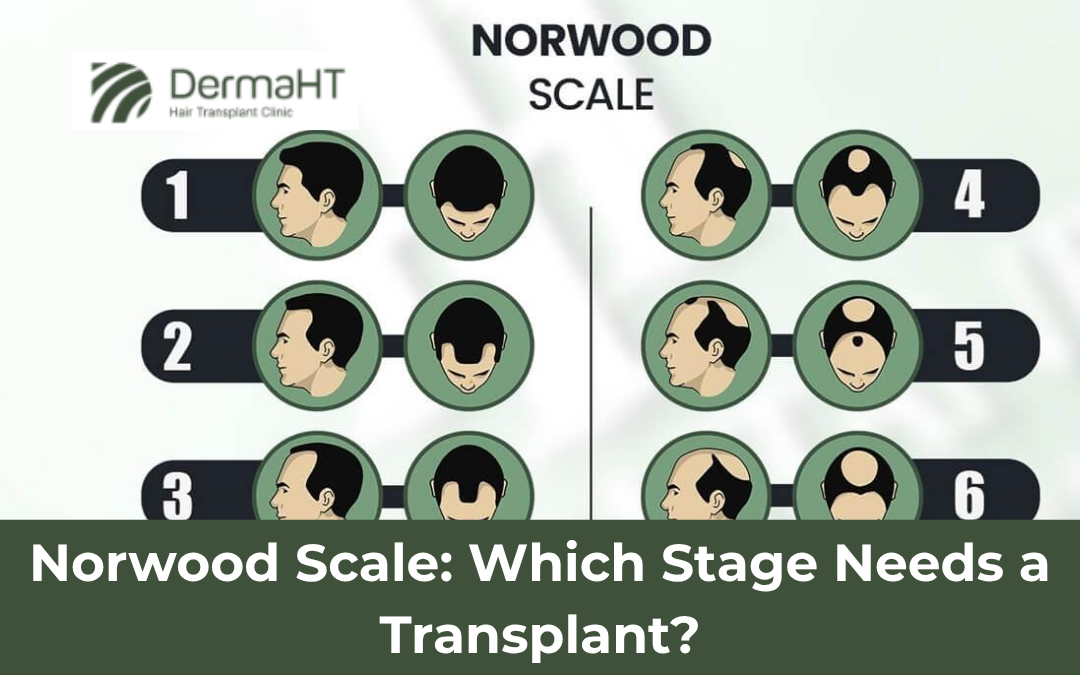
The Norwood scale grades male pattern baldness across seven stages, and not every stage calls for surgery. Stages 1 and 2 are usually managed with medication, while stage 3 is where a transplant first becomes a sensible option. Stages 4 and 5 are often strong surgical candidates, and stages 6 and 7 are treatable but limited by how much donor hair is left. The stage points you in a direction, but donor supply and stability decide the rest.
According to Dr. Nikitha Reddy, an MD Dermatologist offering Hair Transplant in Hyderabad, “Patients fixate on their Norwood number, but the scale only describes the pattern, not the supply. Two people at the same stage can have very different donor reserves. The number opens the conversation, it doesn’t settle it.”
Not sure which stage you’re at?
Which Norwood stages suit a hair transplant?
The right stage isn’t a single number, but the pattern does map onto rough guidance for when surgery starts to make sense.
Stages 1 and 2. Minimal recession or a maturing hairline. There’s little to transplant here, so medication and monitoring usually come first rather than surgery.
Stage 3. The first stage where a transplant is genuinely appropriate. The pattern is established, the recession is defined, and a natural hairline can be rebuilt with relatively modest grafts.
Stages 4 and 5. Strong candidates as a rule, with enough donor hair to cover well-defined frontal and crown loss, often planned in one larger session or two.
Stages 6 and 7. Treatable but constrained, since the bald area outpaces the donor supply, so the goal shifts to a natural frontal frame rather than full coverage.
Advanced stages that need the highest graft numbers in fewer sittings are often where a strip-based FUT earns its place, since it can yield more grafts per session than extraction alone.
What else decides if you need one?
Two people at the same stage can get very different advice, because the Norwood number is only part of the assessment.
Donor supply. The scale measures baldness, not the hair available to fix it, and thin or low-density donor areas limit what any stage can achieve.
Age and progression. Rapid loss in a young patient is a caution flag, since transplanting a low hairline while loss continues behind it can look stranded later.
Medical stability first. Minoxidil or finasteride often comes before or alongside surgery, to hold the native hair so the transplant isn’t chasing a moving target.
Realistic expectations. Surgery restores a frame and meaningful coverage, not the density of a teenager, and matching hopes to donor reality is part of the decision.
This is also where your stage turns into real numbers, and our guide on graft count shows roughly how much each level of loss tends to need.
Why Choose Dr. Nikitha Reddy?
Dr. Nikitha Reddy is an MD Dermatologist registered with the Telangana State Medical Council (TSMC/FMR/04492), with 6+ years in hair restoration. Staging at DermaHT pairs the Norwood pattern with a proper donor assessment, because the number on its own has been shown to vary between examiners and says nothing about how much hair is available to work with. The plan follows the supply, not just the stage.
📞 Call Now: +91 90639 77407
Frequently Asked Questions
At what Norwood stage should I get a transplant?
Usually stage 3 or above, once the pattern is stable.
Can a stage 7 patient have a hair transplant?
Yes, but donor limits mean a hairline frame, not full coverage.
Does a higher Norwood stage need more grafts?
Yes. Coverage needs rise sharply from stage 4 onward.
Is the Norwood stage the only thing that matters?
No. Donor supply, age, and stability matter just as much.
Disclaimer:
This blog is for educational purposes only and is not a substitute for professional medical advice.
Please consult a qualified doctor for guidance specific to your case.