
Not everyone with thinning hair needs to jump straight to surgery. That’s usually the last thing people realise, and only after months of trying random products that never really did much. Copper peptide for hair growth keeps showing up in serums, in scalp treatments, in clinic consultations, but nobody really stops to explain what it does or who it’s actually for.
Dr. Nikitha Reddy, MD Dermatologist and Hair Transplant Surgeon at DermaHT Hair Transplant Clinic, Kokapet, Hyderabad, one of the established names for hair transplant in Hyderabad, shares how copper peptides work on the scalp, who tends to benefit, and where they fit next to other options. Nothing exaggerated here. Just the science, the way she’d explain it to a patient sitting across from her.
What Is a Copper Peptide, Exactly?
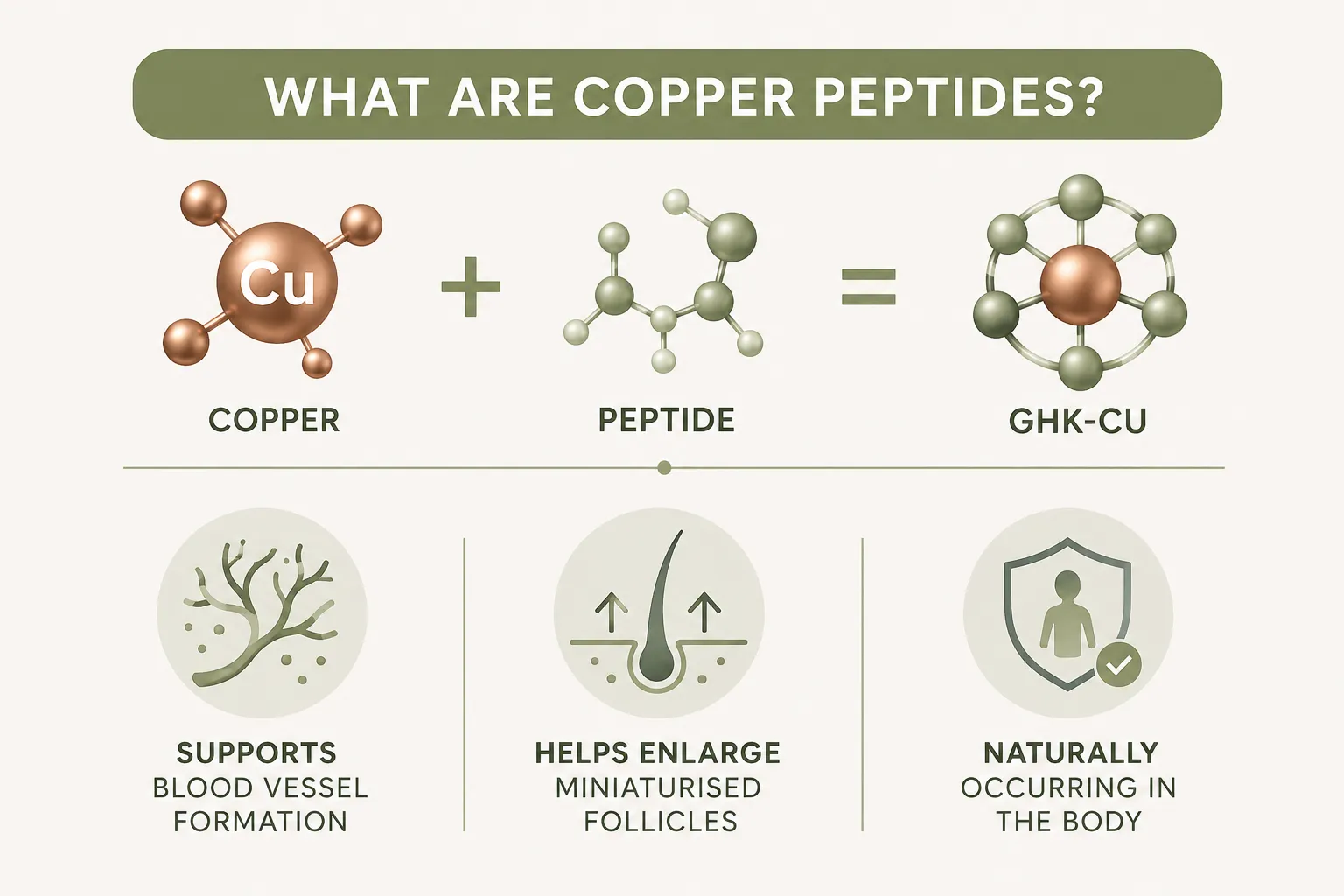
A copper peptide, usually referred to in research as GHK-Cu, is a small peptide bound to a copper ion, and it occurs naturally in the human body. It wasn’t invented for a serum bottle. GHK-Cu was first identified in human plasma decades ago, and interestingly, its levels tend to drop with age, around the same stretch of life when a lot of people first notice their hair thinning out.
That drop is part of why dermatology took an interest in it, not just for skin, but for scalp health too. On the scalp, copper peptides are studied mainly for how they support the tissue around a hair follicle. Not as something that forces new growth overnight, more like something that keeps the surrounding environment healthier.
Dr. Nikitha Reddy puts it plainly in consultations: copper peptides don’t create follicles that aren’t there. What they can do is support the ones still alive but struggling. Which is really why the stage of your hair loss matters so much before deciding if this route makes sense for you.
How Does Copper Peptide Support Hair Growth?
There are a few ways copper peptides are believed to work on the scalp, and they’re all connected:
- Blood vessel formation. Better micro-circulation around the follicle means more oxygen and nutrients get to the root.
- Follicle support. Follicles shrink in early pattern hair loss. Copper peptides are studied for helping with that.
- Lower oxidative stress. GHK-Cu has antioxidant properties, which may help a scalp that’s inflamed or under stress.
- Working with the skin’s own repair process, since the compound is already something the body recognises.

Dr. Nikitha Reddy says: “Copper peptides are one of the better-studied ingredients in this space, but let’s be clear, they’re not a switch you flip. They work quietly, by improving the environment the follicle is trying to survive in. That’s why they usually work best as part of a plan, not something used on its own.”
It’s also why copper peptide for hair growth often comes up alongside PRP and GFC. All three lean on the scalp’s own biology instead of surgically moving hair around.
Copper Peptides vs Other Scalp Treatments — A Quick Comparison

Results build gradually with most of these, and honestly, starting early tends to matter more than which one you pick.
Who Is a Good Candidate for Copper Peptide Treatment?
Hair fall isn’t one thing, so it makes sense that one treatment won’t suit everyone. Copper peptides tend to work better for:
- People still in the early or moderate stage of thinning, with follicles that are still active
- Anyone noticing more shedding than usual, or hair that feels weaker and breaks easily
- Patients who’d rather try a non-surgical route before even thinking about a transplant
- People who’ve already had a FUE Hair Transplant and want to support the results
It’s usually not where you’d start with advanced baldness, where there aren’t really active follicles left to work with. At that point, surgery tends to give a more realistic outcome, and that’s not something to guess at from a product label.
Dr. Nikitha Reddy says: “The mistake I see most is someone using a copper peptide serum on a patch with no active follicles left. It’s not that the ingredient failed, it just was never going to work there. A proper scalp check tells you what you’re actually dealing with.”
Is Copper Peptide Treatment Backed by Research?
GHK-Cu has a fairly long research history in dermatology, mostly around skin repair and wound healing, and there’s growing interest in what it can do for hair. A few published studies point toward its role in tissue regeneration and reducing oxidative damage, and that’s really the basis for using it in hair care.
But let’s be honest about where things stand. Research specifically on copper peptides for hair growth is still developing, and results vary a fair bit from person to person, depending on the stage and cause of the hair loss. That’s true of most regenerative scalp treatments, not just this one.
At DermaHT Hair Transplant Clinic, Dr. Nikitha Reddy looks at each patient’s scalp before suggesting copper peptide therapy or anything else. It isn’t handed out as a default.
Can You Use Copper Peptides at Home?
You’ll find copper peptides in plenty of over-the-counter serums, which is probably where most people first hear the term. Used topically, they can support general scalp health as part of a routine.
But topical use and an in-clinic session aren’t quite the same thing. In a clinic, the compound can be delivered more precisely, closer to where the follicles actually sit, instead of relying on it soaking through the skin. Whether a serum is enough for you, or whether something more targeted makes sense, really comes down to how advanced your thinning is.

That’s really where a proper scalp check counts for more than whatever’s on the shelf.
What Dr. Nikitha Reddy Recommends
At DermaHT, no two patients get the same plan by default. Every scalp is looked at individually before copper peptide therapy, or anything else, comes up.
What she typically checks:
- The stage and pattern of the thinning
- Whether follicles in that area are still active
- What’s actually causing the hair fall
- Whether copper peptides alone will do it, or whether pairing them with PRP or GFC makes more sense
Dr. Nikitha Reddy says: “I’d rather take fifteen extra minutes examining someone’s scalp than watch them spend months on something that was never right for their kind of hair loss. That’s really how we work here.”
Wondering if copper peptide therapy is right for your scalp, or if something else would do more? A proper evaluation is the only real way to know, and that’s a conversation worth having with a dermatologist, not a search bar.
A Few Honest Takeaways
Copper peptide for hair growth isn’t a miracle ingredient, but it’s not a gimmick either. It sits somewhere in between, a reasonably well-researched compound that supports the scalp’s own biology, and it tends to work best for people who catch their thinning early and want a non-surgical way to deal with it.
If you’ve been searching for answers and mostly finding serum comparisons, maybe the better next step is an actual scalp evaluation. If you’re around Hyderabad, it might be worth stopping by DermaHT Hair Transplant Clinic in Kokapet, where Dr. Nikitha Reddy can take a proper look and tell you honestly what will help and what won’t.
Your scalp’s already telling a story. A quick evaluation just helps you read it right.
Frequently Asked Questions (FAQs)
1. What does copper peptide do for hair growth?
Copper peptides, mainly GHK-Cu, support blood vessel formation around the follicle, help with miniaturised follicles, and reduce oxidative stress on the scalp. Together, that creates a healthier environment for the follicles you already have.
2. Is copper peptide better than PRP for hair loss?
Not really a fair comparison. PRP pulls growth factors from your own blood, copper peptides are a specific compound that supports follicle and tissue health. Sometimes they’re combined for a stronger effect, depending on the case.
3. Can copper peptide serums regrow hair on bald patches?
Not likely. Copper peptides support follicles that are still active. Where there’s nothing active left, topical or even in-clinic copper peptide treatment probably won’t do much, and surgery might be the more realistic option.
4. How long does it take to see results from copper peptide treatment?
Like most scalp treatments, it’s gradual, over months, not days, since it works with your hair’s natural growth cycle. A dermatologist can give you a realistic timeline based on your specific case.
5. Are copper peptides safe to use?
Generally, yes, especially when professionally formulated or delivered in-clinic. Still, it’s worth getting your scalp assessed by a qualified dermatologist before starting anything.
References
- National Center for Biotechnology Information (NCBI) — GHK-Cu, a Skin and Hair Care Ingredient: A Review — https://www.ncbi.nlm.nih.gov/
- DermNet NZ — Peptides in Cosmetic Dermatology — https://dermnetnz.org/
- International Society of Hair Restoration Surgery (ISHRS) — Non-Surgical Hair Restoration Options — https://ishrs.org/patients/hair-restoration-options/
Disclaimer: The information shared in this content is for educational purposes only and not for promotional use.