
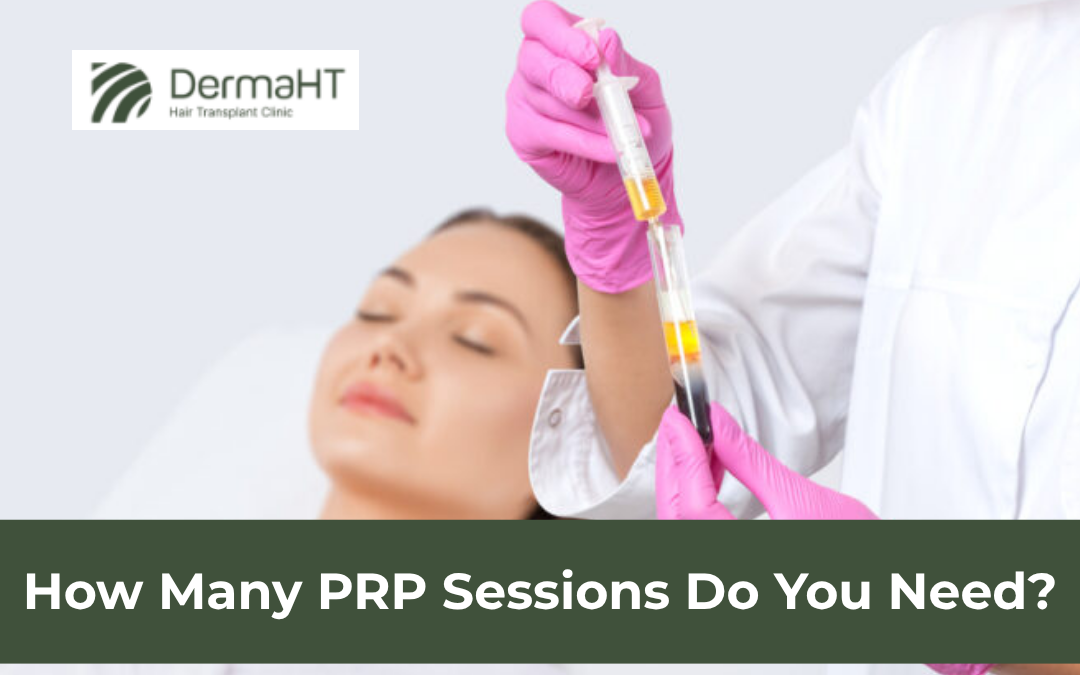
Most people need three to four PRP sessions to start, spaced about a month apart, followed by maintenance every few months. PRP doesn’t stop the underlying cause of hair loss, so the early sessions build the result and the later ones hold it. The exact number depends on how advanced the thinning is and how well you respond. For most patients, the first visible change shows after the second or third session.
According to Dr. Nikitha Reddy, an MD Dermatologist offering Hair Transplant in Hyderabad, “People want a single number, but PRP is a course, not a one-off. The first few sessions do the heavy lifting, and then it’s about maintenance. Skip the upkeep and the gains slowly fade.”
Wondering how many sessions your hair would need?
How many PRP sessions are usually needed?
The typical plan splits into an initial course to build results, then spaced-out sessions to keep them.
Three to four to start. The standard opening course is three to four sessions, roughly a month apart, which gives the follicles repeated stimulation over the early months.
Results around session three. Most people notice reduced shedding first, then gradual thickening, with visible change usually appearing by the second or third session.
Maintenance every few months. After the initial course, a session every four to six months helps hold the result, since the underlying hair loss keeps progressing.
Adjusted to your response. If there’s little change after the first course, the plan is reviewed rather than simply repeated, because not every cause responds the same way.
The right schedule is set after assessing your scalp rather than pulled from a fixed template, which is how a PRP course is planned around your stage of loss.
What changes the number of sessions?
Two people rarely need exactly the same plan, because a handful of factors shift the count up or down.
Stage of hair loss. Early thinning often responds within the standard course, while more advanced loss may need more sessions or a combined approach to show results.
The underlying cause. PRP works best on pattern hair loss and certain thinning types, and less predictably where the cause is scarring or fully dormant follicles.
Combined treatments. Pairing PRP with minoxidil or finasteride can mean steadier results and sometimes fewer top-up sessions over time.
Your goal. Actively rebuilding density needs more sessions up front, while simply maintaining existing hair needs fewer, spaced further apart.
Whether PRP is even the best route depends on your case, and our comparison with GFC vs PRP lays out how the two differ on results and session counts.
Why Choose Dr. Nikitha Reddy?
Dr. Nikitha Reddy is an MD Dermatologist registered with the Telangana State Medical Council (TSMC/FMR/04492), with 6+ years in hair restoration. PRP plans at DermaHT start with a proper diagnosis of why hair is thinning, so the number of sessions is matched to the cause rather than sold as a fixed package. Patients are told upfront when PRP is likely to help and when something else would serve them better.
📞 Call Now: +91 90639 77407
Frequently Asked Questions
How many PRP sessions will I need?
Usually three to four to start, then maintenance every few months.
How far apart are PRP sessions?
About four weeks apart during the initial course.
When will I see PRP results?
Most people notice change by the second or third session.
Do PRP results last without maintenance?
No. Results fade gradually without periodic top-up sessions.
Disclaimer:
This blog is for educational purposes only and is not a substitute for professional medical advice.
Please consult a qualified doctor for guidance specific to your case.