
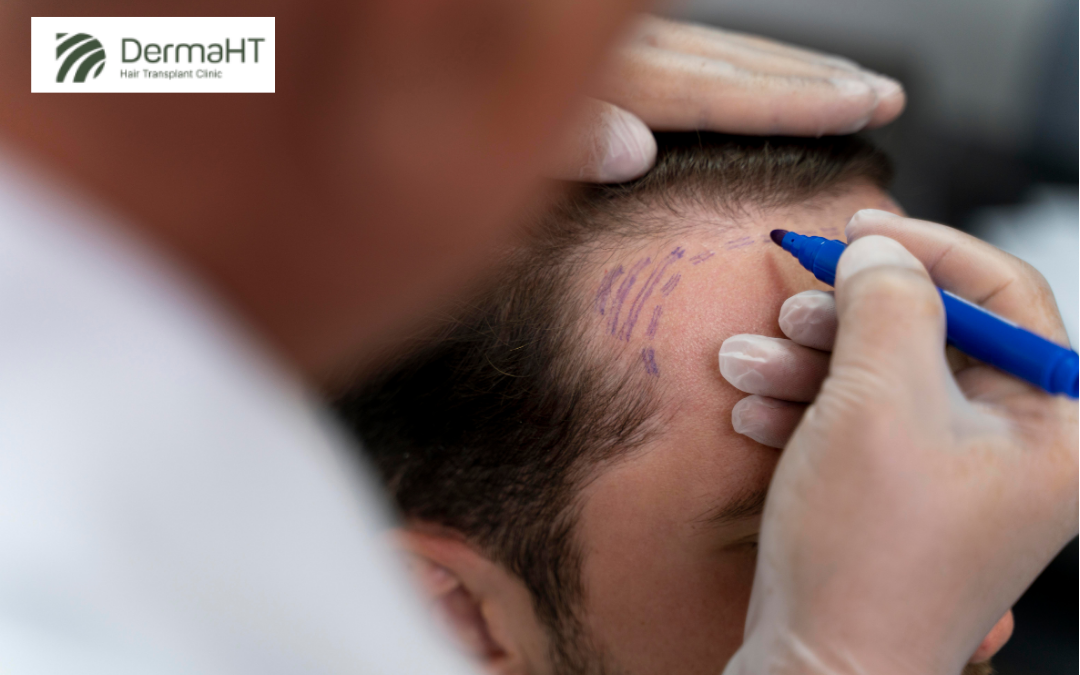
Most FUE patients need between 1,500 and 4,000 grafts, with the exact count depending on Norwood grade, total area needing coverage, and donor density. A Grade 2 recession sits around 1,500 to 2,000 grafts, Grade 3 to 4 pushes that to 2,000 to 3,000, and advanced Grade 5 to 6 cases often cross 3,500. Density goals also shift the number, since a dense hairline pulls more grafts than soft natural coverage.
According to Dr. Nikitha Reddy, one of Hyderabad’s trusted dermatologists offering FUE Hair Transplant in Hyderabad,“Graft counts aren’t something I estimate over a phone call. I map the scalp, check donor density per square cm, and only then give a number you can actually trust.”
Worried your donor zone won’t give enough?
What decides the graft count for FUE?
Graft calculation follows anatomy, not guesswork. Four clinical factors shape every final plan a patient receives.
- Norwood grade. The recession pattern on your scalp sets the opening range for any plan, since different baldness stages expose very different recipient areas before any counting can start.
- Recipient area. Hairline coverage pulls fewer grafts than full crown work, and once the mid-scalp joins the map every zone needs its own density calculation worked out separately.
- Donor density. The back and sides of your head decide what’s actually available to harvest, so a thinner reserve tightens the ceiling on any plan no matter what the patient hopes for.
- Desired look. Thick dense coverage and soft natural blending are two different goals, and each option pulls a different graft volume from the donor reserve you have to work with.
Donor zone limits are real, which is why an advanced FUE hair transplant plan gets built around your reserve first before anything else is decided.
Can donor density limit your graft count?
Donor density sits as the real ceiling on every FUE plan, so the honest answer is yes, it absolutely can limit how high the count goes.
- Follicle count. A healthy donor zone carries around 80 to 100 follicular units per square cm, and anything below that range drops extraction yield because the scalp can’t spare more without leaving gaps.
- Safe zone. Only the permanent donor area at the back and sides gets harvested for FUE, since crossing that boundary risks visible thinning in places that were never meant to be touched.
- Redistribution. When donor reserve falls short for the target area, a strip harvesting alternative may deliver better yield and the doctor will flag that route during your scalp assessment itself.
- Single sitting. Most cases get capped per session because pushing past safe limits stresses the donor zone and hurts graft survival, so bigger needs get split across two sittings months apart.
Pushing donor limits is how clinics leave scars patients notice years later, and if you’re weighing techniques before deciding, our guide on FUE vs FUT breaks down which method suits different donor reserves.
Why Choose Dr. Nikitha Reddy?
Dr. Nikitha Reddy is an MD Dermatologist with 6+ years of hair transplant experience, registered with Telangana State Medical Council (TSMC/FMR/04492), and every graft plan at DermaHT is built after in-person scalp mapping and donor density check, not a phone quote. Patients don’t leave with “we’ll see how many we can do” because they leave with a number, an area map, and a clear plan, which is how good hair transplant results actually start.
Frequently Asked Questions
1. How many grafts are needed for a receding hairline?
Most receding hairlines need 1,500 to 2,500 grafts.
2. Can I get 5,000 grafts in one sitting?
Safe FUE sessions cap around 3,500 to 4,000 grafts, so no.
3. Does higher graft count mean better results?
Donor quality and placement matter more than raw numbers, so not always.
4. How long does harvesting 3,000 grafts take?
A typical 3,000-graft FUE session takes 6 to 8 hours.
References:
- National Center for Biotechnology Information. Follicular Unit Extraction Review. https://www.ncbi.nlm.nih.gov/pmc/articles/PMC3580999/
- International Society of Hair Restoration Surgery. Donor Harvesting Guidelines. https://ishrs.org/