
So, you’ve decided to do something about your hair loss. Good for you. But then you start researching and suddenly you are stuck between two terms: FUE and FUT. Which one works better? Which one hurts less? Which one is right for your hair? These are the questions almost every patient asks before walking into a hair transplant clinic. And the honest answer is: it depends on your hair, your scalp, and your goals. In this blog, Dr. Nikitha Reddy, MD Dermatologist and Hair Transplant Surgeon at DermaHT Hair Transplant Clinic, Kokapet, Hyderabad, breaks it all down in simple terms. No confusing jargon. Just clear, honest information.
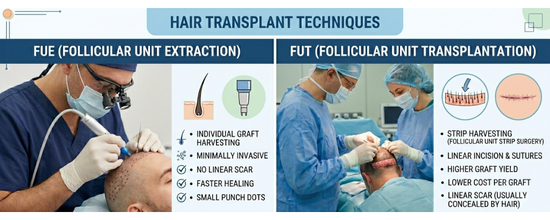
What Is FUE Hair Transplant? (And How Does It Work)
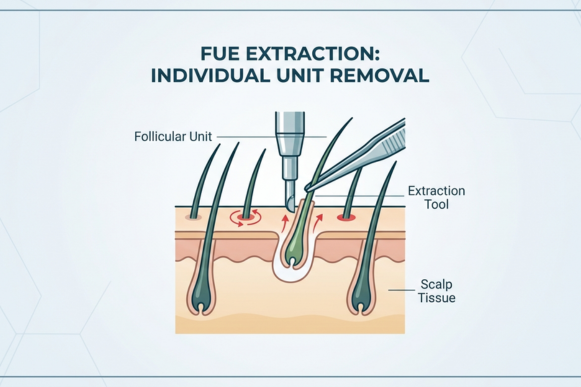
FUE stands for Follicular Unit Extraction. In this technique, individual hair follicles are taken out one by one from the back or sides of your scalp. These follicles are then planted into the thinning or bald areas. Here is what the process looks like step by step:
- Step 1: The donor area (usually the back of the scalp) is shaved and numbed with local anaesthesia.
- Step 2: A tiny circular punch tool (0.6mm to 1mm) is used to extract individual follicular units.
- Step 3: The extracted grafts are kept in a preservation solution.
- Step 4: Tiny incisions are made in the recipient area.
- Step 5: The grafts are placed carefully into these incisions.
The whole procedure can take anywhere from 6 to 8 hours, depending on how many grafts are needed.
Dr. Nikitha Reddy says: “FUE is the most preferred technique today because it does not leave a linear scar. Patients can go back to their routine much faster, and the results look completely natural when done by an experienced surgeon.”
What Is FUT Hair Transplant? (And How Does It Work)
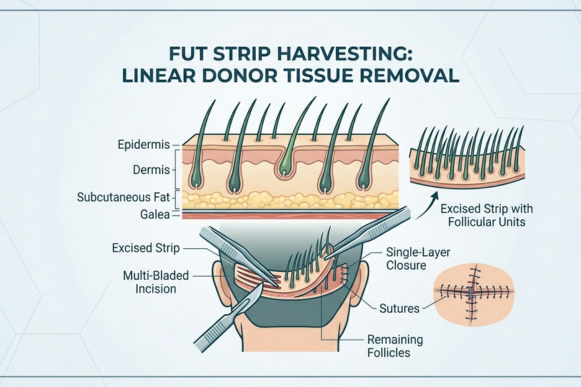
FUT stands for Follicular Unit Transplantation. It is also called the strip method. In FUT, a thin strip of scalp is surgically removed from the back of the head. This strip is then cut into smaller pieces under a microscope to separate individual follicular units. These units are then transplanted into the thinning or bald areas. Here is what the process looks like:
- Step 1: A strip of scalp (usually 15 to 30 cm long) is removed from the donor area.
- Step 2: The wound is stitched or stapled closed.
- Step 3: The strip is divided into individual grafts under magnification.
- Step 4: The grafts are planted into the recipient area.
Because a strip of skin is removed, FUT leaves a linear scar at the back of the head. This scar is usually hidden by surrounding hair, but it becomes visible if you shave your head very short.
FUE vs FUT: A Side-by-Side Comparison
This table gives you a quick overview of how FUE and FUT differ across the most important factors.
Factor | FUE | FUT |
Technique | Individual follicle extraction | Strip of scalp is removed |
Scarring | Tiny dot scars (not visible) | Linear scar at the back |
Recovery Time | 5 to 7 days | 10 to 14 days |
Pain / Discomfort | Minimal | Moderate (due to stitches) |
Number of Grafts | Up to 3000-4000 per session | Up to 4000-5000 per session |
Best For | Mild to moderate hair loss, short hair preference | Severe hair loss, maximum grafts needed |
Hair Shaving Required | Yes (donor area) | No |
Cost | Slightly higher | Slightly lower |
Natural Results | Excellent | Excellent |
Suitability | Most patients | Patients with large bald areas |
As you can see, both techniques give excellent, natural-looking results. The right choice depends on your individual case.
Which Technique Gives Better Results?
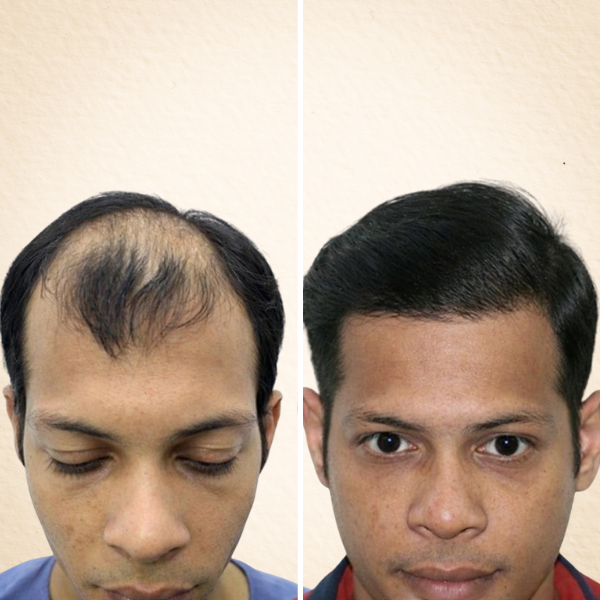
This is probably the most searched question about hair transplants. And the answer is: both FUE and FUT give long-lasting, natural results when performed by a skilled surgeon. That said, results do depend on a few things: Graft survival rate: Both techniques have a high graft survival rate when handled correctly. Poor technique, not the method itself, is what causes bad results. Hair density: FUT can sometimes yield more grafts in a single session. So for patients with large bald areas, FUT may produce denser coverage faster. Natural appearance: With FUE, because grafts are placed individually, the hairline can be designed very precisely. This makes FUE popular for hairline restoration and eyebrow transplants as well.
Dr. Nikitha Reddy says: “Both FUE and FUT can give you excellent results. What matters more than the technique is the skill and experience of the surgeon performing it. Always choose a qualified dermatologist-led clinic over a technician-run setup.”
Who Is a Good Candidate for FUE?
FUE works best for patients who:
- Have mild to moderate hair loss (Norwood Scale Grade 1 to 4)
- Want to keep their hair short or shaved after the procedure
- Prefer minimal downtime and a faster recovery
- Need a smaller number of grafts (1000 to 3000)
- Want eyebrow, beard, or body hair transplant
- Have a tight scalp (which makes FUT harder to perform)
FUE is also a good option for people who have already had a FUT procedure and want to cover the linear scar using individual grafts.
Who Is a Good Candidate for FUT?
FUT works best for patients who:
- Have advanced hair loss (Norwood Scale Grade 5 to 7)
- Need a large number of grafts in a single session (3000 to 5000+)
- Do not mind a linear scar at the back (usually covered by hair)
- Have a good amount of scalp laxity (loose scalp skin)
- Are not concerned about keeping hair very short at the back
FUT is sometimes preferred when the donor area is limited. Because the grafts are extracted from a single strip, the yield per session can be higher compared to FUE in some cases.
Recovery: What to Expect After Each Procedure
Recovery is one of the biggest deciding factors for many patients. Here is an honest breakdown:
FUE Recovery Timeline
- Day 1 to 3: Mild swelling and redness in the treated areas. Tiny scabs form around each graft.
- Day 5 to 7: Most patients can return to work. Scabs start to fall off naturally.
- Week 2 to 3: Transplanted hairs may shed (this is completely normal and expected).
- Month 3 to 4: New hair growth begins.
- Month 9 to 12: Full results are visible.
FUT Recovery Timeline
- Day 1 to 5: The donor area has stitches. Some tightness and discomfort is normal.
- Week 2: Stitches are removed. The linear scar is still healing.
- Week 3 to 4: Transplanted hairs begin to shed (again, completely normal).
- Month 3 to 4: New hair growth starts.
- Month 9 to 12: Full results are visible.
FUE generally has a shorter, more comfortable recovery compared to FUT.
FUE vs FUT Cost in Hyderabad: What Affects the Price?
The cost of a hair transplant in Hyderabad depends on several factors, not just whether you choose FUE or FUT. Here is what affects the price:
- Number of grafts needed: More grafts = higher cost
- Technique used: FUE is typically priced slightly higher than FUT due to the precision required
- Surgeon’s experience: A qualified dermatologist-led clinic costs more than a technician-run centre, but the results are far better and safer
- Clinic infrastructure and technology used
- Post-procedure care and follow-up included
As a general range in Hyderabad, hair transplant costs can go from Rs. 40,000 to Rs. 1,50,000 or more, depending on the above factors. Always be cautious of clinics offering very low prices. Low cost often means compromised technique, untrained staff, or poor graft handling, which directly affects your results.
What Does Dr. Nikitha Reddy Recommend?

At DermaHT Hair Transplant Clinic in Hyderabad, every patient goes through a detailed scalp and hair analysis before a technique is recommended. There is no one-size-fits-all answer. Dr. Nikitha Reddy, MD Dermatologist and Hair Transplant Surgeon, evaluates:
- The grade and pattern of hair loss
- The donor area density and quality
- The patient’s lifestyle and recovery preference
- The number of grafts required for natural coverage
- Long-term hair loss progression
Dr. Nikitha Reddy says: “I always tell my patients: the goal is not just to transplant hair. The goal is to give you a result that looks like it was always yours. That starts with an honest assessment, the right technique, and a surgeon who genuinely cares about the outcome.”
At DermaHT, procedures are led directly by Dr. Nikitha Reddy, not handed off to technicians. This is what sets a dermatologist-led clinic apart from others.
Frequently Asked Questions (FAQs)
1. Which is better, FUE or FUT hair transplant?
Neither is universally better. FUE is less invasive and leaves no linear scar, making it the most popular choice today. FUT can deliver more grafts in a single session and may suit patients with advanced hair loss. The right technique depends on your hair loss grade, donor area, and lifestyle. A qualified hair transplant surgeon will guide you to the right choice.
2. Is FUE hair transplant permanent?
Yes. Transplanted hair follicles are taken from the back and sides of the scalp, which are genetically resistant to hair loss. Once transplanted, these follicles retain their original characteristics and continue to grow naturally for a lifetime. However, it is important to note that existing non-transplanted hair can still thin over time due to ongoing hair loss, which is why a long-term treatment plan matters.
3. Does FUE leave a scar?
FUE leaves very tiny, dot-like scars at the extraction sites. These are usually less than 1mm each and not visible to the naked eye, especially once the surrounding hair grows back. You can comfortably keep your hair very short after FUE without any visible scarring.
4. How many grafts can be done in one FUE session?
In a single FUE session, typically 2000 to 3500 grafts can be safely extracted and transplanted. In some cases, up to 4000 grafts can be done depending on donor area quality and scalp characteristics. For patients needing more than 4000 grafts, a second session may be recommended.
5. What is the success rate of hair transplant in Hyderabad?
When performed by an experienced, qualified dermatologist, the graft survival rate for hair transplants is between 90% and 95%. Results begin to show at 3 to 4 months, with full results visible at 9 to 12 months. Success depends heavily on the surgeon’s skill, graft handling, and post-procedure care.
References
- International Society of Hair Restoration Surgery (ISHRS) – FUE vs FUT Clinical Guidelines https://ishrs.org/patients/hair-restoration-options/
- National Center for Biotechnology Information (NCBI) – Follicular Unit Extraction: Minimally Invasive Surgery for Hair Transplantation https://www.ncbi.nlm.nih.gov/pmc/articles/PMC4158628/
- DermNet NZ – Hair Transplant Surgery https://dermnetnz.org/topics/hair-transplant-surgery
Disclaimer: The information shared in this content is for educational purposes only and not for promotional use.