
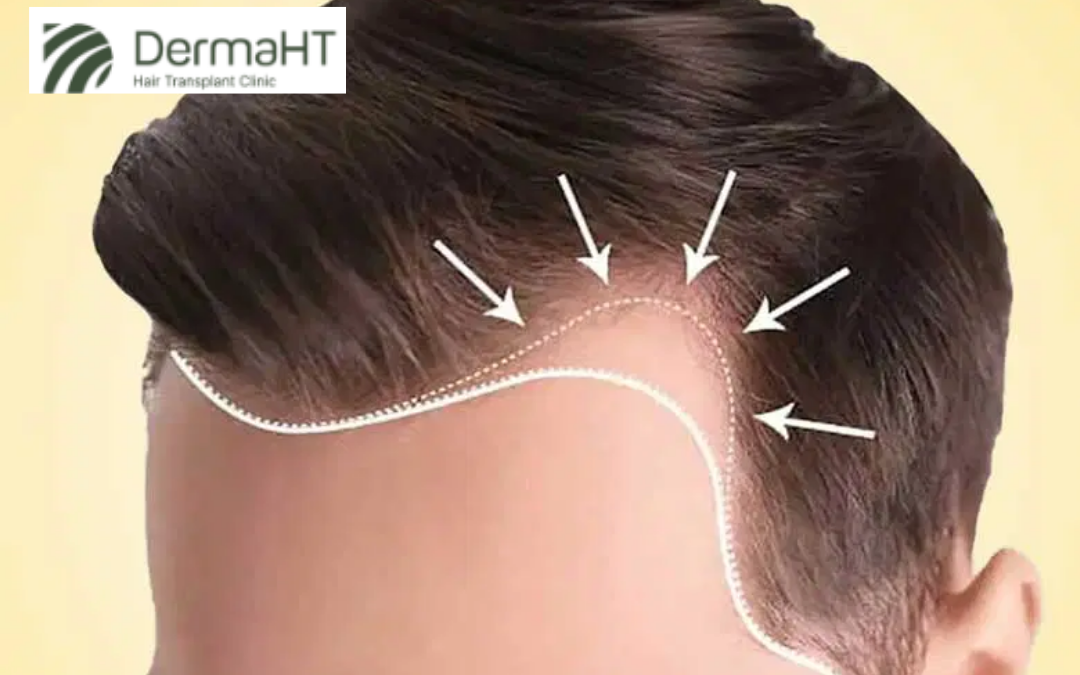
This is a frontal restoration procedure where follicles get pulled from the back of the scalp and placed along a freshly drawn hairline to fix the receded zone. Most cases need 1,500 to 2,500 grafts, and full results show up between month 9 and month 12. What decides the outcome isn’t graft count alone. It’s the hairline design, angle, and age-appropriate density that actually shape how the final result reads.
According to Dr. Nikitha Reddy, one of Hyderabad’s trusted dermatologists offering FUE Hair Transplant in Hyderabad,“The hairline is the most artistic part of any transplant I do. One millimetre off in the wrong direction and the whole face changes, which is why I draw every hairline by hand before starting surgery.”
Noticing your hairline drifting back?
How is the new hairline designed for FUE?
Hairline design isn’t a formula. It pulls together face shape, age, hair type, and how the hair loss might progress later, all into one planned curve drawn on the scalp.
- Age-matched positioning. Your new hairline can’t sit where it did at 22, because a deep low hairline on a 40-year-old face reads fake instantly, and if the sides keep receding later, maintaining it becomes impossible anyway.
- Facial symmetry. Forehead width gets measured, eyebrow position gets checked, temple angles get factored in, so the hairline suits your actual face rather than copying some template off a chart.
- Natural irregularity. A dead-straight hairline is the first giveaway of a bad transplant. That’s why the design builds in small rough edges and a slightly uneven front line, because real hair has never grown in a perfect line.
- Transition zone. First 1 to 2 cm uses only single-hair grafts set at careful angles for a soft feathered edge, while the zone behind gets multi-hair units for weight and fullness.
Every design gets drawn straight on the scalp before anything else begins, and a properly planned FUE hair transplant always starts with this decision before a single graft leaves the donor zone.
What results can you expect from FUE on a receding hairline?
Results don’t arrive in one burst. They roll out in stages across the full year of recovery, with each window bringing a different visible change.
- Month 1 to 2. The transplanted hair sheds during shock loss and the hairline looks close to how it was before surgery, which throws off most first-time patients though it’s fully expected biology.
- Month 3 to 4. Fine baby hair starts pushing through the front zone unevenly, since every follicle wakes from dormancy on its own schedule and patchy growth at this stage is normal.
- Month 5 to 8. Coverage thickens as grafts gain calibre and length, the hairline shape becomes obvious in the mirror, and most patients start getting noticed around month seven by friends and family.
- Month 9 to 12. Final density settles in with full colour, thickness, and styling ability, after which the hairline blends cleanly into native hair and can be cut or coloured like any other part of the scalp.
Recovery timing shifts slightly from person to person, and what each stage looks like from day one through to final hairline density at month twelve follows its own steady progression.
Why Choose Dr. Nikitha Reddy?
Dr. Nikitha Reddy is an MD Dermatologist with 6+ years of hair transplant experience, registered with Telangana State Medical Council (TSMC/FMR/04492), and every receding hairline case at DermaHT starts with a hand-drawn hairline planned around your face, age, and likely future recession pattern. Patients don’t walk out with templated hairlines because the front zone decides how the whole transplant reads, and at DermaHT the design time matters just as much as the surgery itself.
Frequently Asked Questions
1.How many grafts are needed for a receding hairline?
Most receding hairline cases need between 1,500 and 2,500 grafts.
2.At what age can FUE be done for receding hairline?
FUE is usually advised after 25 once hair loss stabilises.
3.Will my transplanted hairline look natural?
With proper design and angle placement, results look fully natural.
4.Is a receding hairline reversible without surgery?
Early recession can slow with medication, though real reversal needs FUE.
References:
- National Center for Biotechnology Information. Hairline Design in Hair Transplantation. https://www.ncbi.nlm.nih.gov/pmc/articles/PMC5782436/
- International Society of Hair Restoration Surgery. Clinical Guidelines for Hairline Restoration. https://ishrs.org/