
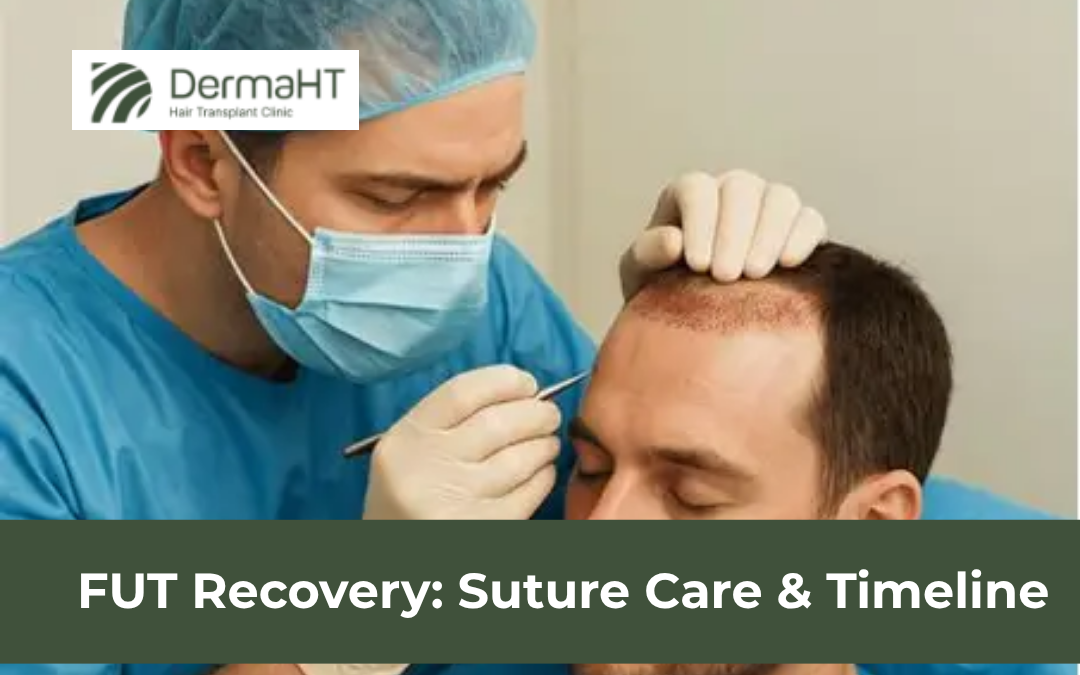
FUT Recovery is a structured healing process that runs from the moment the donor strip is closed through to final hair density at month 12, with suture care being the most critical part of the early weeks. Sutures usually come out between day 10 and day 14, and the donor closure line needs gentle handling for the first 4 weeks to keep the scar narrow. Recovery moves through five clear phases that every FUT patient passes through, regardless of graft count or surgical setup.
According to Dr. Nikitha Reddy, one of Hyderabad’s trusted dermatologists offering FUT Hair Transplant in Hyderabad,
“FUT recovery is forgiving when patients follow suture care properly. Most wide scars I see during revision consults trace back to the patient lifting weights too early or sleeping flat instead of propped up.”
Confused about how to handle the stitches at home?
How do you care for FUT sutures during the first two weeks?
Suture care decides how the closure line eventually heals, and most scar problems show up because of small mistakes made in the first ten days after surgery.
Day 1 to 3. Mild swelling and tightness around the donor area is expected, with the dressing usually removed within 24 to 48 hours by the clinic, after which gentle saline rinses begin to keep the suture line clean.
Day 4 to 7. Hair washing starts cautiously with doctor-prescribed shampoo, where water is poured rather than sprayed directly, and the closure line should never be scrubbed or rubbed even when scabs start lifting on their own.
Day 8 to 10. Scabs begin flaking off naturally and the donor zone starts feeling less tight, with patients usually returning to office work by this stage if the role doesn’t involve heavy physical activity.
Day 11 to 14. Sutures or staples are removed at the clinic depending on the closure type used, after which the scalp feels visibly more comfortable and the closure line begins entering the scar maturation phase.
Suture care is rarely complicated when patients follow instructions, and a properly executed FUT hair transplant protocol always includes a written aftercare plan handed over before the patient leaves the clinic.
What does the full FUT recovery timeline look like?
Recovery doesn’t end with stitch removal. The full healing arc runs across 12 months, with each phase delivering different visible changes that compound into the final outcome.
Week 3 to 4. Shock loss kicks in as transplanted hairs shed before the follicles enter their new growth cycle, which patients often confuse with treatment failure though it’s actually a normal biological reset every graft passes through.
Month 2 to 3. The scalp looks quieter than it did pre-surgery and the donor line continues maturing, with most physical restrictions including heavy lifting and contact sports being lifted by the doctor around this stage.
Month 4 to 6. Fine baby hairs begin pushing through the recipient area unevenly, since different follicles wake from dormancy on their own schedules, and early density starts becoming visible in good lighting.
Month 7 to 12. Density builds steadily across the transplanted zone with full colour, thickness, and styling capability settling in, while the donor scar line continues maturing and softening across the same window.
Scar visibility through this period depends heavily on how the closure line was managed during recovery, and our breakdown on FUT scar visibility covers what affects width and how to keep it minimal long term.
Why Choose Dr. Nikitha Reddy?
Dr. Nikitha Reddy is an MD Dermatologist with 6+ years of hair transplant experience registered with Telangana State Medical Council (TSMC/FMR/04492), and every FUT patient at DermaHT receives a written suture care protocol with scheduled follow-up visits at day 10, week 4, month 3, and month 6 to track healing progress directly. Patients aren’t left guessing whether something looks normal, because closure line problems caught early are easier to manage than ones spotted six months later.
📞 Call Now: +91 90639 77407
Frequently Asked Questions
1. When are FUT sutures removed?
Sutures are usually removed between day 10 and day 14 after surgery.
2. Can I wash my hair with sutures still in?
Gentle washing starts day 4 with poured water, no direct spray.
3. How long until I can lift weights after FUT?
Heavy lifting resumes after 4 weeks once the donor line stabilises.
4. Is shock loss after FUT normal?
Temporary shedding around week 3 to 4 is part of normal regrowth.
References:
- National Center for Biotechnology Information. Growth Factor Concentrate in Hair Restoration. https://www.ncbi.nlm.nih.gov/pmc/articles/PMC8743393/
- International Society of Hair Restoration Surgery. Non-Surgical Hair Loss Therapies. https://ishrs.org/