
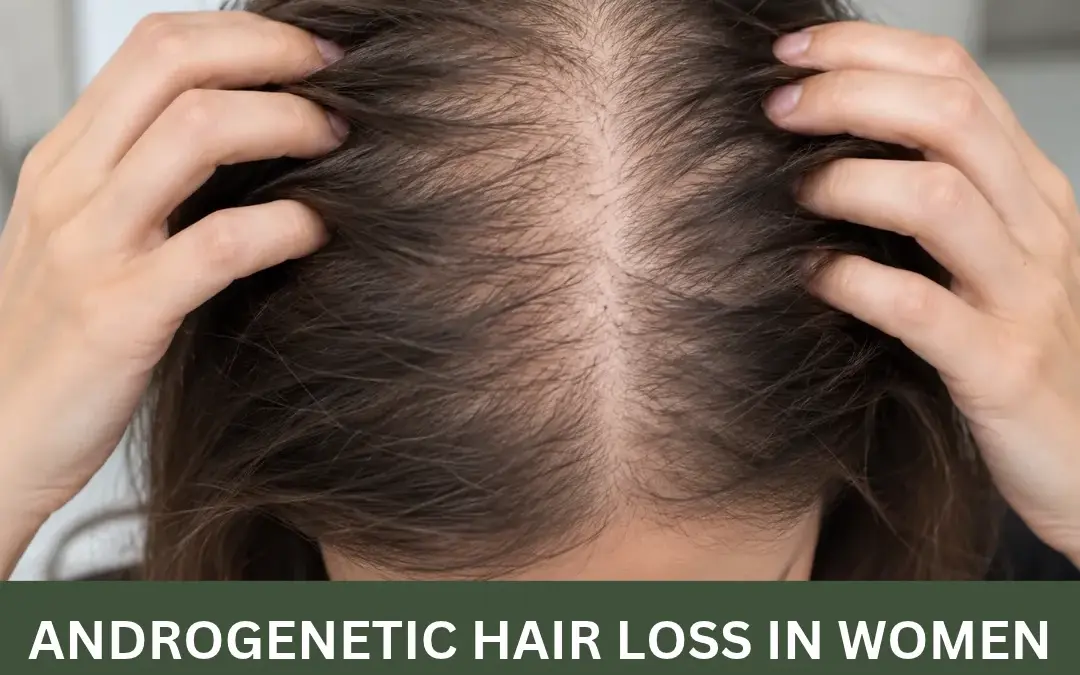
Hair thinning in women doesn’t usually announce itself the way it does in men. No receding hairline to point at, a wider part and a thinner ponytail than you remember. By the time most women bring it up to a doctor, they’ve usually spent months blaming stress, the weather, or “one of those phases.”
Dr. Nikitha Reddy, MD, Dermatologist and Hair Transplant Surgeon known for hair transplant in Hyderabad, explains what’s actually happening on the scalp, why it looks different in women than in men, and what treatment realistically looks like.
It’s called androgenetic hair loss, and it’s a lot more common than most women realise. People don’t talk about it with the same directness as male pattern baldness, which is part of why so many women end up managing it quietly, on their own, for far longer than they need to.
What Is Androgenetic Hair Loss in Women?
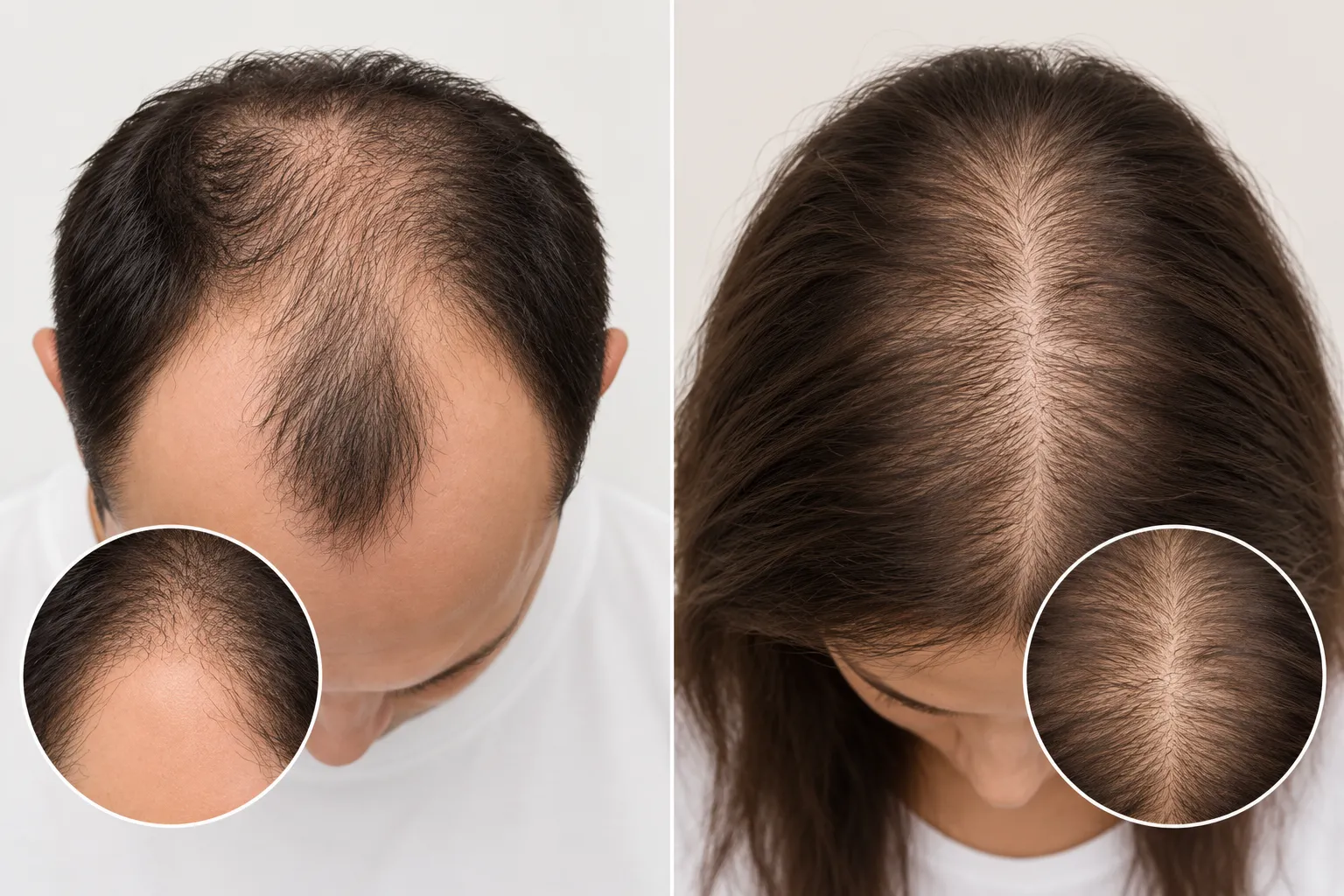
Androgenetic hair loss in women, also called female pattern hair loss, happens when genetically sensitive hair follicles gradually shrink in response to androgens, mainly a byproduct of testosterone called DHT. It’s the same underlying hormone pathway involved in male pattern baldness, but it manifests differently on a woman’s scalp.
.
Instead of a receding hairline, women usually see diffuse thinning across the top and crown, with the front hairline staying mostly intact. The part line widens first. Hair might still be there, technically, finer, shorter, and a lot less dense than before.
Genetics play the biggest role here. If your mother or grandmother dealt with thinning hair, there’s a reasonable chance the same pattern shows up in you, though it doesn’t always follow a clean family line the way it tends to in men.
What Causes It?
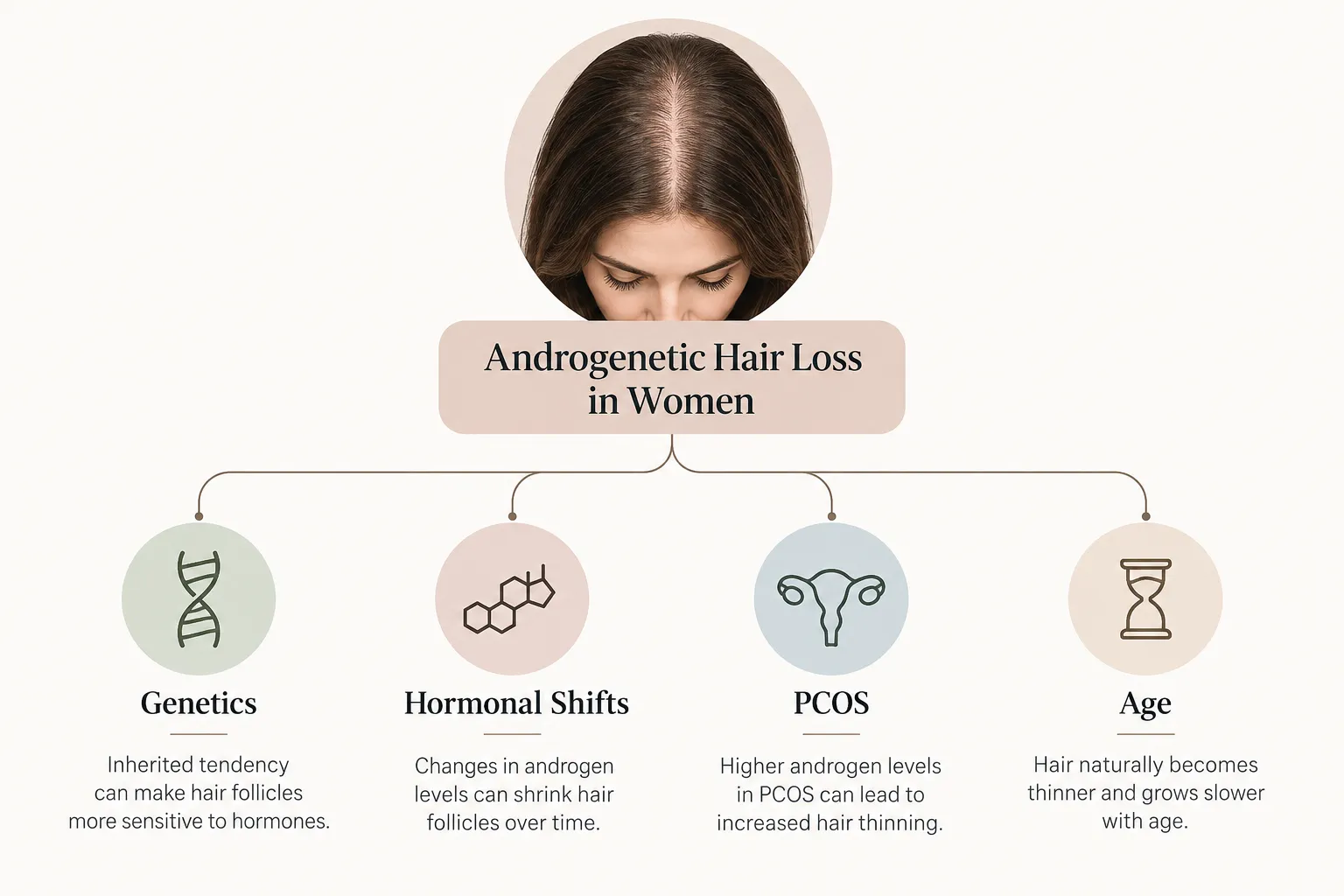
A few things tend to feed into androgenetic hair loss in women, and it’s rarely one cause working alone:
- Hormonal shifts.
- PCOS and other hormonal conditions.
“Women often assume hormonal hair loss is temporary and will fix itself once things settle down. Sometimes that’s true, especially after childbirth. But when there’s a genetic component involved, it usually needs an actual treatment plan, not just patience,” said Dr. Nikitha Reddy, MD, Dermatologist, Derma HT, Hyderabad
Early Signs Worth Paying Attention To
Female pattern hair loss tends to progress slowly, which is exactly why it’s easy to miss early on. A few things worth noticing:
- The part looking wider than it used to, especially in photos taken from above
- A ponytail that feels noticeably thinner in your hand
- More visible scalp under bright light
- Increased shedding that doesn’t settle after a few weeks
None of these confirm androgenetic hair loss on their own. Thyroid issues, iron deficiency, and telogen effluvium (a stress-related shedding pattern) can look similar in the early stages, which is why a proper diagnosis matters more than guessing from symptoms alone.
Androgenetic Hair Loss vs Other Types of Female Hair Loss — Quick Comparison
|
Type |
Pattern |
Onset |
Reversible? |
|
Androgenetic Hair Loss |
Diffuse thinning, widened part, crown-focused |
Gradual, often around menopause |
Manageable, not fully reversible |
|
Telogen Effluvium |
Sudden, all-over shedding |
2-3 months after a trigger (illness, stress, childbirth) |
Usually reversible |
|
Iron/Thyroid-Related |
Diffuse thinning, brittle hair |
Variable |
Reversible once corrected |
|
Traction Alopecia |
Localised, near hairline/temples |
Gradual, tied to hairstyling habits |
Reversible if caught early |
What Are the Treatment Options?
There’s no single fix, and anyone promising one probably isn’t being upfront with you. Treatment for androgenetic hair loss in women usually depends on its stage and underlying causes:
- Topical minoxidil — often the first line of treatment; helps slow shedding and support existing follicles
- PRP therapy — uses growth factors from your own blood to support follicle health
- GFC treatment — a more concentrated version of the same growth factor approach
- Addressing underlying hormonal issues — relevant when PCOS or another condition is contributing
- Hair transplant — considered in more advanced cases where thinning has progressed significantly and other options haven’t provided enough density back
Which of these actually makes sense depends on the stage and cause, and that’s not something to self-diagnose from a blog, however detailed it is.
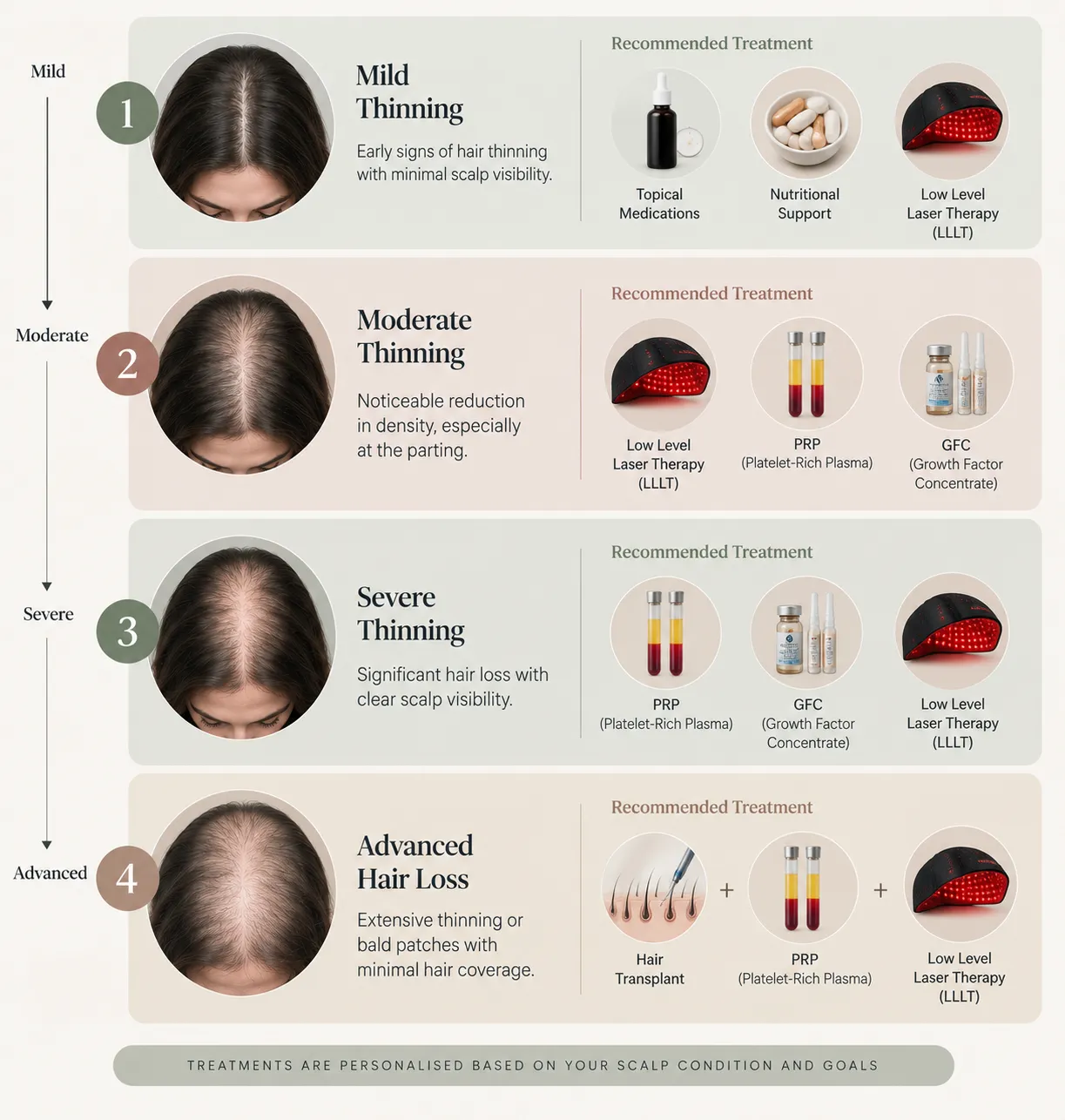
“The biggest difference between a good outcome and a frustrating one usually comes down to timing. Women who come in early, when thinning is still mild, have a lot more options on the table than someone who has waited years hoping it resolves on its own,” said Dr. Nikitha, whose work at DermaHT has earned the clinic recognition on leading doctor discovery platforms, including ClinicSpots and Practo.
Can Hair Transplant Work for Women?
Yes, though it’s not the starting point for most cases. Hair transplant surgery for women works differently than it does for men, mainly because the donor area (usually the back of the scalp) isn’t always as clearly defined in diffuse female thinning. A dermatologist needs to confirm there’s a stable, healthy donor zone before the transplant even becomes a realistic conversation.
For women dealing with more advanced thinning, or those who’ve already tried non-surgical options without enough improvement, it can be a genuinely good long-term solution. It’s not something to jump to as a first step without ruling out hormonal or nutritional causes first.
A Note on Living With It
Hair loss in women feels different from what it does for men. It’s important to recognize this difference instead of ignoring it. It’s tied up with a lot more than appearance for most people. That’s part of why an actual diagnosis matters, not just for treatment planning, but for peace of mind. Understanding what’s happening and why can make it easier to cope, even before treatment starts working.
If you’re noticing a widening part or thinner ponytail and wondering whether it’s “just stress,” it might be worth getting it checked rather than sitting with the uncertainty for another few months.
Frequently Asked Questions
1. What is the main cause of androgenetic hair loss in women?
2. At what age does female pattern hair loss usually start?
3. Can androgenetic hair loss in women be reversed?
4. Is hair transplant a good option for women with thinning hair?
5. How is androgenetic hair loss different from stress-related hair loss?
References
- PubMed — Androgenetic Alopecia in Women (J Investig Dermatol Symp Proc) — https://pubmed.ncbi.nlm.nih.gov/12894991/
- NCBI — Female Pattern Hair Loss: Review — https://www.ncbi.nlm.nih.gov/pmc/articles/PMC3968982/
- International Journal of Trichology — Female Androgenetic Alopecia Study — https://pubmed.ncbi.nlm.nih.gov/27625557/
Disclaimer:
This blog is for educational purposes only and is not a substitute for professional medical advice.
Please consult a qualified doctor for guidance specific to your case.