
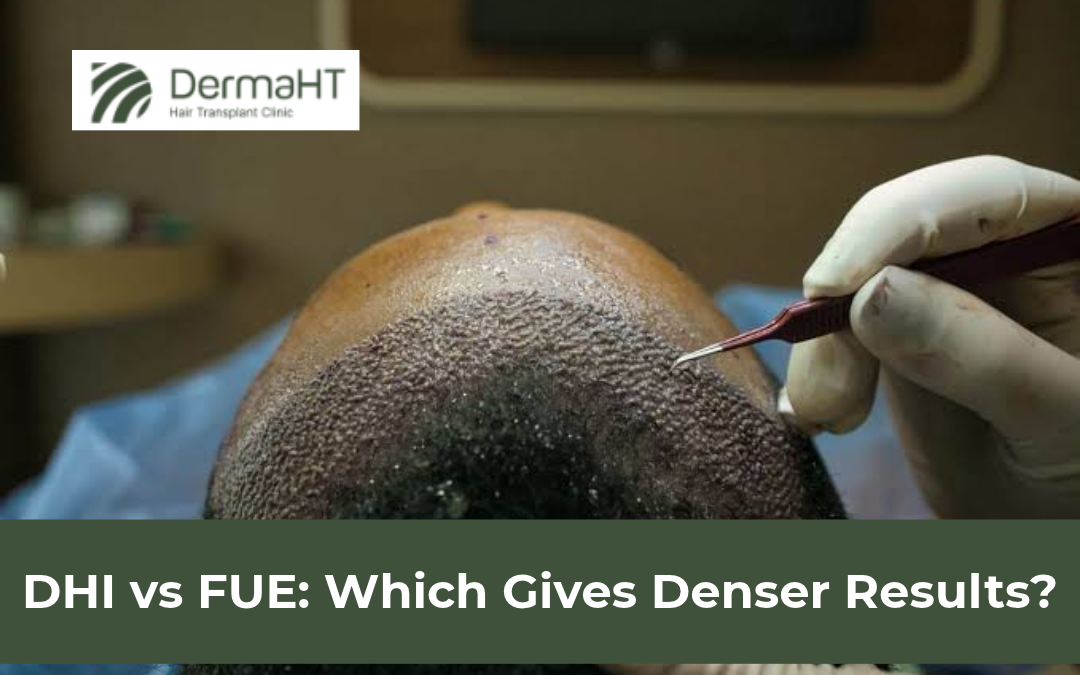
It is not a given that one is going to win on density. DHI is in essence FUE transplant with a different method of grafting, and the follicles are removed from the donor site the same way as they are in FUE. It is much more about the donor hair of your donor, the number of grafts that can be safely spared and who plans and places them to make your result look full than about the name of the technique.
According to Dr. Nikitha Reddy, a Dermatologist and Hair Transplant Surgeon in Kokapet, Hyderabad, “People often walk in asking if DHI will give them thicker hair than FUE, and I understand why, because that’s how it gets advertised. The pen is simply one way of placing grafts. What makes a hairline look full is the quality of your donor area, how carefully the grafts are handled, and the spacing and angles planned before we begin. That’s why I examine the scalp first and decide the technique afterwards.”.
Questioning if DHI or FUE will be able to provide the density you are looking for with your hairline?
What's the difference between DHI and FUE?
- The extraction is identical. In both cases the follicles are excised, one by one, from the back and sides of the scalp.
- They are different in terms of their placement. The standard FUE technique is to create small recipient sites, then move the grafts into them. An implanter pen is used in DHI to make the site and place the graft in one motion.
- The pen gives close control of angle and depth. It can be helpful in smaller and more specific areas such as the front hairline, however, a skilled team with forceps will be able to pack as tightly.
- Growth doesn’t vary by the tool used. Pen placement trials are still lacking that demonstrate a growth of hair and final density only becomes apparent around 12-18 months.
Since both methods begin with the same donor follicles, we’ve explained the full process on our FUE hair transplant in Hyderabad page.
What Method is Right for Your Hair Loss?
- Small thin patches or receding hairline: In the pen, some surgeons choose this option due to the fine control they have over the direction of each graft.
- Large areas of baldness or the crown: FUE using pre-made sites is likely to be able to get more grafts in one session, whereas pen sessions may be limited in number.
- There is no technique that provides an additional amount of hair. It only moves what you have, so the plan has to respect what the donor area can safely give.
- Thinner or fine hair: A thicker hair shaft will cover a larger surface area, resulting in the same number of hair grafts appearing less dense, depending on the technique.
If the bald area is very extensive, your doctor may also talk you through strip-based harvesting, which you can read about under FUT hair transplant in Hyderabad.
How to Decide Which Option is Perfect for You: DHI vs FUE?
- The safe density of donors, and hair density; Generally, the safe zone for donors is from 65 to 85 units per square cm, and this is the upper limit for any technique.
- The size of the area to cover determines the approach: small areas with distinct zones require different approaches than large areas.
- Hairline design: The design and spacing of the planned hairline is as important as the tool used to create it.
- Before recommending any method, a trichoscopic exam reveals miniaturisation and donor quality of the scalp.
- The experience of the surgeon: Different surgeons will perform the surgery in different ways.
- Session length and cost: This should also be considered, as the placement of pens can take longer and may also cost more per graft.
Frequently Asked Questions
- Does DHI give more density than FUE?
Not by default. Both methods are equally effective at taking grafts and there is no good comparative evidence that any method results in more hair. The density will depend on your donor area, the quantity of grafts and their careful planning and placement.
- Is DHI is totally different than FUE?
No. DHI uses the same extraction as FUE. The difference is at the implantation step where an implanter pen is used for creating the site and placing the graft in.
- How long will the density of the transplants be at 100%?
Transplanted hair typically falls out first and new hair begins to emerge approximately 3-4 months after the transplant. Either of the two will yield results in the range of 12- to 18-months final growth and visible density.
- Receding hairline: which is the best?
It will depend on the area and your donor hair. Some surgeons prefer to use the pen at the front for fine control, some prefer forceps as well. The only sure way to determine is by performing a scalp assessment.
Disclaimer:
This blog is for educational purposes only and is not a substitute for professional medical advice.
Please consult a qualified doctor for guidance specific to your case.