
Ask ten people with thinning hair about DHT blocker therapy and you’ll get ten different answers. Some swear by it, others are scared off by what they’ve read online. Most have only half the picture.
Dr. Nikitha Reddy, MD Dermatologist and Hair Transplant Surgeon, explains how this treatment fits into the wider picture of hair loss care, from medication to hair transplant in Hyderabad, and what’s worth weighing up before starting.
One thing to know upfront: these are prescription medicines, not supplements, and they work very differently from a serum or a procedure.
What Is DHT, and Why Does It Thin Hair?

DHT, short for dihydrotestosterone, is a hormone our body makes from testosterone with the help of an enzyme called 5-alpha reductase.
In people who are genetically prone to pattern hair loss, some follicles react strongly to it. Cycle after cycle, those follicles shrink. The hair that grows back is finer, shorter, and stays on the scalp for less time. Doctors call this miniaturisation, and it’s the core process behind androgenetic alopecia in men and women, even though the pattern looks different in each.
How Does DHT Blocker Therapy Work?

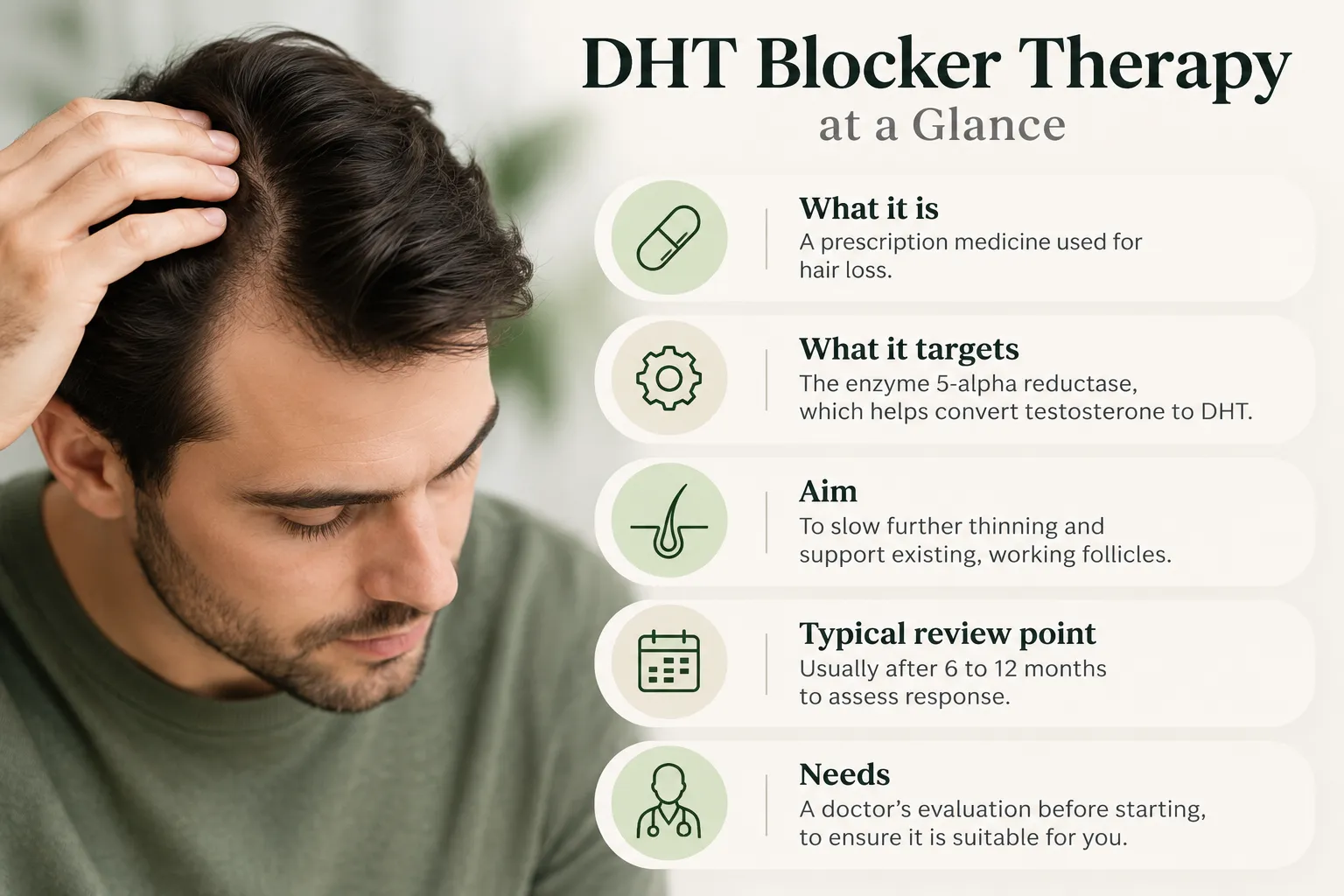
Most DHT blockers don’t “block” DHT at the scalp directly. They’re 5-alpha reductase inhibitors, which means they slow the enzyme that turns testosterone into DHT. Less DHT, less pressure on sensitive follicles.
Finasteride targets one form of the enzyme and is the medicine most commonly approved for male pattern hair loss. Dutasteride blocks two forms, so it lowers DHT further, and it’s used off-label for hair loss in many countries. A 24-week meta-analysis found dutasteride more effective than finasteride with similar side-effect rates, though that rests on only three trials, so it’s early days.
What they can’t do matters just as much. They don’t bring back follicles that are already gone. The goal is to slow further thinning and support the follicles still working.
“A DHT blocker isn’t a quick fix, and it isn’t for everyone. It acts on the cause behind pattern hair loss, but only in follicles that are still alive, which is why the diagnosis has to be confirmed first,” said Dr. Nikitha Reddy, MD Dermatologist.
Types of DHT Blocker Therapy

Minoxidil often gets mentioned alongside these, but it isn’t a DHT blocker. It works by a different route, and doctors sometimes combine the two.
Who May Benefit, and Who Should Be Careful

DHT blocker therapy tends to suit adults with confirmed pattern hair loss in the early to moderate stage, when follicles are thinning but not gone. It won’t help thinning that comes from other causes, like thyroid problems, low iron, crash diets, or stress-related shedding. Those need their own fix.
Some people need extra caution. Pregnant women, or women who may become pregnant, shouldn’t take these medicines or handle crushed or broken tablets, because they can affect a male foetus. People with liver problems should tell their doctor, and finasteride can lower PSA readings, which matters for anyone having prostate screening. In women, oral DHT blockers aren’t a standard first option; hormonal evaluation comes first.
Side Effects: What the Research Shows
Possible Sexual and Mood-Related Side Effects
The main side effects reported with these drugs include:
- Reduced libido: A decrease in sexual desire.
- Erectile difficulty: Trouble achieving or maintaining an erection.
- Ejaculation changes: Changes in ejaculation.
- Risk of sexual dysfunction: A meta-analysis of 15 placebo-controlled trials involving 4,495 men found a 1.57-fold higher relative risk of sexual dysfunction overall. Most participants did not experience these problems, but the risk is not zero.
- Mood changes: Some men report low mood or anxiety. Regulators in several countries have required these risks to be mentioned on drug labels. Any mood changes should be discussed with the prescribing doctor early.
- Persistent symptoms: Rare reports describe symptoms continuing after stopping the medication, although research into this is ongoing.
“Follow-up is a big part of the treatment. If a patient notices anything that bothers them, it’s better to adjust or stop early than to push through it quietly,” said Dr. Nikitha Reddy, MD Dermatologist.
What to Expect: A Realistic Timeline

Hair grows slowly, so this therapy does too. In the first few weeks, some people notice a bit of extra shedding. It usually settles. By three to six months, shedding often reduces. A fair judgement of results usually takes around twelve months, and responses vary from person to person.
Here’s the catch most people don’t expect: the benefit lasts only while treatment continues. Stop, and thinning generally picks up again over the following months.
DHT Blocker Therapy Alongside Other Hair Loss Treatments
Medication rarely works in isolation. Doctors often pair DHT blockers with topical minoxidil, and sometimes with in-clinic treatments.
Once follicles in an area are gone, medication can’t bring them back. That’s where FUE Hair Transplant enters the conversation, and even then, many doctors continue a DHT blocker afterwards to protect the native hair around the transplanted area.
What a Doctor Checks Before Starting DHT Blocker Therapy
Who evaluates. A registered dermatologist confirms the type of hair loss before any prescription is written. At DermaHT in Kokapet, this evaluation is done by Dr. Nikitha Reddy, usually with a scalp examination and, where needed, dermoscopy to look at follicle size and density.
What gets reviewed. Family history, pattern and stage of thinning, medical history (liver, prostate, mood), current medicines, and sometimes blood tests for thyroid, iron, or vitamin D, since those can mimic or add to pattern hair loss.
How the plan is decided. Medicine alone, a combination, or a procedure depends on what the evaluation shows. Follow-up reviews are usually set at three to six months to check response and side effects.
A Few Things Worth Remembering
DHT blocker therapy is a medical decision, not a hair-care habit. It’s slow, it needs ongoing use, and it works best when the diagnosis is right in the first place.
Before picking a treatment, it helps to know what’s actually behind the thinning. A scalp check usually answers that.
Frequently Asked Questions
What is DHT blocker therapy?
How long does DHT blocker therapy take to work?
Can women use DHT blockers?
Do I need to take it forever?
Do natural DHT blockers work?
References
- Efficacy and safety of dutasteride compared with finasteride in treating men with androgenetic alopecia: a systematic review and meta-analysis. Clin Interv Aging. 2019;14:399-406. https://pubmed.ncbi.nlm.nih.gov/30863034/
- Arif T, Dorjay K, Adil M, Sami M. Dutasteride in Androgenetic Alopecia: An Update. Curr Clin Pharmacol. 2017. https://pubmed.ncbi.nlm.nih.gov/28294070/
- Adverse Sexual Effects of Treatment with Finasteride or Dutasteride for Male Androgenetic Alopecia: A Systematic Review and Meta-analysis. Acta Derm Venereol. 2019;99(1):12-17. https://pubmed.ncbi.nlm.nih.gov/30206635/
- Comparison between dutasteride and finasteride in hair regrowth and reversal of miniaturization in male and female androgenetic alopecia: a systematic review. https://pmc.ncbi.nlm.nih.gov/articles/PMC11694415/
Disclaimer: The information shared in this content is for educational purposes only and not for promotional use.