
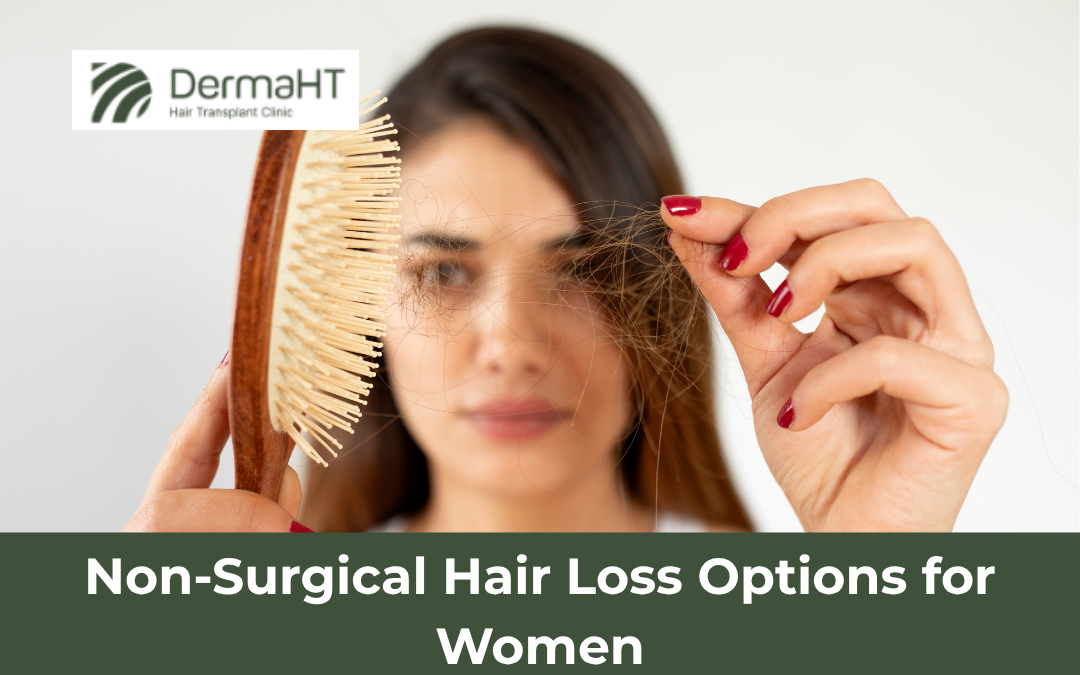
Hair loss in women rarely follows the same path as it does in men, and most cases respond to non-surgical care if the right therapy gets matched to the cause. Options covered include PRP, GFC, scalp mesotherapy, exosome therapy, and prescription topicals like minoxidil. Each one works on follicles differently, some by feeding them, some by signalling them, some by holding off the hormonal pressure pushing the hair into shedding cycles. Most women see real change between 3 to 6 months once the right plan starts.
According to Dr. Nikitha Reddy, one of Hyderabad’s trusted dermatologists offering PRP Treatment in Hyderabad,“Female hair loss is rarely just genetic. I check ferritin, thyroid, and hormones first because injecting growth factors won’t fix a thyroid problem, no matter how good the PRP kit is.”
Seeing scalp showing through where it didn’t before?
What are the main non-surgical treatments for women?
Each of the main therapies works through a different biological route, so calling them all “hair loss treatments” hides what’s actually happening at the follicle.
Topical minoxidil. A daily 2 percent or 5 percent solution that widens scalp blood vessels and keeps follicles in their growth phase longer than they’d naturally stay. Works for diffuse thinning. Takes 3 to 4 months before shedding visibly drops, sometimes longer.
PRP and GFC injections. These deliver platelet growth factors straight into thinning zones using fine needles. PRP uses your blood with a single spin. GFC uses a cleaner double-step process with higher concentration. Both work best when follicles are weak but still alive.
Scalp mesotherapy. A custom blend of vitamins, peptides, and amino acids injected at 2 to 4 mm depth, going where oral supplements can’t always reach. Suits women dealing with deficiency-driven shedding, post-pregnancy hair fall, or stress-related thinning where the body just isn’t sending follicles what they need.
Oral medications. Spironolactone for hormonal cases, finasteride in selective post-menopausal cases, and iron or vitamin D when bloodwork flags a real deficiency. None of these are first-line for everyone, and prescription only follows after proper workup.
Choosing between these isn’t a tier ranking, and our breakdown on FUE Hair Transplant covers exactly how custom nutrient blends work for women whose scalp is starving rather than scarring.
Which option suits which type of female hair loss?
The cause tells you the treatment, not the other way around. That’s where most women lose months of progress, picking a therapy by popularity instead of by what’s actually driving the loss.
Postpartum shedding. Three to six months after delivery, hormones reset and shedding spikes. Mesotherapy plus oral support brings it back, usually within a year. No PRP needed unless the recovery stalls past month 12.
Female pattern hair loss. The widening part line. Crown thinning. This needs minoxidil for the long term, plus PRP or GFC every 4 to 6 weeks for the first year. Stopping early is the most common reason women say “the treatment didn’t work.”
Telogen effluvium. Sudden shedding after stress, fever, illness, or crash diets. Mesotherapy supports the regrowth phase, but the real fix is finding what triggered it. Without that, the cycle just repeats six months later.
PCOS-related thinning. Androgen sensitivity drives this one, and topical or injection therapy alone rarely cracks it. Spironolactone or hormonal management has to be part of the plan, otherwise you’re treating the symptom while the root cause keeps pushing back.
Treatment matching makes the difference between visible improvement and wasted sessions, and our FUE recovery timeline blog also covers when these injectable therapies get added during post-surgery support if women eventually need transplant work down the line.
Why Choose Dr. Nikitha Reddy?
Dr. Nikitha Reddy is an MD Dermatologist with 6+ years of hair restoration experience registered with Telangana State Medical Council (TSMC/FMR/04492), and every female patient at DermaHT goes through a full hormonal and nutritional workup before being matched to non-surgical therapies rather than being booked into a default PRP protocol. Patients are sometimes told their hair loss needs internal treatment first, because injecting growth factors into a scalp that’s losing hair from a thyroid issue won’t fix the actual problem.
📞 Call Now: +91 90639 77407
Frequently Asked Questions
Which non-surgical treatment works best for female hair loss?
Cause decides the treatment, with mesotherapy and PRP being common starters.
Can women use minoxidil long term?
Daily 2 percent or 5 percent minoxidil is safe under medical supervision.
Are PRP injections safe during pregnancy?
PRP and most injectables are avoided during pregnancy and breastfeeding periods.
How long until non-surgical treatments show results?
Visible improvement typically appears between 3 to 6 months of consistent treatment.
References:
- National Center for Biotechnology Information. Non-Surgical Female Hair Loss Therapies. https://www.ncbi.nlm.nih.gov/pmc/articles/PMC8743393/
- International Society of Hair Restoration Surgery. Female Pattern Hair Loss Guidelines. https://ishrs.org/